When Players Stop Midway and Come Back, How Do You Write a Spoiler-Free Recap?
The recap's job is to let players know again who they are, what they have done, what they have not done yet, and what they can do right now. It is not responsible for explaining secrets, nor for judging the player's last choice. The way to write it can be summarized in four lines: current identity, confirmed facts, unfinished tasks, immediate available actions. Each line only writes content the player has already experienced or personally confirmed; any clue the player must piece together themselves does not go into the recap.
Introduction
The recap's job is to let players know again who they are, what they have done, what they have not done yet, and what they can do right now. It is not responsible for explaining secrets, nor for judging the player's last choice. The way to write it can be summarized in four lines: current identity, confirmed facts, unfinished tasks, immediate available actions. Each line only writes content the player has already experienced or personally confirmed; any clue the player must piece together themselves does not go into the recap.
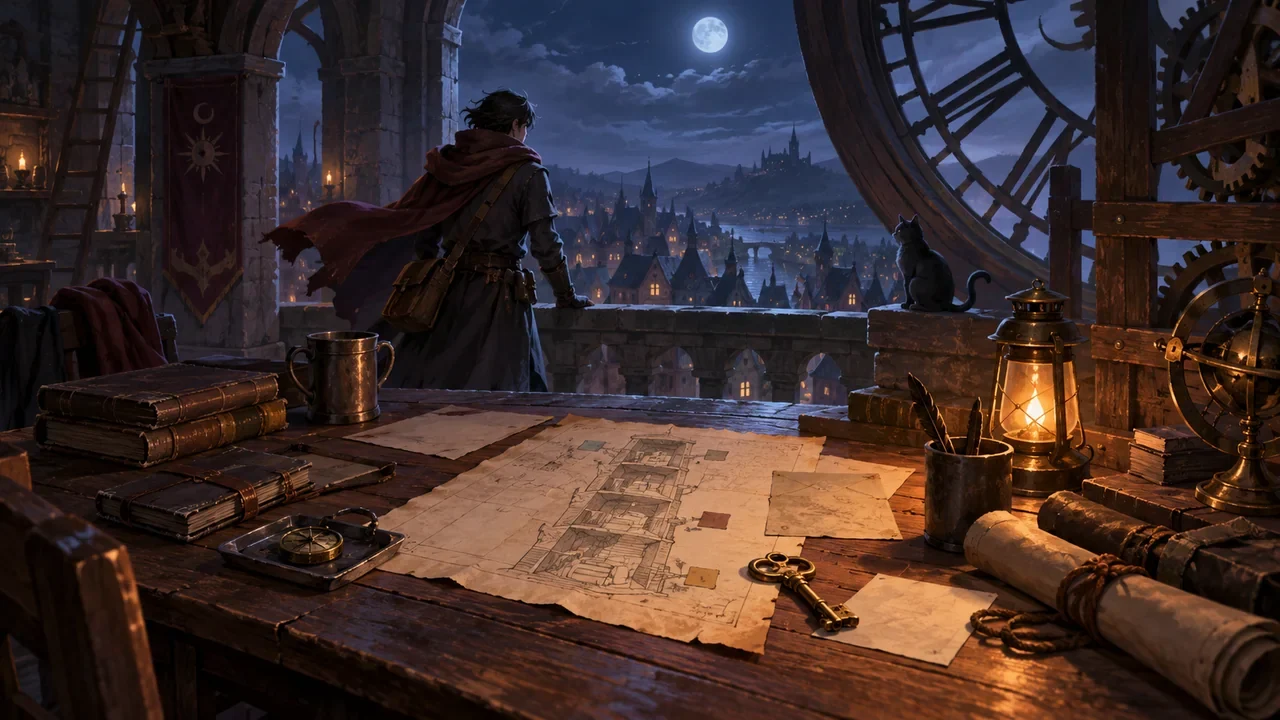
The following uses fictional teaching examples for illustration. The clock tower, characters, and values in the examples were made up to demonstrate the writing method, not actual test data.
First Distinguish Three Types of Information
Before writing a recap, divide the information you have about this progress into three types.
Type one is confirmed facts: people the player has seen, places the player has been, things told to the player face to face or seen with the player's own eyes. For example, "you have met the clock keeper Mira," "you got the brass key," "you promised to return to the clock tower before sunset." These can be written directly into the recap.
Type two is unfinished tasks: things the player knows to do but has not finished yet. For example, "the door on the third floor has not been opened yet," "the page of records Mira asked you to find has not been given to her yet." When writing tasks, only write the task itself, not the reason behind the task.
Type three is forbidden information: truths the player has not confirmed yet, motives others have not spoken aloud, possible consequences of the player's last choice. These stay in the script and do not go into the recap. Even if the author knows "Mira is actually hiding the reason the bell stopped," as long as the player has not found it out, it cannot appear in the recap.
A simple self-check method: for every sentence in the recap, ask, "In which scene, from whom, and in what way did the player learn this?" Sentences you cannot answer should be deleted.
Recap Text for Two Routes
Suppose in Clock Tower Duty, the player plays the night-shift duty officer and must handle three things in the clock tower before dawn: the door on the third floor that cannot be opened, the stopped clock, and a page of records entrusted by the clock keeper Mira. The player may stop in two positions: shortly after entering the clock tower, or after having already gone up to the third floor.
Route A: Stopping After Meeting Mira for the First Time
Player's current identity: night-shift duty officer at the clock tower, on duty for the first night. Confirmed facts: you have met the clock keeper Mira; she gave you a brass key; you heard the bell stop before midnight; you promised her to return to the duty room before dawn. Unfinished tasks: the door on the third floor has not been opened yet; the stopped clock has not been checked yet; the page of records Mira mentioned has not been found yet. Immediate available actions: go to the third floor and try the key; go to the bell room to check the pendulum; return to the duty room and search the record cabinet.
The corresponding recap text can be written like this:
You are the duty officer at the clock tower tonight. Mira gave you the brass key and told you the bell stopped before midnight. You promised her to return to the duty room before dawn. Now the door on the third floor is still locked, the bell room has not been visited yet, and the page of records she wants has not been found yet. You can first go to the third floor, or first go to the bell room, or return to the duty room and search the record cabinet.
This text does not include "why Mira cares about that page of records" or "why the bell stopped." They belong to forbidden information.
Route B: Stopping After Opening the Third-Floor Door
The player's current identity is unchanged, but the player already has one more experience. Confirmed facts: you have met Mira; you used the brass key to open the door on the third floor; on the third floor there is a duty roster with your own name on it; you have not told Mira about this yet. Unfinished tasks: the stopped clock has not been checked yet; that page of records has not been found yet; you have not told Mira about the third-floor duty roster yet. Immediate available actions: return to the duty room and search the record cabinet; go to the bell room to check the pendulum; go find Mira to talk about the third-floor duty roster.
The recap text can be written like this:
You are the duty officer at the clock tower tonight. You used the brass key Mira gave you to open the door on the third floor, and inside you saw a duty roster with your name on it. You have not told Mira about this yet. The bell room has not been visited yet, and the page of records she wants has not been found yet. You can return to the duty room and search the record cabinet, go to the bell room to look at the pendulum, or go find Mira to talk about the duty roster.
"Why your name is on the duty roster" belongs to forbidden information; the recap only writes the fact the player saw with their own eyes: "your name is on it."
Comparison of Retainable Facts and Forbidden Information
Organize the two routes into a table for easy comparison.
| Information | Route A | Route B | Handling method |
|---|---|---|---|
| Identity is clock tower night-shift duty officer | Confirmed | Confirmed | Write into recap |
| Have met Mira | Confirmed | Confirmed | Write into recap |
| Got the brass key | Confirmed | Confirmed | Write into recap |
| Third-floor door has been opened | Did not happen | Confirmed | Handle separately by route |
| Third-floor duty roster has the player's name | Did not happen | Confirmed | Write in Route B, do not write in Route A |
| Mira hides the reason the bell stopped | Unconfirmed | Unconfirmed | Forbidden |
| Whether the player's last choice disappointed Mira | Unconfirmed | Unconfirmed | Forbidden |
| Relationship between the name on the duty roster and the player | Unconfirmed | Unconfirmed | Forbidden |
"Unconfirmed" in the table does not mean "did not happen," but that the player does not know yet. The recap only handles the part the player knows.
Handling Mira's Fabricated Excuse
Suppose in a certain branch, Mira says to the player, "The third floor is just a place where old ledgers are stored, no need to go up." This sentence was said by Mira and belongs to content the player heard with their own ears, so it can enter confirmed facts and be written as "Mira said the third floor is just a place where old ledgers are stored."
But whether Mira's sentence is true has not been verified by the player. So the recap cannot be written as "the third floor is just a place where old ledgers are stored," nor as "Mira is lying to you." The former treats the character's words as world fact, while the latter makes a judgment for the player. A character's fabricated excuse is only something the character said, not a new world fact.
If the player later opens the third-floor door and sees the duty roster, then the recap can write both things at the same time: "Mira said the third floor is just a place where old ledgers are stored" and "you saw a duty roster with your own name on it on the third floor." The two sentences stand side by side, letting the player compare them themselves. The recap does not point out the contradiction for the player.
One Limitation When Using AI Assistance
If using AI to generate a recap draft, you can first list the above three types of information separately for the model: confirmed facts, unfinished tasks, forbidden information. Prompt constraints do not guarantee that every output is correct; after generation, manual checking is needed, especially checking whether forbidden information has been written in and whether a character's words have been written as world fact.
Completion Check
After writing a recap, check item by item:
- Does the first sentence state the player's current identity.
- Can all confirmed facts correspond to scenes the player experienced or heard with their own ears.
- Do unfinished tasks only write the task, without writing the reason behind the task.
- Do the immediate available actions come from entrances the player already knows, without adding locations or characters the player does not know.
- Is there any forbidden information, including truths, others' motives, and consequences of the last choice.
- Are things characters said marked as "someone said," rather than directly treated as facts.
- Is there any evaluation of the player's last decision, such as "you did the right thing" or "luckily you chose."
If all seven pass, this recap can be used. If any one does not pass, go back to the corresponding position and revise it; do not cover it up by adding a sentence like "in short."
The next time the player stops, you can first write a four-line draft: identity, confirmed, unfinished, available actions, then delete sentence by sentence any content that requires the player to infer it themselves.