A Single-Room Interactive Short: How Can Two Choices Change Different Things?
To make two choices change different things, the approach is to first define three spatial anchors for the room, then have each choice act on a different object, and finally separate the two paths by degree of knowledge. The following uses the fictional teaching example "Repair Room" to illustrate; the characters, numbers, and dialogue are all invented for demonstration, not actual test data.
Introduction
To make two choices change different things, the approach is to first define three spatial anchors for the room, then have each choice act on a different object, and finally separate the two paths by degree of knowledge. The following uses the fictional teaching example "Repair Room" to illustrate; the characters, numbers, and dialogue are all invented for demonstration, not actual test data.
First Define Spatial Anchors So Changes Are Visible
The easiest mistake to make with a single room is having both choices change only the dialogue. The audience hears different words, but the visuals look the same, so the choice feels weightless. The solution is to first fix three spatial anchors: objects the audience can see repeatedly, whose positions can change, and whose changes can be captured by the camera.
The three anchors of the Repair Room can be defined like this:
| Anchor | Initial position | Function |
|---|---|---|
| Duty log | Left side of the workbench, closed | Carries "who knows what" |
| Spare key | On the hook, second slot | Carries "who can enter where" |
| Disassembled old radio | Center table of the room | Carries "whether the two cooperate" |
There should be few anchors. Three are enough to support two choices; with more, the audience cannot remember them, and the author will struggle to keep positions consistent in every branch.
Each Choice Acts on a Different Object
If both choices land on the same person, the result is often "he is a bit nicer" and "he is a bit less nice." To avoid this same-ending-with-different-dialogue problem, have the choices act on different objects: one on an object, one on a person.
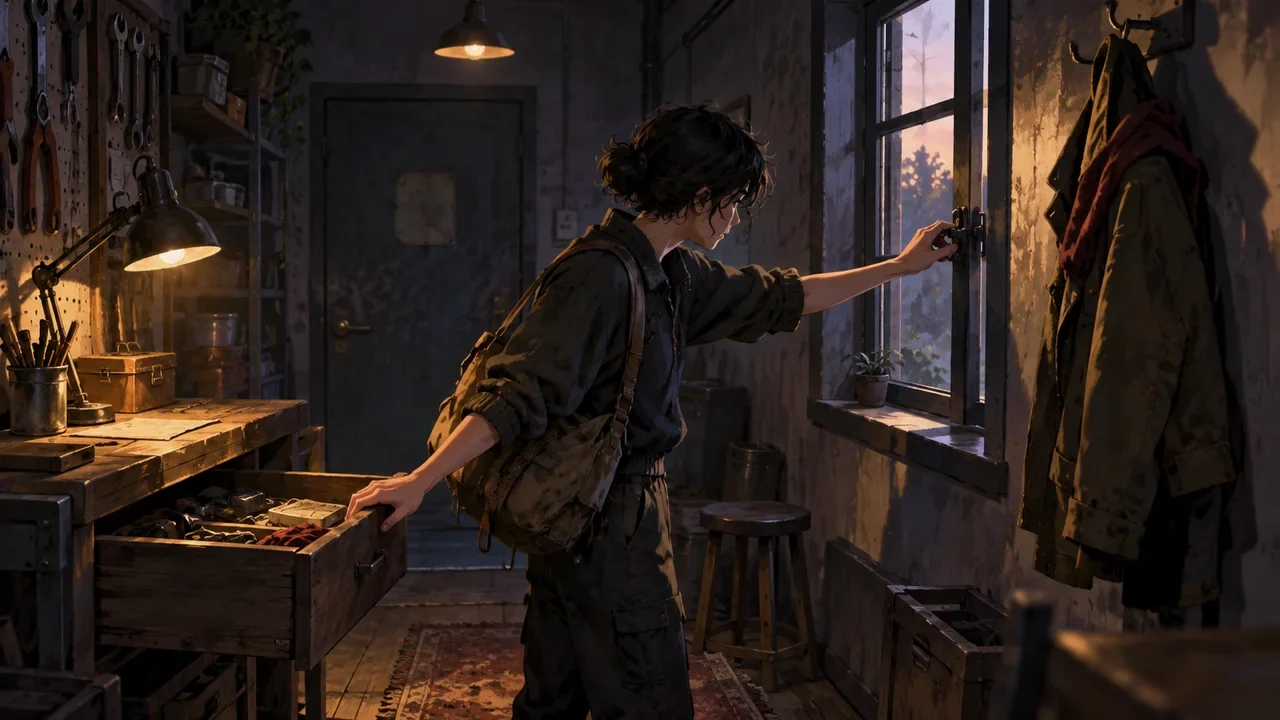
In the Repair Room, the protagonist A-Lan and the repairman Lao Zhou are in the same room. The first choice can be designed as:
- Open the duty log first
- Ask Lao Zhou first who came by last night
These two options act on different objects. Opening the log acts on an object and changes A-Lan's degree of knowledge; asking Lao Zhou acts on a person and changes the warmth of their relationship. Lao Zhou may answer, or he may avoid it, but the avoidance itself is relationship information, not a world fact—the excuse he makes up only shows that he does not want to say, not that the thing really happened.
The second choice then acts on another object:
- Take the spare key off the hook
- Push the old radio to the middle so the two repair it together
Taking the key acts on spatial permission, while pushing the radio acts on cooperation. At this point, the two choices fall on four different dimensions: knowledge, relationship, permission, and cooperation, and will not be squeezed into the same result.
Use Degree of Knowledge to Separate the Paths
State differences must be readable by later shots. You can record a simple state for each choice; there is no need to build a complex system, writing it on paper is enough:
- Knowledge: low / medium / high
- Relationship: cold / neutral / close
- Permission: none / yes
- Cooperation: no / yes
If A-Lan opens the log first, knowledge becomes medium; then if she takes the key, permission becomes yes. If A-Lan asks Lao Zhou first, the relationship becomes close or cold; then if she pushes the radio, cooperation becomes yes. The four state lines are independent, and the paths formed by their combinations are naturally different.
Three Sets of Shot Descriptions
Below are three sets of shots showing how the same room can produce different events because of different states. Each set only writes the key images, not a complete storyboard.
Set one: A-Lan opens the log first, then takes the key. Shot one, left side of the workbench, A-Lan opens the closed log, her finger stops on a certain page. Shot two, second slot of the hook, the key is taken down, the hook is empty. Shot three, Lao Zhou stands at the doorway, sees the empty hook, and does not come closer. The empty hook here is a signal to the audience: permission has changed, the relationship has not.
Set two: A-Lan asks Lao Zhou first, then pushes the radio. Shot one, A-Lan does not touch the log, turns to Lao Zhou and speaks. Shot two, while Lao Zhou speaks, his hand stops on the radio, he does not look up. Shot three, the radio is pushed to the center of the table, the two sit on opposite sides, screws and wire ends spread out. The log remains closed the whole time, and the audience knows A-Lan's degree of knowledge is still low.
Set three: A-Lan opens the log first, then pushes the radio. Shot one, the log is opened, A-Lan reads a certain line, her expression changes. Shot two, she closes the log and walks to the center table. Shot three, the radio is pushed between the two, Lao Zhou glances at the log, then at the radio, and hands over the screwdriver in his hand. In this set, both knowledge and cooperation have changed, permission has not, and the key is still on the hook.
The three sets use the same room, the same two people, and the same three props, but the audience sees different events: set one is permission and estrangement, set two is closeness without knowledge, set three is cooperation after knowledge. The difference comes from state, not from dialogue.
Completion Check
After writing the two choices, check item by item:
- Whether the three anchors appear in every path, and whether their positions are consistent.
- Whether the two choices act on different objects, rather than the same person.
- Whether each choice changes at least one state line.
- Whether in the three sets of shots, one prop's position or open/closed state is different.
- Delete all dialogue and look only at the images: can you tell which path this is?
If item five cannot be done, the changes are still at the dialogue level, and you need to return to the anchors and rearrange positions.
When AI-assisted generation is involved, prompt constraints do not guarantee that every output matches these state settings, and the author still needs to manually check whether the images correspond to the states.
Next, pick the single-room short you have on hand, write down the three anchors and the objects each of the two choices acts on, then delete all dialogue and see whether the images can distinguish them.