How to Write Interactive Horror in a Single Hotel Room: Limit Information, Never Change Spatial Rules Casually
Let's make the answer clear first: treat the hotel room as a closed system, lock down three spatial rules first, then let players verify them only through sound, door state, and repeated clues. Before danger appears, give at least one observable test and one clear exit choice. Below, we walk through the complete process using the fictional teaching case "Knocking Sounds in Room 207." The room, characters, numbers, and dialogue in the case are all invented for explanation, not actual test data.
Introduction
Let's make the answer clear first: treat the hotel room as a closed system, lock down three spatial rules first, then let players verify them only through sound, door state, and repeated clues. Before danger appears, give at least one observable test and one clear exit choice. Below, we walk through the complete process using the fictional teaching case "Knocking Sounds in Room 207." The room, characters, numbers, and dialogue in the case are all invented for explanation, not actual test data.
Step One: Lock Down Three Spatial Rules
Rules should be few, repeatedly verifiable by players, and the author must not change them midway. Changing rules is cheating the player; horror turns into confusion.
The three rules of "Knocking Sounds in Room 207":
- Room 207 has only one door, and the door can only be opened from the inside. There is no second door in the corridor that can enter this room.
- When someone knocks outside the door, the peephole always shows the corridor, never the knocker's face.
- The phone in the room rings only once after the knocking stops, rings three times, and when picked up there is only breathing.
The three rules govern space, information, and repetition respectively. They do not explain "why," only describe "what will happen." Players do not need a worldview, only the ability to predict the next step.
When writing rules, it is recommended to add a self-check: if players reason according to the rules, will they arrive at an executable judgment? For example, "when there is knocking, looking through the peephole is useless"—this is an executable judgment. If a rule can only make players afraid but cannot help them make a decision, delete or rewrite it.
Step Two: Use Sound and Door State as the Information Layer
A hotel room has limited sensory channels available, which makes it perfect for limiting information. You can give only three types of clues:
- Sound: the position, rhythm, and interval of the knocking.
- Door state: whether the handle moves, whether the light under the door is blocked, whether the chain is on.
- Repeated clues: the phone, corridor light, room number.
The opening of "Knocking Sounds in Room 207" is written like this:
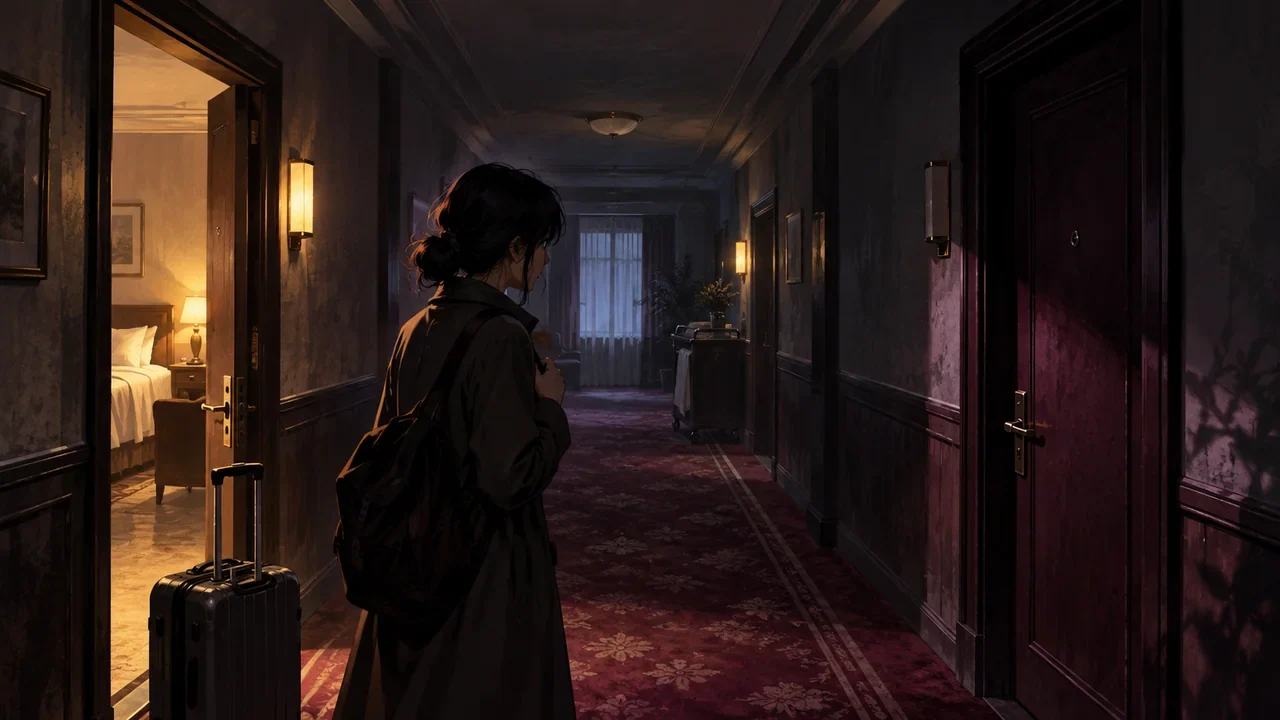
You sit on the edge of the bed, the door chain is on. The knocking comes from the lower part of the door panel, three times, pause for two seconds, three times again. The corridor light under the door does not change. You walk to the door; through the peephole there is only an empty corridor and a flickering light. The knocking stops. The phone rings, three times. You pick up the receiver; on the other end is breathing, slower than your own.
In this passage there is no monster, no blood, only verifiable information: the knocking position is low, the light under the door does not change, the peephole shows no one, the phone rings three times. At this point players can do very little, but everything has a basis.
Note that "the light under the door does not change" is a clue, not a conclusion. It only means no one outside is blocking the light, not that no one is outside. The author should not make judgments for the player.
Step Three: Give One Verifiable Test
Before danger arrives, players must make one low-risk test, and the test result must be able to verify or overturn one of the rules. The test must not directly trigger death, otherwise players learn nothing.
"Knocking Sounds in Room 207" gives three options:
- Do not open the door; look through the peephole again.
- Press your ear against the door panel and listen.
- Retreat to the window, pull the curtain, and look at the fire escape on the side of the corridor.
Choose 1: Through the peephole it is still an empty corridor, but the corridor light no longer flickers; it becomes constantly on. The knocking does not come again. The phone does not ring. The player has verified "the peephole cannot see a person," but the change in the corridor light is new information.
Choose 2: You can hear the sound of fabric rubbing outside the door, like someone sitting down against the door. The knocking stops. The phone rings, three times. The player has verified "there is something outside the door," but has not seen it.
Choose 3: There is no one on the fire escape, but on the outside of Room 207's window there is a fresh scratch, pointing upward. The player gets a clue unrelated to the door, suggesting that the hypothesis "the room is not the only entrance" may hold, but Rule One has not been overturned, because the scratch is outside the window, not in the corridor.
None of the three options directly harms the player, but all change the information available afterward. This is the function of a "verifiable test": the player makes a choice, the world gives feedback, and the feedback can be remembered.
Step Four: Two Action Consequences and Endings
After the test, the player must make a real action choice. Here are two consequences, one more conservative and one more risky, but neither is written as "correct/wrong."
Ending choices for "Knocking Sounds in Room 207":
- Action A: Do not answer the phone, re-hook the door chain, and sit until dawn. Consequence: The knocking stops at 3 a.m., and the phone no longer rings. After dawn the corridor is normal, but the room number changes from 207 to 208. The player survives, but the room has changed.
- Action B: Pick up the phone and say "Who are you?" to the breathing. Consequence: The breathing stops, and a voice on the other end says "I'm behind you," in the same voice as the player's own. The phone hangs up. The door chain is still on, the door has not opened. The mirror in the room is covered by cloth, and the cloth is the one the player brought.
Neither consequence explains the truth; each leaves only one verifiable change. A's change is the room number, B's change is the mirror and the voice. Players can carry these changes into the next segment, or end here.
Do not write "you finally understand" or "the horror has only just begun" in the ending. Let the last concrete object or state remain in the player's hands.
Completion Check
After writing "Knocking Sounds in Room 207," check against the following:
| Check item | Standard |
|---|---|
| Spatial rules | Within three, each verifiable by the player |
| Information channels | Only sound, door state, repeated clues; no narration explanation |
| Test | At least one low-risk test, result observable |
| Exit choice | Clear option not to open the door/leave before danger |
| Consequences | Two actions each have concrete changes, no judgment of right or wrong |
| Rule stability | No temporary changes to spatial rules throughout |
If a rule was changed during writing, return to Step One and rewrite; do not patch it with "actually the door could always open."
Finally, do one small action: delete all "suddenly" from the room scene you are writing, and replace it with a clue the player has already seen. Horror comes from predictable rules being verified bit by bit, not from things the author adds at the last minute.