Two Characters Look Alike: How Can Clothing, Behavior, and Forms of Address Help Players Tell Them Apart?
Conclusion first: split recognition into four mutually independent clues, each of which can stand on its own, so players do not need to rely on facial features to tell them apart. The four are: silhouette (different at a distance), carried objects (ownership visible up close), action habits (confirmable in motion), and forms of address and self-reference (identifiable in dialogue). Below, a pair of fictional twin watchmakers is used to build a complete construction; the characters, numbers, and dialogue are all teaching examples, not measured data.
Guide
Conclusion first: split recognition into four mutually independent clues, each of which can stand on its own, so players do not need to rely on facial features to tell them apart. The four are: silhouette (different at a distance), carried objects (ownership visible up close), action habits (confirmable in motion), and forms of address and self-reference (identifiable in dialogue). Below, a pair of fictional twin watchmakers is used to build a complete construction; the characters, numbers, and dialogue are all teaching examples, not measured data.
First build a recognition table, then write the storyboard
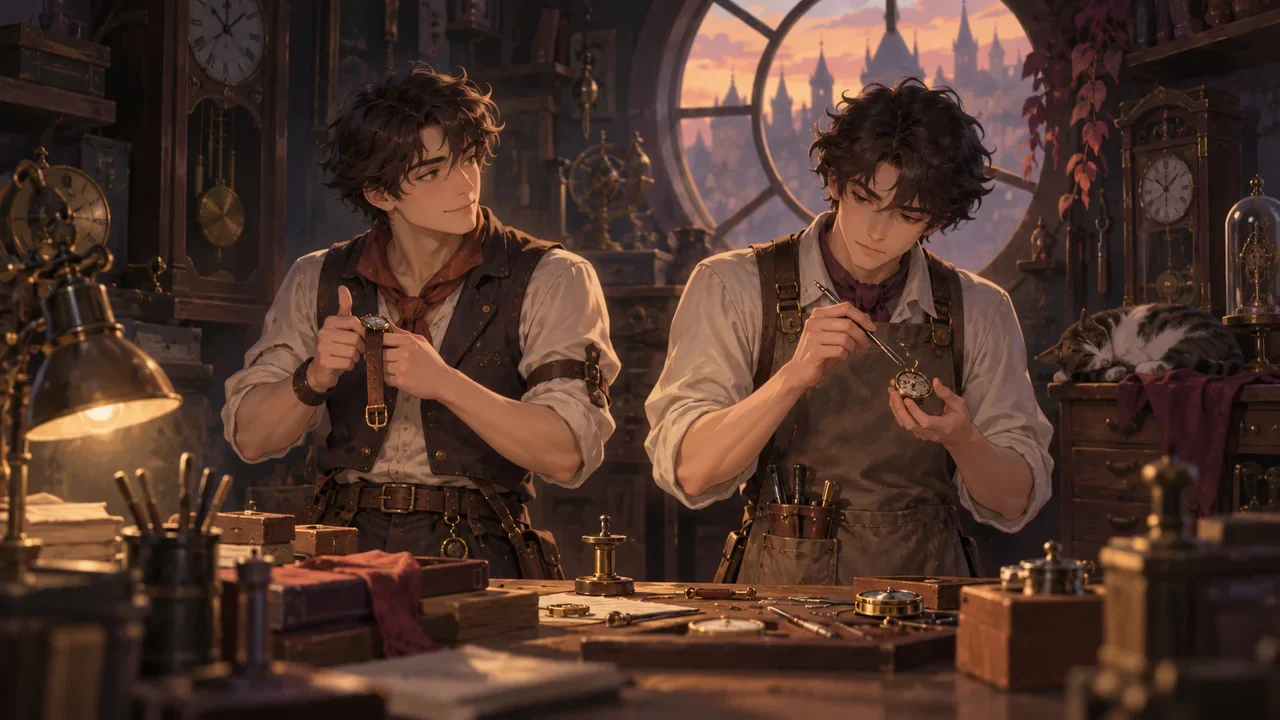
Setup: adult twin watchmakers, the older brother named Qi Yun, the younger brother named Qi Lang. Their facial features are close; this is the premise, and the intention is not to solve it through faces.
| Clue | Qi Yun | Qi Lang | At which layer it is confirmed |
|---|---|---|---|
| Silhouette | Long work apron, hem reaching the calves, straps crossed on the back | Short vest, cuffs rolled up to the elbows, leather roll pouch hanging at the waist | Long shot, back view, inside a door frame |
| Carried objects | Three fine tweezers inserted in the left chest pocket, with different lengths exposed | A circle of old watch strap wrapped around the right wrist, buckle facing outward | Medium close-up, hand close-up |
| Action habits | Before speaking, first pulls the tweezers out of the pocket and inserts them back | While listening to someone speak, rubs the strap buckle with the thumb | During dialogue, at pauses |
| Forms of address and self-reference | Refers to himself as "I," calls his younger brother "A Lang" | Refers to himself as "I," calls his older brother "Yun Ge" | Dialogue, narration, others' retelling |
The purpose of this table is division of labor, not stacking. Long shots give only the silhouette, medium shots give the objects, and dialogue gives actions and forms of address. Any single layer appearing alone can let players recognize the person.
How to write each of the four clues
Silhouette must be drawable in one stroke. The apron and the short vest differ in shoulder line, hem length, and waist volume, and can be distinguished even in backlight or out of focus. Avoid both wearing "dark work clothes"; that pushes the recognition pressure back onto the face.
Carried objects must have fixed positions and states. The tweezers are always in the left chest pocket, and the strap is always on the right wrist; do not have them in the pocket in this scene and in the hand in the next. Once the position drifts, the clue fails. The objects do not need their origins explained unless the plot needs to use them.
Action habits must be tied to the rhythm of dialogue, not inserted randomly. Qi Yun's "pulls out the tweezers and inserts them back" is placed before he is about to answer; Qi Lang's "rubs the buckle" is placed after he finishes hearing a line from the other person. In this way, the action itself carries the information of "who is speaking, who is listening."
Forms of address and self-reference are the lowest-cost clue. Let the two call each other, and players immediately establish the mapping. Be careful not to let the two also use different nicknames for self-reference; that would add another set of rules to remember. Using "I" uniformly for self-reference and placing the distinction in "how they address the other person" is lighter.
Three dialogue tests without names
Test method: delete all names from the following dialogue, leaving only action cues and forms of address, and see whether the speaker can be identified. Each passage first gives the clues, then lets the reader infer.
Passage one (only actions)
(Pulls out the tweezers, then inserts them back into the pocket) This balance wheel is off. (Thumb rubs over the strap on the wrist) Off by how much? (Pulls out and inserts the tweezers again) Half a mark. What about the one in your hand? (Rubs the buckle) Same.
Inference: the one who first pulls out the tweezers is Qi Yun, and the one who rubs the strap is Qi Lang. Each of the two actions appears twice, forming a stable rhythm.
Passage two (only forms of address)
A Lang, pass me the hairspring tweezers. Yun Ge, they are on your left. On my left is your leather roll pouch. Then they are behind the pouch.
Inference: the one who calls "A Lang" is Qi Yun, and the one who calls "Yun Ge" is Qi Lang. This passage does not rely on appearance or actions at all.
Passage three (mixed, including one misdirection)
(Short vest, cuffs rolled up to the elbows) Not taking any work today. (Long apron, straps crossed on the back) Rent still has to be paid. (Thumb rubs the strap) So I am taking apart my own watch. (Pulls out the tweezers and inserts them back) Can it be put back together after you take it apart?
Inference: the short vest and rubbing the strap are Qi Lang; the long apron and pulling out the tweezers are Qi Yun. The third line's "taking apart my own watch" is what Qi Lang says on the spot; whether it is true needs separate confirmation. This line can be used to identify the speaker, but it cannot be used to conclude that he definitely has a watch that can be taken apart, nor to judge without basis that he is lying.
Completion check
After writing one episode's storyboard, check item by item:
- Cover both people's faces and look only at the silhouettes; can you say who is who?
- Delete all names and forms of address, leaving only actions; can the dialogue still be identified?
- Delete all action cues, leaving only forms of address; can it still be identified?
- Pick any medium shot and check whether the positions of the carried objects match the recognition table.
- Check whether there is any passage in which none of the four clues appears. If there is, add one; do not let facial features bear the burden alone.
Only when all five pass is this round of recognition checking complete. If any one fails, first add the missing clue, and after adding it, recheck all five items; do not treat adding one action as proof that the effect has been verified.
A limitation when AI output is involved
If the dialogue or storyboard is generated by AI, writing the four clues clearly in the prompt does not guarantee it will be correct every time; the generated result needs to be manually checked item by item according to the above checks, especially object positions and action ownership, because the model easily mixes up the two people's habits.
One thing you can do right away
Take an existing pair of similar characters you have, fill in a four-row recognition table like the one above, then choose an existing passage of dialogue, delete the names, and see whether you can still recognize who is speaking. If you cannot, it means the clues have not yet landed in the dialogue and actions.