After a Team Vote, How Can Minority Views Still Shape the Story?
After a three-to-two vote to change routes, let the decision take effect while preserving objections as concerns that can be checked, clearly assigned responsibilities, and conditions for further discussion. A fill-in meeting record can connect the losing vote to what happens next.
Introduction
After a three-to-two vote to change routes, minority views can still change how the team acts, what it checks, and when it reopens discussion. When writing, put the decision, reservations, implementation responsibilities, and review points in the same meeting record: the majority determines what happens now, dissenters leave unresolved questions on the table, and later scenes respond to them.
The repair team, routes, characters, and dialogue below are all fictional teaching examples. They are not real user cases, tested results, or DramaFork product features. The meeting record is a tool for authors to organize their stories.
1. Establish Exactly What This Vote Decided
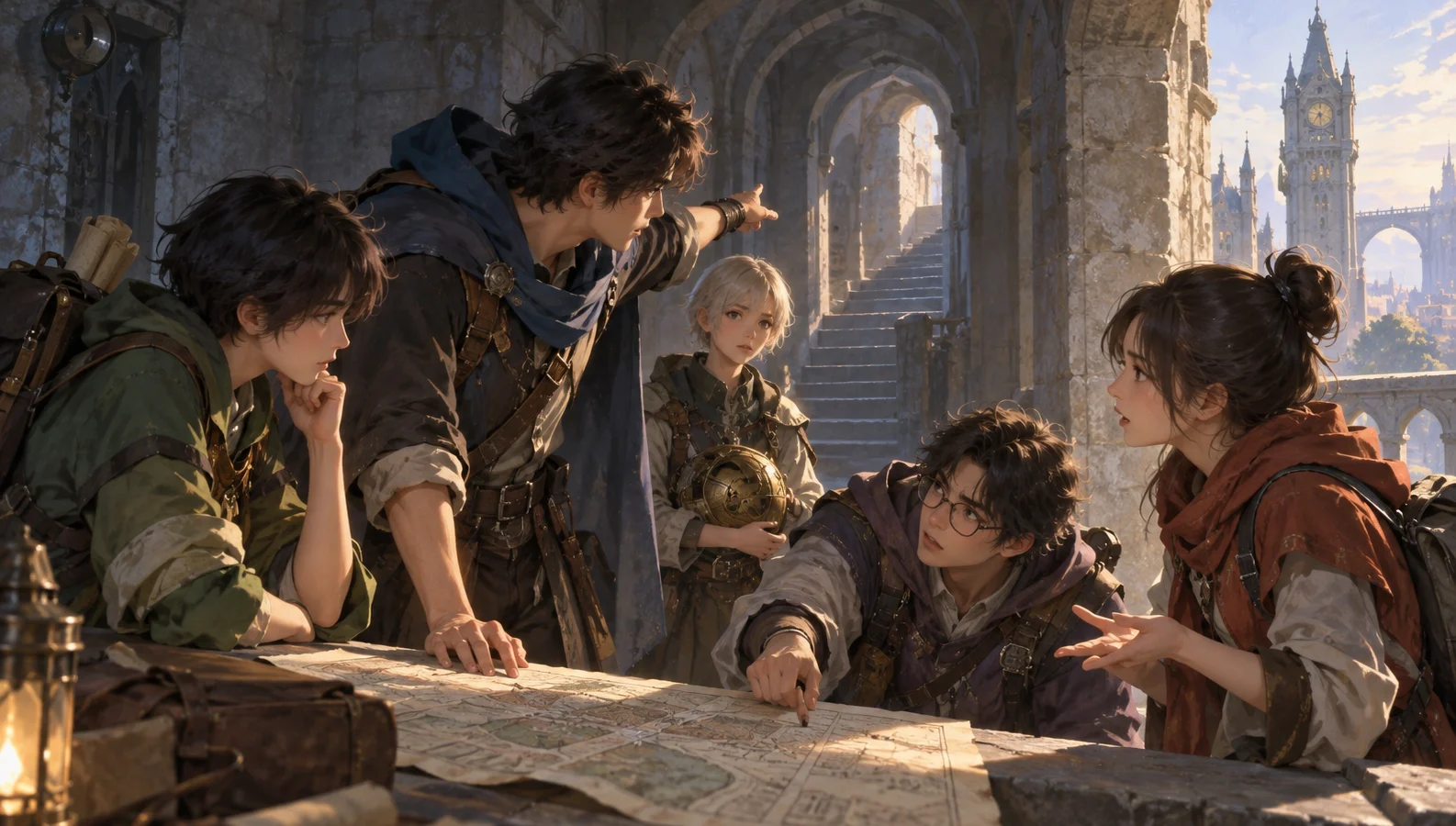
In this fictional story, a five-person repair team must deliver a calibration core to the old city's clock tower. They originally planned to cross the market, but Cen, the team leader, proposes taking the northern corridor instead. Cen, Luo, and He vote in favor; Mi and Tao vote against. The result is three to two.
The majority believes that market stalls are being packed away and transport carts might block the entrance. Mi worries that the corridor's door signs still use the old numbering and could lead the team to the wrong floor. Tao remembers that they promised to pick up an apprentice waiting at the market.
These two objections cannot be lumped together as “they are more cautious.” Mi questions the basis for the route choice; Tao cares about an earlier promise. Even if the corridor later proves clear, Tao's concern does not disappear.
The decision should therefore read, “Take the northern corridor as far as the first junction,” rather than, “The whole team agrees that the northern route is better.” The first sets the scope of action; the second rewrites two people's positions without justification. Nor should the dissenters immediately say, “Fine, we'll do it your way,” once the vote is announced, erasing every disagreement.
2. Use a Meeting Record to Keep Different Views Relevant Later
You can use the following record by replacing the characters, places, and conditions. It records the agreement made in this scene; it does not imply that every team uses the same procedure.
| Field | Entry for This Example |
|---|---|
| Decision and scope | Three votes in favor, two against; take the northern corridor, then check the route at the first junction |
| Reservations | Mi: the old numbering may indicate the wrong floor; Tao: the apprentice is still waiting at the market as originally agreed |
| Implementation responsibilities | Cen leads and explains the reason for the route change; Luo carries the calibration core; He leaves a message for the apprentice about the change of plan |
| Dissenters' participation | Mi agrees to consult the old map he carries; Tao agrees to draft the message but has not endorsed the route change |
| Review point | Check at the first junction as agreed; if a discrepancy between the door signs and the old map appears earlier, a check may be requested sooner |
| Evidence and authority for review | First check the door signs, map, and acknowledgment of receipt of the message; Cen organizes the discussion, and any route change still requires a vote by all five |
| Unfinished business | If delivery of the message cannot be confirmed, the promise to pick up the apprentice remains outstanding and must not be written as resolved |
A blank version needs only seven items: what was decided, who still has which reservations, who is responsible for implementation, what participation the dissenters accept, when to review, what would justify an adjustment, and what remains unresolved.
The point most easily overlooked is whether participation was agreed to. Mi raising a concern does not mean he must single-handedly prove that the entire route is unusable. If he does not want to check the map, Cen must still assign someone to do it. Otherwise, “listening to objections” becomes a way to give dissenters extra work.
3. Turn the Meeting Record into a Scene Where Something Actually Changes
After the vote, you could write:
Cen: Three to two. We'll take the corridor and check at the first junction. Mi, your concern about the numbering is still on the table.
Mi: I can check the map, but I haven't changed my vote. If something doesn't match, I'll ask you to stop and check it.
Cen: Agreed. Checking the map isn't your responsibility alone. I'll watch the door signs too.
Tao: What about the apprentice? Changing routes doesn't let us cancel our promise along with it.
He: I'll leave a message. Until we get acknowledgment of receipt, we'll treat the apprentice as not yet informed.
The next scene must follow through on at least one of these arrangements. At the junction, the team sees “Floor Seven” written on the wall, while Mi's old map labels it “Floor Six.” Mi holds up the map, Cen stops leading the team forward, and Luo keeps custody of the calibration core. Requesting a review thus neither removes Cen as leader nor cancels everyone's implementation responsibilities.
After checking, they find a nearby sign comparing the old and new numbering: the floor names have changed, but the passage still leads to the clock tower. The team can continue, but have Cen check the numbering comparison signs first at subsequent junctions. Mi's concern has not justified another route change, but it has changed how the team is led.
Meanwhile, He returns with only a receipt showing that the message was left, not a reply from the apprentice. Tao asks that they make arrangements to pick up the apprentice after reaching the clock tower, and Cen records this as their own outstanding responsibility. The two objections receive different responses: new information narrows one concern, while the promise behind the other still needs to be kept.
This approach does not need to prove that the minority is smarter. What matters is that readers can identify what extra action the team took because they spoke up, and who accepted which responsibility.
4. Different Objections Can Have Different Effects
Not every objection should trigger another vote. Authors can choose how to carry it forward according to the substance of the disagreement.
Factual concerns lend themselves to verification scenes, such as checking whether the numbering has changed. Disagreements about implementation can alter the division of work: Tao might agree to travel with the team but refuse to explain the changed arrangement on the leader's behalf. Conflicts of values can persist through the end of the mission: the calibration core has been delivered and the apprentice found, yet Tao still feels the team treated its promise too lightly.
If the next scene needs to move quickly, keep one acknowledgment and one follow-up action rather than staging a complete second meeting. For example, Cen opens the map at a junction without being prompted, and only then does Mi follow. This saves space while leaving a trace of the earlier argument.
If the author wants to show a worsening relationship, Cen can refuse the review. But the writing should make clear that Cen is breaking the agreement just made, and Mi or Tao should change their willingness to cooperate accordingly. You cannot write a leader who never considers objections while describing the team as one that thoroughly discusses its decisions.
Returning to the market is another option, but doing so needs a new basis for judgment. Do not overturn the vote unconditionally just after setting out to comfort those who lost. That would make the majority's choice meaningless.
5. Check Whether Minority Views Have Become Decoration or Privilege
The first failure is leaving them as dialogue alone. A dissenter says, “I still have reservations,” but no later check, shift in responsibility, or response in the relationship follows. When revising, connect that line to the next visible action; there is no need to build an entire extra subplot.
The second failure is endless reconsideration. The same person repeats the same reasons every few steps, and the team keeps voting again. A character can respond, “We've recorded that concern, and we'll check at the junction. What new information have you found now?” The earlier objection remains valid, but repeating it does not automatically reopen the meeting.
The third failure is making the minority right every time. If every three-to-two vote features two people predicting disaster, voting soon becomes little more than waiting for the author to reveal the answer. As in this example, let a factual concern receive an explanation while a promise remains binding, rather than reducing different kinds of disagreement to winning and losing.
Finally, check whether responsibility has been shifted onto the wrong person. If the route fails, Mi's participation in checking the map does not justify dumping all of the leader's decision-making responsibility on him. If the route succeeds, that does not mean Tao must withdraw criticism of the broken promise. Helping carry out a decision, agreeing with it, and endorsing the result are three things that can be written separately.
This record suits teams that still want to complete a task together. If a character has already decided to leave, or does not recognize the voting agreement at all, the next scene should address the departure and the conflict over power. Filling out a form cannot manufacture consensus. Before submitting the draft, remove everything the two dissenters say and reread what follows. If the actions, responsibilities, and relationships remain exactly the same, you still need to add a concrete change caused by their objections.