How Much Story to Show on a Small Screen: Divide Passages by Decision Task
Do not split mobile story passages by a fixed word count. Label the draft as facts, actions, and choices, keep decision information close to the choice, and move background that does not affect the current decision until after the action.

Define the Decision First, Then Decide How Much to Show
When repair instructions and background description crowd together on a phone, first write down the question the player must answer right now, then divide the passage around it. One reading passage should support a clear task: understanding the current state, performing an action, or comparing paths. Its length should follow the task, rather than a rule about how many lines fit on each screen.
A practical approach is to label sentences as “facts, actions, or choices,” then check whether the background affects the current judgment. Keep what does; move passages that only add character history until later. Facts and actions can share a passage, but players should not have to finish reading a memory before discovering an instruction buried earlier in the text.
Here, a “reading passage” and a “screen” are different things: the former is a complete unit of meaning; the latter depends on the device, text size, and interface. A passage can wrap or scroll without having to fit on one screen. Starting a new passage does not necessarily require another click, either.
The fictional teaching example below is “Repairing the Old Theater’s Memory Box.” The memory box and its repair rules are inventions for this article. They are not a real user case, tested results, or product features, and they do not describe how to repair real equipment.
The Original Draft: How Background Crowds Out Decision Information
In this scenario, the protagonist, Ahe, wants to repair a memory box to retrieve a recording left by her teacher. The box has two mutually exclusive recovery paths: preserve the old audio, or erase it to restore tonight’s time signals. First, consider a draft that deliberately mixes everything together:
Rain tapped against the old theater’s windows, and Ahe remembered how her teacher always stayed after the audience had left to listen to the chimes. The moon symbol on the memory box on the table was lit, while the star symbol had gone dark. She needed to move the moon tile into the empty central slot first, then wait for the text display to show “Old audio remains.” Her teacher had once said that the chimes here could help lost people find the door. Inserting the echo tile next would preserve her teacher’s recording, but the box would not announce the time tonight; inserting the dawn tile would restore tonight’s time signals, but erase the recording. Ahe touched the scarf her teacher had left her and decided to try.
The problem is not simply that this passage is long. “Move the moon tile first” is an action still to be performed, but it is surrounded by rain and memories. “Old audio remains” is the result of that action, yet it is buried in the instructions before the action takes place. The closing “decided to try” does not specify which path she chooses.
When breaking down the draft, mark it this way: the lit moon symbol and dark star symbol are current facts; moving the moon tile is an action; the text on the display is a new fact after completion; and the effects and costs of the two tiles provide the basis for a choice. The history of the teacher and the chimes shapes the emotional meaning and can stay, but it need not sit between the action and its result.
One sequence must also remain intact: before an action has been performed, tell players only what they can expect to happen. Do not present that expectation as a state that already exists. Otherwise, even very short passages will leave readers unsure how far they have progressed.
The Revised Draft: Give Facts, Actions, and Choices a Clear Place
The first passage establishes the situation, reducing the setting to one sentence and naming the objects explicitly:
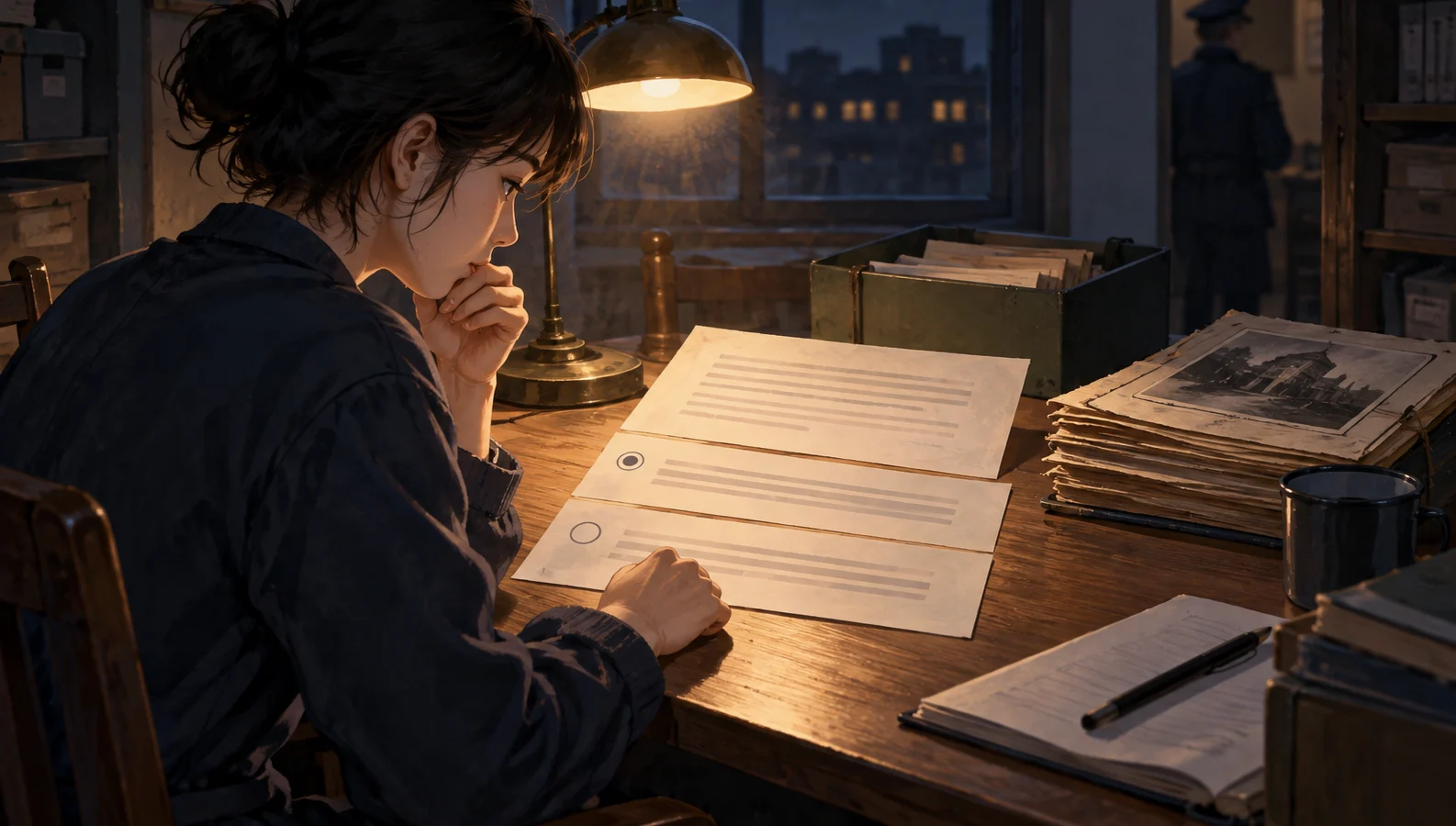
Rain tapped against the old theater’s windows. On the memory box, the moon symbol was lit and the star symbol had gone dark; the central slot was still empty.
Next step: move the moon tile into the empty central slot.
There is only one prescribed action here, so it can be presented as a clear interaction without disguising it as a story branch. After the action is completed, show the second passage:
The moon tile settled into the slot, and the text display showed “Old audio remains.” The recording her teacher had left was still there.
Ahe gripped the scarf. Her teacher used to stay after the audience had left, waiting until the final chimes had finished before leaving.
The memory comes after the result to give emotional weight to “the recording was still there.” It neither interrupts the repair instructions nor replaces the explanation of the paths that follows. The third passage focuses on supporting the decision:
Only one tile can be inserted now. Once this is done, it cannot be exchanged.
Insert the echo tile: preserve her teacher’s recording, but the box will not announce the time tonight.
Insert the dawn tile: restore tonight’s time signals, but erase her teacher’s recording.
Choose: insert the echo tile / insert the dawn tile.
The key costs sit immediately beside the choice, so players do not need to return to the first passage to find them. If the echo tile is chosen, a follow-up sentence could read: “The text display showed ‘Old audio preserved,’ and tonight’s time-signal indicator went dark.” If the dawn tile is chosen: “The time-signal indicator lit up again, and the list of old recordings was empty.” These are sample branches for authors, not a claim that a system will automatically save or apply these states.
This revision also has an editorial cost: the detail that “the chimes help lost people find the door” has been temporarily removed. If it affects how players judge the value of the time signals, restore it to the shared context before the choice. If it is merely theater folklore, save it for a later scene. Whether to retain it depends on its role in the story, not a blanket rule to delete all background.
A Reusable Deliverable: The Decision Passage Card
For another draft that mixes these elements together, fill in the following card for each node. It is an editing tool; readers do not need to see all the field labels.
| Field | What to Enter | Entry for This Example |
|---|---|---|
| Current task | One question that defines the passage’s purpose | Preserve the recording or restore the time signals? |
| Essential facts | Information needed to compare the paths | The old audio remains; the two paths are mutually exclusive |
| Pending action | Name the object and the conditions for acting | Insert the selected tile after confirming |
| Choices and costs | State what each path gains and loses | Keep recording, stop time signals; restore time signals, erase recording |
| Background placement | Keep it here or name a specific destination | Move the scarf memory after the text-display feedback |
| Carry-forward facts | The new state the next passage can build on | Old audio preserved, or old audio erased |
After completing the card, check the passage against its stated task: reading only “Current task” and the corresponding body text, can you find everything needed to answer? If readers must still go far back to find a cost, condense that information and bring it close to the choice. Necessary repetition is acceptable here. For example, consistently referring to what was previously called “the voice left by her teacher” as “her teacher’s recording” reduces the effort required to determine whether both phrases mean the same thing.
Then do a paper walkthrough: suppose a reader stops after the second passage and resumes at the third. Both materials, their uses, and their costs remain fully stated there, so the reader does not need to reconstruct the comparison from memory. This kind of walkthrough can reveal dependencies in the writing; it cannot establish that the reading experience on a phone has been validated.
When to Combine Passages and When to Change the Presentation
If the repair has only one route and no resource trade-offs, write “state, action, result” in sequence as a single short passage and remove the choice field. Mechanically splitting it into three cards turns a simple action into repeated taps on “Continue.” If two paths require comparing several conditions, you could instead use parallel lists. First ensure that the conditions correspond, then address passage length.
A common failure is to add blank lines while leaving “it” or “that spot” referring across passage boundaries. Another is to move costs into the background explanation, leaving only material names beside the buttons. Yet another is to hide a new restriction at the end of every page, forcing players to overturn a judgment they have just formed. Fix these problems by naming objects fully and introducing restrictions earlier, rather than continuing to shorten sentences.
The limits also need to be clear: if larger text no longer fits on one screen, that does not mean essential conditions must be removed. Scrolling can be allowed, but the actual layout needs to be checked to see whether options and supporting information are easy to compare. If the story deliberately conceals a material’s effect, do not pretend the choice is a fully informed trade-off. Tell readers that the effect is unknown.
The final deliverable should include the annotated original, the revised draft, and the passage card. Together, they let authors explain which decision each split serves and which facts must appear before that decision.