How to Explain When a Location Cannot Be Entered: A Text Adventure's Threshold Must Be Understandable and Changeable
When a location cannot be entered, don't rush to write "the door is locked." The author must first classify the threshold, then decide what the player sees and can do. Once the classification is clear, the rules at the entrance will not change on the fly.
Introduction
When a location cannot be entered, don't rush to write "the door is locked." The author must first classify the threshold, then decide what the player sees and can do. Once the classification is clear, the rules at the entrance will not change on the fly.
Four Types of Thresholds
Physical obstruction: The bridge is broken, the stone door is too heavy, the passage is flooded. The player can see the obstacle itself and can judge what conditions are needed. Permission: A guard, a registration desk, a lord's password. The obstacle is not on the object, but on a certain person or a certain record. Timing: Only open at night, the market only opens on the first day of each month, passage is only allowed after the bell rings. Information threshold: The road is right there, but the player does not know where the entrance is, what the password is, or whom to look for.
The difference among the four types of thresholds lies in whether the player can discover the path to removal on their own. Physical obstruction usually requires tools or a detour; permission requires identity, relationships, or exchange; timing requires waiting or changing the current state; information threshold requires first obtaining a certain clue. Writing "you cannot enter" as a single sentence "you cannot enter" is equivalent to compressing the four types into one, and the player can only repeatedly try the same action.
Three Entrances of the Floating City: A Fictional Teaching Case
The following example is a fictional teaching case; the numbers and dialogue are illustrative and are not actual test data.
The Floating City has three entrances: east, west, and north, corresponding to three types of thresholds.
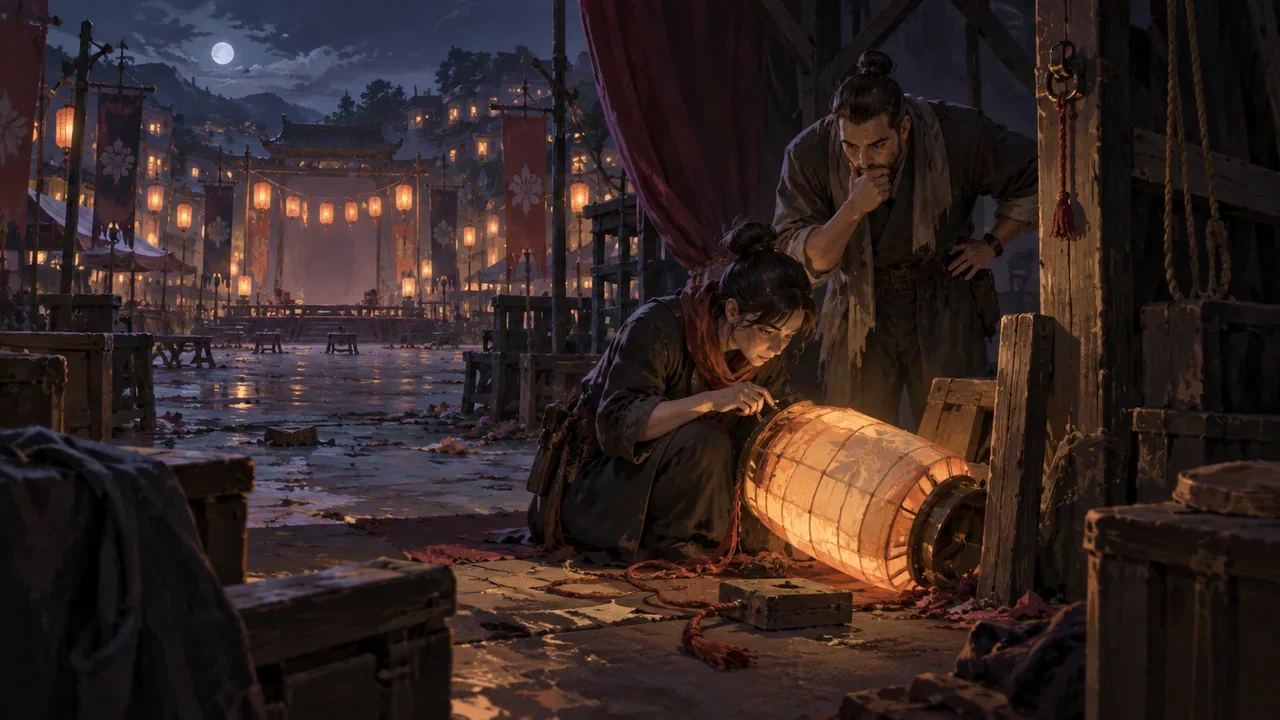
The east gate is a broken bridge. The bridge deck collapsed from the middle by about four meters, and old rope still hangs from the edge of the break. When the player first arrives, they see:
The bridge planks break after the third post, and below the gap is fog. The lights on the opposite bank are on, but no one comes over.
This is physical obstruction. There are two discoverable clues: the wooden post at the bridgehead is carved with "In flood season, take the west gate," and in the nearby grass there is a section of thick rope that has been cut. If the player examines the wooden post, they get a detour hint; if they pick up the thick rope, they can attempt to rig a rope to cross the bridge in a later turn, but they must first find a hook post that can secure the rope. The hook post is not at the gate, but on a section of abandoned boardwalk going back from the east gate. In this way, the removal path is divided into two steps, and the first step can be discovered before reaching the gate.
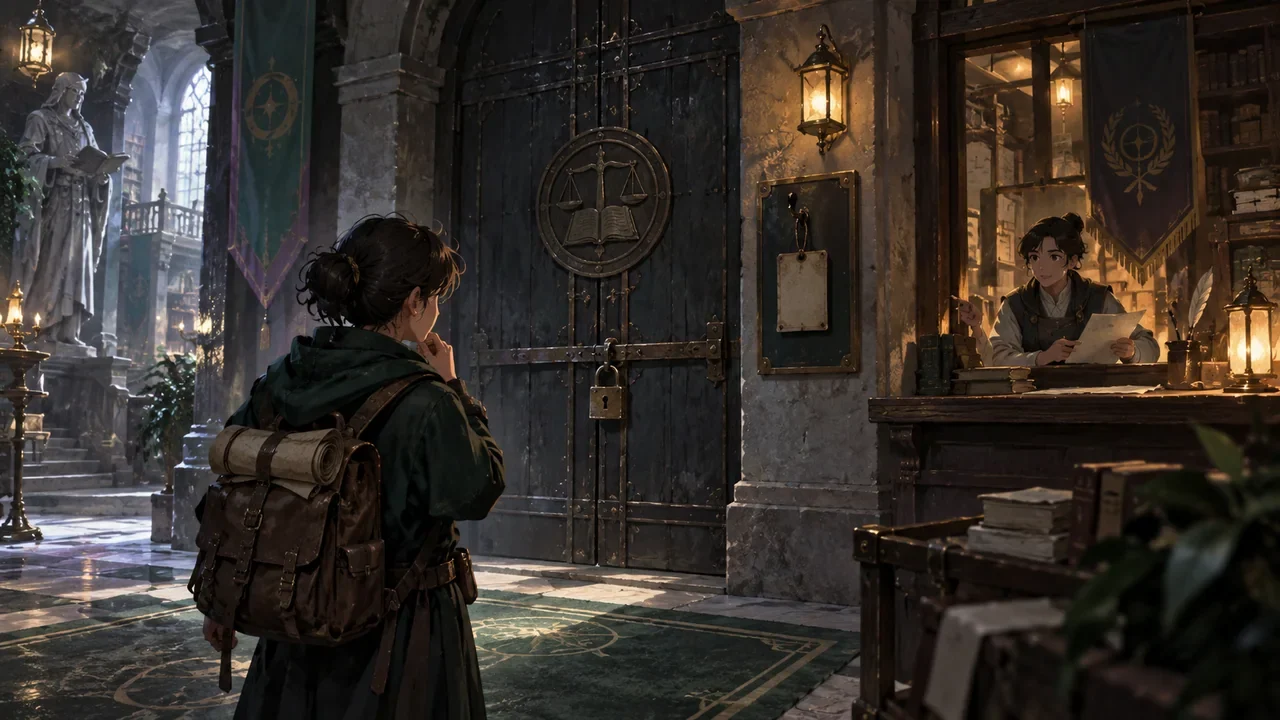
The west gate is a registration desk. The guard requires the player to state their name, purpose, and guarantor. If the player directly says, "I want to enter the city," the guard replies:
"Name, purpose, who guarantees you. Once all three are ready, step over here."
This is a permission threshold. The discoverable information is: one page of the registration book already says "Guarantor: Gray Falcon," but whether Gray Falcon is willing to guarantee requires the player to first find him in the city. If the player has no guarantor, the guard will not let them through because of repeated dialogue. The detour option is the north gate, but the north gate has a timing restriction.
The north gate is only open at night. When arriving during the day, the gate is closed, and the stone pillar beside it is carved with "Opens at sunset, closes at sunrise." This is a timing threshold. The player can wait until night, or first go do other things, turning "waiting" into a schedulable period of time. If the player repeatedly pushes the gate during the day, the feedback should remain consistent:
The gate does not move at all. The carving on the stone pillar is very clear in the daylight: Opens at sunset, closes at sunrise.
Location Threshold Table
| Entrance | Threshold type | What the player first sees | Discoverable clues | Removal path | Feedback after arrival |
|---|---|---|---|---|---|
| East gate | Physical obstruction | Broken bridge, fog, lights on the opposite bank | Carving on the wooden post, cut rope | Detour to the west gate, or find the hook post to rig a rope | After crossing the bridge, the bridge deck continues to collapse behind you, and you cannot return the same way |
| West gate | Permission | Guard, registration book | The guarantor's name in the registration book | Find Gray Falcon, or switch to the north gate | After registration, the guard gives a wooden token, and the token says "West gate entry" |
| North gate | Timing | Closed gate, carving on the stone pillar | The content of the carving | Wait until sunset, or first do other things | At night the gate opens, and the guard only checks the wooden token, not names |
The purpose of this table is to let the author fill it out once before writing the scene. The three columns of threshold type, clue location, and removal path must match up. If the "discoverable clues" column cannot be filled in, it means this threshold currently can only be let through by the author on the fly, and the player has no operable space.
Feedback After Arrival Must Change the State
After the player removes the threshold, the feedback cannot just be "you entered." The feedback must leave a trace, letting the player know that this entry is different from the last one. After crossing the east gate bridge, the bridge deck continues to collapse, meaning the return trip must find another way; after registering at the west gate, the player gets a wooden token, and the wooden token can be used later at the north gate; after entering the north gate at night, the rules for coming again during the day remain unchanged, but the player already knows the time.
Feedback must also handle repeated attempts. When the player repeats the same action at the same entrance, the text can be shortened, but the information cannot change. The first time pushing the north gate is written in two lines, and the third time can be written in one line:
The gate is still closed. Opens at sunset, closes at sunrise.
This neither punishes the player nor implies that "trying one more time will open it."
Detours Are Not Failure
Detours are part of threshold design. After the east gate bridge breaks, the west gate and north gate become optional paths; the west gate requires a guarantor, and the north gate requires waiting until night. When the player chooses a detour, the author must ensure that the detour itself has content, rather than writing the detour as "you walked for a long time and arrived at another gate." On the detour, the player can encounter Gray Falcon, and can also encounter the hook post that can secure the rope. In this way, the detour and the threshold removal share the same batch of clues.
If all three entrances are blocked, the player will think the world is preventing them from moving forward. Leave at least one discoverable, executable path, even if it requires waiting or first doing other things.
Completion Check
After writing the threshold of a location, check item by item:
- Which category the threshold belongs to among physical, permission, timing, and information, and whether it belongs to only one category.
- Before reaching the entrance, can the player already discover at least one clue.
- Is the removal path specific to an action or object, rather than "find a way in."
- When the same action is repeatedly attempted, is the feedback consistent and does it not imply random passage.
- Does the detour have independent content, and is it connected to the clues.
- Does the feedback after entering change the state, such as leaving an item, changing the return trip, or updating known information.
If all six items can be filled in, the rules at the entrance will not change on the fly. The next step can be to take a piece of paper and draw the location currently blocking the player into three columns: threshold type, clue location, removal path. The column that cannot be filled in is the place that needs additional writing.