How to Create Choices in a Warm Slice-of-Life Text Adventure: Starting from a Bakery's Morning Shift
Once life-or-death crises are removed, choices must stand on three things: limited ingredients, the specific needs of different customers, and opening time. Stacked together, every decision the player makes spends margin somewhere else, and failure only makes something later or worse, not end the story. Below, we walk through the fictional teaching example "Six-Thirty Bakery." All numbers and dialogue are examples, not tested data, and do not constitute food preparation or allergy handling advice.
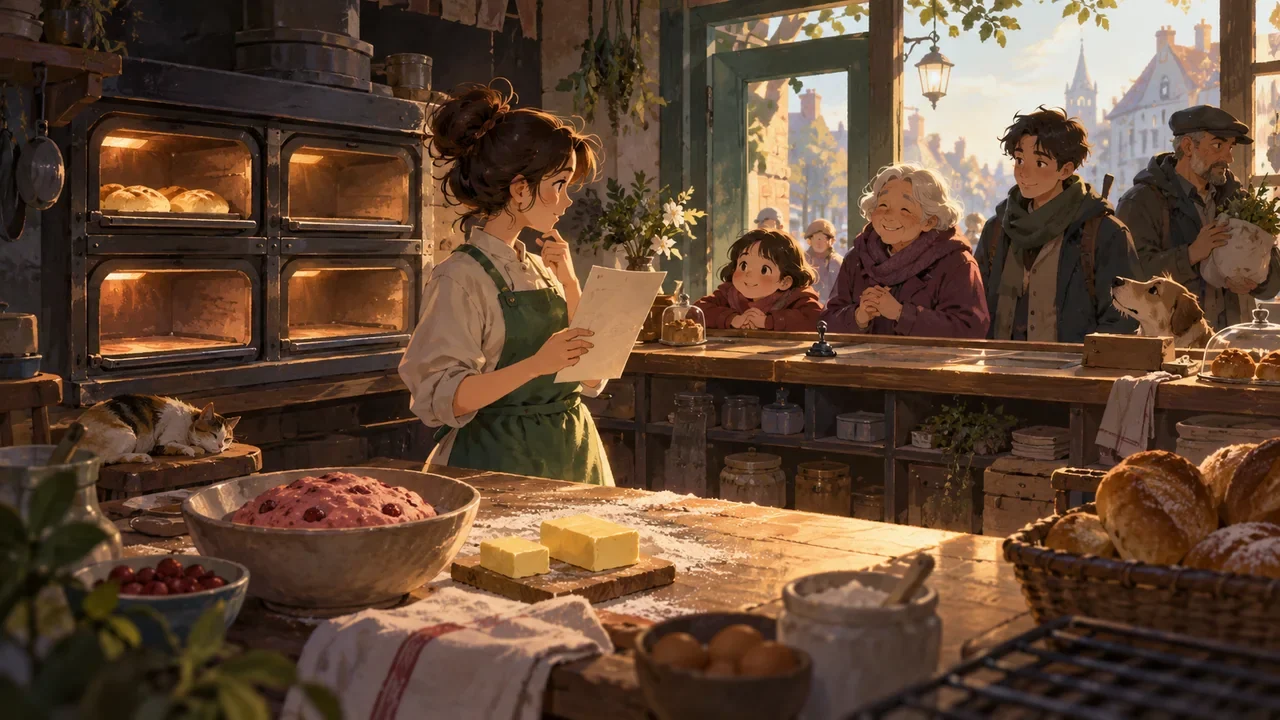
Introduction
Once life-or-death crises are removed, choices must stand on three things: limited ingredients, the specific needs of different customers, and opening time. Stacked together, every decision the player makes spends margin somewhere else, and failure only makes something later or worse, not end the story. Below, we walk through the fictional teaching example "Six-Thirty Bakery." All numbers and dialogue are examples, not tested data, and do not constitute food preparation or allergy handling advice.
Write the ingredient list first, then the first sentence
Everyday trade-offs need to be countable. Before writing, first list the ingredients available for the day, clearly noting quantities and states, so the player can see the boundaries at a glance.
| Ingredient | Quantity | State |
|---|---|---|
| Bread flour | 4 portions | Plentiful |
| Butter | 2 portions | Enough for only two batches |
| Yeast | 1 portion | Activated, use up today |
| Red bean paste | 6 portions | Each portion corresponds to one red bean bun in this example |
| Eggs | 5 | Room temperature |
This table's purpose is to make orders correspond to verifiable consumption. In this example, two butter rolls count as one portion of butter, and each red bean bun counts as one portion of filling; these are abstract units for the story, not a baking recipe. Before writing options, calculate once using the same rules; a route cannot suddenly use half a portion of material to make double the quantity.
First turn: ten minutes before opening
The first turn should not throw an event; first give a repeatable morning action so the player establishes rhythm.
At six twenty, you pull up the roller shutter. The dough in the proofing basket is a finger higher than last night. The oven takes eight minutes to preheat, and the first batch can only go in one tray. The blackboard is still empty. Whatever you write today is what customers will order.
- Bake plain rolls first. Safe, but the shelf will look monotonous.
- Bake red bean buns first. Uses one portion of filling, and the aroma is more attention-grabbing.
- Don't bake yet. Write the blackboard well, and decide after the first customer comes in.
The difference between the three options is not right or wrong, but "what gets spent first." Choosing 1 preserves butter and filling; choosing 2 uses one portion of filling in exchange for faster foot traffic; choosing 3 gives time to information, but the first batch comes out later. Here, "the aroma is more attention-grabbing" is only narrative description and does not promise sales results.
Two conflicting orders: make what customers want squeeze against each other
The core of gentle trade-offs is demand collision. Design two customers who arrive at the same time, each with reasonable needs, but sharing the same ingredient.
Order A: Regular customer Aunt Lin wants six red bean buns, saying her grandson will pick them up after school, and she is willing to wait twenty minutes. Order B: New customer A-Che wants four butter rolls, saying he needs to catch the 7:30 bus and can only wait ten minutes.
Below, this follows after option 1 in the first turn: the shelf already has four plain buns, butter still has two portions, and red bean paste still has six portions. The two arrive at the same time. The currently available oven holds four buns per round, and each round counts as ten minutes in the story. A-Che's four butter buns need two portions of butter and one round; Aunt Lin's six red bean buns need six portions of filling and two rounds. The two orders total ten, and both cannot be completed as originally specified within their respective deadlines. Existing plain buns can be substituted, provided the customer is willing.
Options that can be given:
- In the first round, make A-Che's four butter buns; in the second round, make Aunt Lin's four red bean buns, and ask whether she is willing to replace the remaining two with two ready-made plain buns.
- Use two rounds to complete Aunt Lin's six red bean buns; ask whether A-Che is willing to immediately take the four plain buns from the shelf.
- In the first round, make only two butter buns, paired with two ready-made plain buns for A-Che; in the second round, make four red bean buns for Aunt Lin, delay the remaining two, and keep one portion of butter and two portions of filling for later use.
The three paths respectively change flavor, delivery quantity, and remaining materials. Choosing 1 requires Aunt Lin to accept a substitution; choosing 2 requires A-Che to accept a substitution; choosing 3 makes both adjust their orders but leaves margin. Customers can also refuse to change orders, and the author should write feedback for refunds or canceling fictional orders; an inquiry cannot be directly treated as consent.
Rework feedback: turn the unfinished part into the entrance to the next turn
The room for repair in everyday adventure comes from "you can try again." When the player chooses the third path, and Aunt Lin agrees to delay the remaining two, the next turn can show brief feedback.
Aunt Lin takes the four red bean buns, counts them, and says, "These for today; I'll come get the remaining two tomorrow." With her consent, you add a small line to the blackboard: two red bean buns reserved for tomorrow. You notice there is still half a piece of chalk in the corner of the blackboard, enough to write one line.
This feedback confirms the delivery gap and also leaves an actionable remedy. The player can register the delayed quantity in the next turn, or arrange a priority order round for tomorrow. Record the account first, then write the new task, to avoid later text treating the six red bean buns as all delivered today.
What needs to be clearly marked is: Aunt Lin saying "I'll come get them tomorrow" is her own statement, not a new world fact. Whether she actually comes tomorrow depends on how later turns are written, and cannot be treated as an already fulfilled promise.
Use time as invisible pressure, not a scary countdown
Opening time can be made a soft constraint. For example, the shop opens at seven, and by six fifty you must decide the first batch to come out. The player will not see a red countdown, only sentences like "the oven still has four minutes." Time advances triggered by actions, not driven by real-world seconds.
A repeatable turn structure:
- Describe the current state (ingredients, time, customers).
- Give two to three action options.
- After execution, update the ingredient table and time.
- Insert a short piece of feedback pointing to the next fixable place.
These numbers first serve as a narrative ledger maintained by the author. If an actual work is to automatically settle materials and time, the corresponding rules still need to be implemented and the results checked; telling a model to "strictly follow the table" cannot by itself guarantee that calculations are always correct. Ingredients are plentiful but oven slots are insufficient; this is the source of conflict in this example, so do not accidentally expand the oven slots to double when revising.
Completion check
After writing one morning-shift turn, you can self-check according to the following points:
- Whether every number in the ingredient table is used up or retained in the turn, and whether any portions appear out of nowhere.
- Whether the two customers' needs share at least one ingredient, and whether the conflict comes from time rather than good versus evil.
- Whether every option leaves something unfinished, with no hidden optimal solution of "have it all."
- Whether after failure an actionable remedy clue appears, rather than directly ending.
- Whether what characters say in the feedback is marked as a character statement, not mixed into world fact.
- Whether time advancement is triggered by actions, not dependent on a real-world countdown.
If AI-assisted option generation is involved, it can be treated as a source of drafts, not a rules guarantee. Prompt constraints do not guarantee that every output is correct, and the author still needs to manually check whether the ingredient numbers and timeline are self-consistent.
Next step
Pick a familiar everyday scene, write down five things available that day and two people who will appear at the same time, then write only one turn of the ten minutes before opening. First let the ingredient table stand, then let the customers speak.