How to Teach Players Controls in Interactive Stories: Let the First Attempt Also Complete a Story Task
The easiest way to teach players controls is to write the tutorial action directly as the story task itself. The player's first attempt made to advance the story is the operation you want to teach; feedback comes simultaneously from the interface and the story, and there is no need to open an extra "tutorial level."
Introduction
The easiest way to teach players controls is to write the tutorial action directly as the story task itself. The player's first attempt made to advance the story is the operation you want to teach; feedback comes simultaneously from the interface and the story, and there is no need to open an extra "tutorial level."
Specifically, it can be arranged in three steps: first give one low-risk action that must be completed, then let this action produce a story consequence, and finally allow skipping. Below, a fictional teaching example, "A postal newcomer checks documents," is used to explain.
Step 1: Break the operation into one action, teaching only one thing at a time
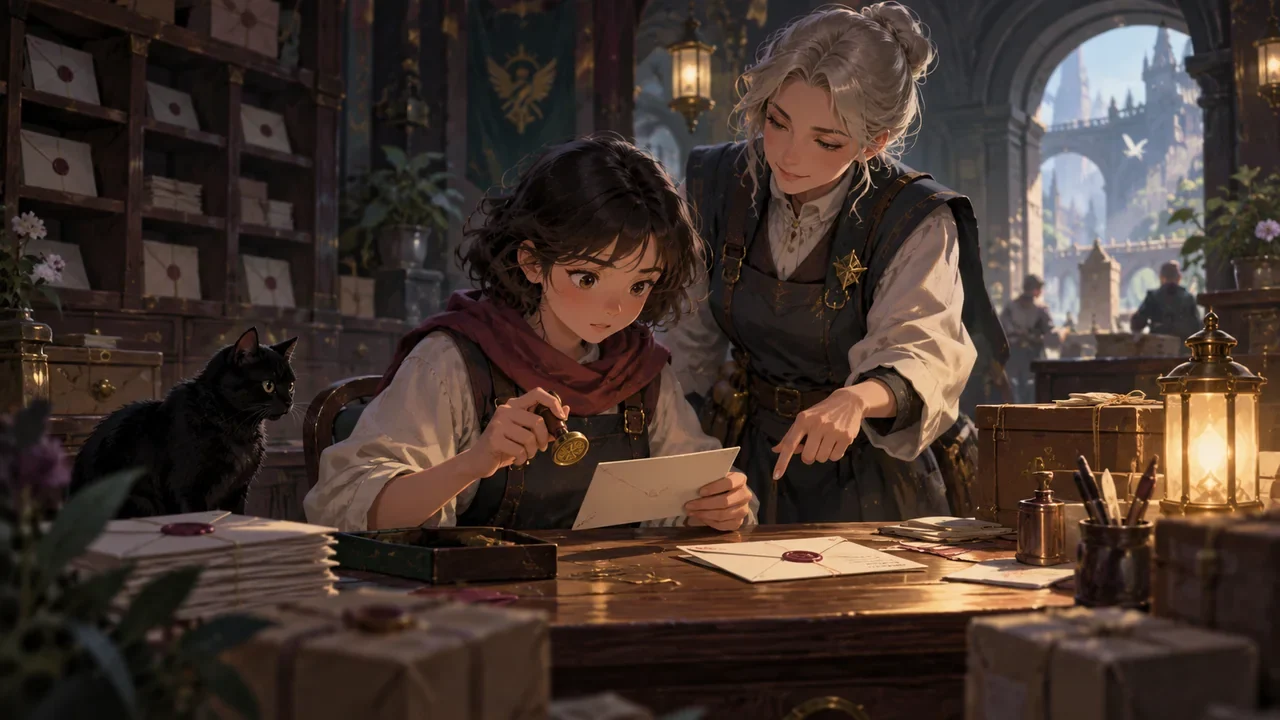
Suppose in your story, the player plays a newcomer who has just started working at a post office. The operation you need to teach is "check three fields on the document." Do not put all three fields out at once and let the player find them; instead, first require checking only the first one.
The dialogue can be written like this:
The old clerk behind the counter pushes over a document: "First look at the recipient's name, and see whether it is the same as what is written on the envelope."
The player sees two names: the document says "Lin Xiaoman," and the envelope says "Lin Xiaoman."
Options: A. Tell the old clerk "they match" B. Stamp it directly C. Check it again
Here, only the single action of "comparing names" is taught. Choosing A gets affirmative feedback, choosing B will be stopped by the old clerk with the explanation "you cannot stamp before the name has been checked," and choosing C is not punished, only repeating the comparison once. None of the three options causes the task to fail, and the player will not get stuck just because they clicked wrong the first time.
The key to this step is: one action corresponds to one feedback. The feedback must be specific to "what you just did and what the result was"; do not write empty phrases like "operation correct."
Step 2: Let the operation result enter the story, rather than stopping at a prompt box
After checking the name, do not pop up a "tutorial complete" prompt and end it. Let this action change what happens next.
The old clerk nods: "The name is right. Next look at the mailing date. The envelope says September 3, and the document says September 4."
The player discovers that the dates are inconsistent.
Options: A. Register according to the document's September 4 B. Register according to the envelope's September 3 C. Ask the old clerk which one should be used as the standard
If A or B is chosen, the old clerk will point out, "When the dates are inconsistent, you cannot choose one yourself; you must ask first"; choosing C advances the story, and the old clerk says, "Use the envelope as the standard; the document may have been copied incorrectly." What the player learns here is not "which date is correct," but the judgment "when encountering inconsistency, ask."
This separates operation teaching from story judgment. The former is "can you click, can you look," while the latter is "how do you decide when encountering disagreement." When the two are mixed together, if the player clicks wrong, you will think they do not know how to operate, but in fact they may just have a different judgment.
Step 3: Give a skip path, but skipping does not mean skipping the story
Some players do not want to check field by field. You can give an option to "ask the old clerk directly," letting them skip the manual comparison, but the story continues.
Options: A. Check item by item B. Directly ask the old clerk, "Is there a problem with this document?"
When B is chosen, the old clerk will say, "The dates do not match. Register according to the envelope first; I will go check the stub." The player did not perform the checking action, but learned the story information that "the dates are inconsistent." What is skipped is the operation practice, not the story task.
The skip path must clearly state the cost: the player misses one practice, and when encountering similar documents later, they may still have to face the same choice. Do not write it as "if you skip, you will never learn it," and do not write it as "skipping makes no difference at all."
Use a table to check your tutorial task
| Check item | Qualified performance | Unqualified performance |
|---|---|---|
| Number of actions | Only one action is required at a time | Simultaneously requiring checking name, date, and number |
| Failure consequence | Stopped, can retry, story continues | Task fails, return to the beginning |
| Feedback source | Character dialogue explains the result | Only pops up "operation error" |
| Relationship to story | The checking result affects subsequent registration | After the tutorial, the story starts separately |
| Skip path | Skips the operation but retains story information | Skipping equals skipping the entire story segment |
| Judgment distinction | Not knowing how to operate and different judgment are handled separately | Clicking wrong is judged as the player not knowing how |
Distinguish "not knowing how to operate" from "different judgment"
When the player chooses wrong, do not rush to add a prompt. It can be divided like this:
- If the player repeatedly clicks the same invalid position, or clearly says "I do not know where to click," that is not knowing how to operate, so give a more direct instruction once.
- If the player chooses among several valid options the one you do not recommend, that is a different judgment, so let the story give the consequence, and do not pop up an operation prompt.
In the post office example, if the player chooses "register according to the document date," it is not that they do not know how to operate; they understood, but judged wrongly. The old clerk points out the problem and the story continues, and that is enough. If the player chooses "check it again," it is also not that they do not know how; they just want to confirm, and repeating once does not deduct points.
Output limitations to note when AI is involved
If the tutorial dialogue is generated by AI, prompt constraints do not guarantee that every output is correct. You need to hard-code the feedback lines that must appear at key nodes, such as "the name matches" and "if the dates are inconsistent, ask," and do not let AI freely improvise these judgments. If the first feedback the player sees is unstable, the teaching becomes ineffective.
Completion check
After writing the tutorial section, walk through it yourself:
- Does the first attempt require only one action?
- After making a mistake, can it still continue, and does the story change?
- Does the skip path retain story information?
- Are there places where "different judgment" is treated as "not knowing how to operate"?
- Is the key feedback hard-coded and not dependent on AI improvisation?
If all five pass, this tutorial section is qualified. Next, you can take the earliest task in your existing story and rewrite its first action as story dialogue, changing only this one place first.