When Options Are Long and Players Forget the Previous One After Reading: First Unify the Comparison Order
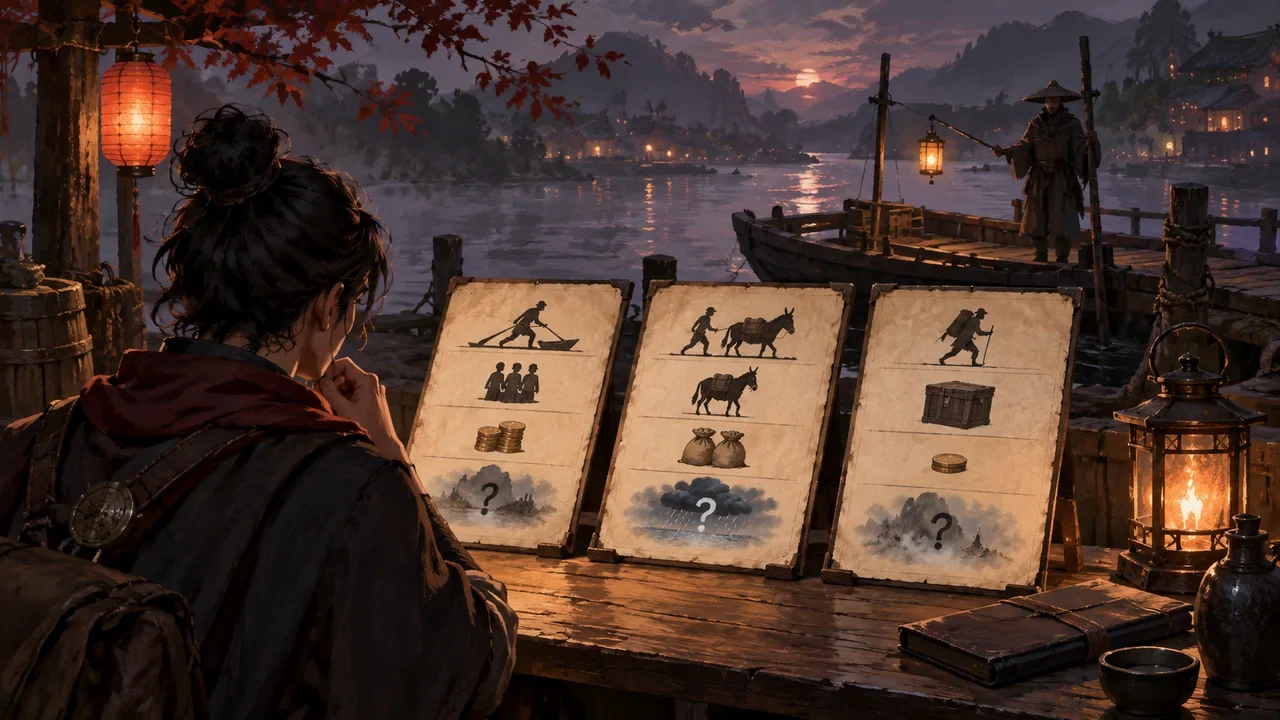
Arrange the three options in the same order: first write the action, then the object, then the known cost, and finally the uncertain result. Place the same type of information in the same position for each option, so readers have a fixed basis for comparison. Move background exposition outside the options, and keep risks within the corresponding action. Below, a fictional teaching example, "Three Options at the Ferry," goes through three rewrites, and a manual check method for reader retelling is provided.
Introduction
Arrange the three options in the same order: first write the action, then the object, then the known cost, and finally the uncertain result. Place the same type of information in the same position for each option, so readers have a fixed basis for comparison. Move background exposition outside the options, and keep risks within the corresponding action. Below, a fictional teaching example, "Three Options at the Ferry," goes through three rewrites, and a manual check method for reader retelling is provided.
First Set the Comparison Order, Then Write the Options
When players compare options, they are actually comparing four things: what I am going to do, to whom I do it, what I already know I must pay, and what I still do not know will happen. If each option scrambles these four things, readers have to relocate each item, and after reading later they naturally lose what came before.
The recommended order:
- Action: a short sentence beginning with a verb, explaining what the player will do.
- Object: who or what the action falls upon.
- Known cost: the payment or loss the player can already confirm at this moment.
- Uncertain result: the part not yet determined and revealed by later narrative.
The purpose of this order is to align similar information. Action against action, cost against cost, and players can compare horizontally at a glance. The uncertain result is placed last because it inherently cannot be compared and can only be retained as suspense.
Three Options at the Ferry: First Rewrite
Original wording (fictional teaching example, ferry scene). Previously the boatman has already said: the last boat will leave within half a shichen, and the exact time still depends on the water level; walking along the stone shoal takes one shichen, and the sky will darken after half a shichen. These are the known conditions shared by the three rewrites:
You can board the old boatman's ferry; he promises to take you across the river, but you must give him the copper bell you carry, and no one knows what is on the other side of the river; you can also walk downstream along the stone shoal, where the water is said to be shallow, but it is getting dark, and it is unclear whether anyone is waiting for you on the stone shoal; you can also return to the ferry hut and ask the night watchman about the boat; he will tell you some things, but he wants you to watch the fire for him for half a shichen first.
All three options are stuffed with background, cost, and uncertain results. Their lengths are similar, but after reading the third item, players often cannot clearly remember whether the first item's payment was the copper bell or something else.
The first rewrite does only one thing: unify the order.
Board the boat. The object is the old boatman. The known cost is handing over the copper bell. Uncertain result: what is on the other side.
Take the stone shoal. The object is the downstream shallow-water area. The known cost is walking for one shichen, and it will get dark along the way. Uncertain result: whether anyone is on the stone shoal.
Ask the night watchman. The object is the night watchman in the ferry hut. The known cost is watching the fire for him for half a shichen. Uncertain result: how much he will say.
Now each option has a consistent structure. But there is still a problem: the actions are too short, and the connection between object and cost relies on readers to fill in themselves; the cost of "Take the stone shoal" is darkness, and its relationship to the action is not direct enough. The second rewrite handles this.
Second Rewrite: Remove Repeated Background
All three options mention "ferry," "river," and "darkness." These are shared scene information and should not be repeated in every option. Move the background before the options as an independent passage:
At the ferry there remain only one ferry boat, one stretch of stone shoal, and one lamp in the hut. After half a shichen it will be dark, and the ferry boat will also leave during this time; walking the stone shoal takes one shichen.
Then the options write only their differences:
Board the boat. Give the copper bell to the old boatman in exchange for him taking you across the river. What is on the other side, he does not say.
Take the stone shoal. Walk along the downstream shallow-water area for one shichen, and it will get dark along the way. Whether anyone is on the stone shoal, you cannot see clearly.
Ask the night watchman. Spend half a shichen watching the fire for him in exchange for him telling you about the ferry boat. How much he will tell, he does not guarantee.
Background is explained in one place, and the options retain only the reminders needed for the action, without repeating the entire ferry scene. Each item still retains action, object, known cost, and uncertain result. Whether a clear "cost-suspense" pairing has formed requires the later retelling check; it cannot be assumed just because the sentences became shorter.
Here there is a tradeoff: after removing the background, the options may seem to lack information when viewed alone. If the options will be quoted or displayed alone, the background cannot be completely moved away. The criterion is whether the options always appear together with the scene narration. In the ferry example, the options appear together with the scene, so the background can be moved outside.
Third Rewrite: Keep the Risk, Do Not Pursue the Shortest
After the second rewrite, some people will want to delete "he does not say," "you cannot see clearly," and "he does not guarantee" to make the options shorter. This would delete important risk: players need to know which results are unknown in order to judge whether they are willing to bear them.
The third rewrite does not delete the uncertain results, but writes the known costs more concretely, making the risks comparable:
Board the boat. Give the copper bell to the old boatman in exchange for him taking you across the river. What is on the other side, he does not say.
Take the stone shoal. Walk along the downstream shallow-water area for one shichen; along the way it will get dark, and you will also miss the ferry's last boat. Whether anyone is on the stone shoal, you cannot see clearly.
Ask the night watchman. Spend half a shichen watching the fire for him in exchange for him telling you about the ferry boat; if you wait until the fire-watching ends before going to take the boat, the last boat will already have left. How much he will tell, he does not guarantee.
Now the known costs of all three options can be inferred from the conditions: hand over the copper bell; spend one shichen and miss the ferry; watch the fire for half a shichen and miss the ferry. The uncertain results are still retained: what is on the other side, whether anyone is on the stone shoal, and how much he will tell. "May have left" should be classified as risk and cannot be mixed in as a certain cost; in this example, the latest departure time is given, so it can be written as a definite miss.
Reader Retelling Check
After revising, find a reader who has not read this passage, have them read the three options once, then close the text and retell each option in their own words. Check three things:
- Whether they can state the action and object of each option;
- Whether they can state the known cost of each option;
- Whether they remember at least one uncertain result.
If they get stuck at the second item, or assign the first item's cost to the third item, it means the order is still not unified, or the background is still repeated in the options. This check requires no tools and no statistical sample; one or two readers can expose arrangement problems. Note that this is a manual check, not effect validation; the reader's retelling only shows whether the text is easy to remember, not which option players will choose.
Completion Check
Before delivery, confirm item by item:
- Whether three or more options use the same order: action, object, known cost, uncertain result;
- Whether shared background has been moved outside the options, and the options can still be understood independently;
- Whether known costs are concrete enough to be confirmed and have not been compressed into vague words;
- Whether uncertain results are retained and have not been deleted for brevity;
- Whether a reader retelling check has been done once, and the place where they got stuck has been recorded.
If any item is not satisfied, first change the order, then change the background position, and only lastly consider deleting words. Length is not the goal; comparability is.