A Player’s Guess Is Not a Character’s Conclusion: Writing a Deduction Check
Turn a guess into a prediction stated in advance, define the conditions for a valid check, and let the observed result determine how far the conclusion can go. Use a deduction check card to write rounds where a guess proves right, proves wrong, or remains inconclusive.

Turn “I’ve figured it out” into “How do we check?”
When a player guesses what a coded message means, a character can acknowledge that the interpretation is worth trying, but should first propose a check with an observable result. A complete round goes like this: state the guess, agree on what should happen if it is right, perform the check, and revise the conclusion according to the result. The check lets players take the step from interpretation to evidence themselves.
For example, if a player says, “‘Three sounds’ means three strikes of the clock,” the character might reply, “If it means the chiming clock, what should change at the west cabinet when the third chime ends?” This turns a verbal association into a question the story can answer and identifies what to observe.
The post office, west cabinet, coded message, and dialogue below are all fictional teaching examples. They are not real user cases, measured test results, or product features. The check card is for authors to plan scenes manually; it does not mean the platform automatically verifies deductions.
First, define the scope of the conclusion: this check concerns the condition for opening the cabinet indicated by the message. Who owns the items inside and who left the message remain separate questions. Opening the cabinet successfully does not also prove that the missing-person case is solved.
Give the same message two distinguishable interpretations
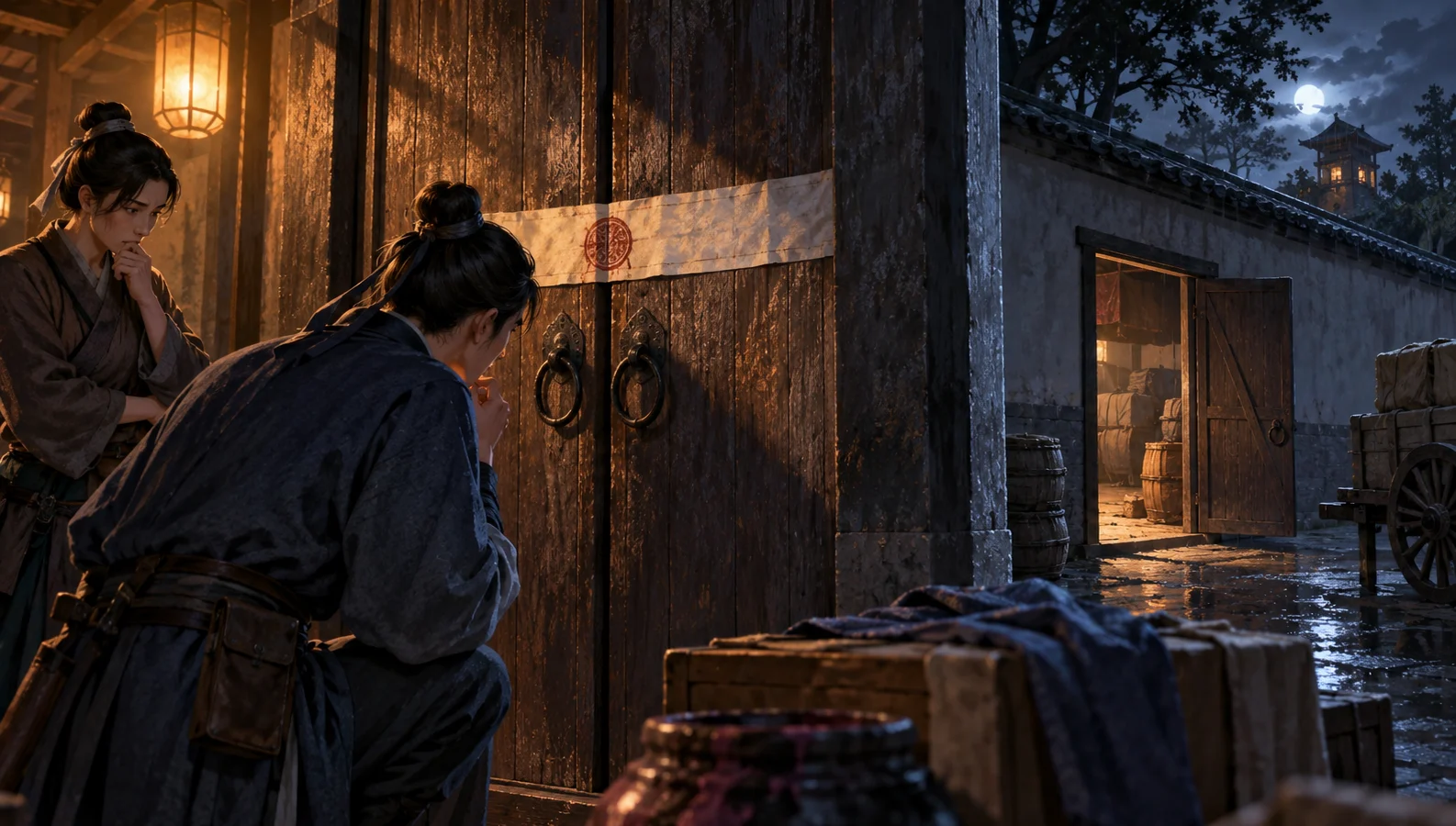
The scene takes place in an old post office that is no longer in operation. The player and its caretaker, Aran, find a note: “Three sounds, west cabinet opens.” The story has already established that the hall clock always chimes three times on the hour, regardless of the hour; a brass ring is mounted on the west cabinet’s door, with three short marks carved beside it; and the door is currently latched shut. Aran knows the old cabinet was once repaired, but does not know how to open it.
The player’s first guess is, “The cabinet opens when the clock strikes for the third time.” Another interpretation is to knock on the door three times in succession using the brass ring. The chimes fit “three sounds,” while the ring and marks support the knocking interpretation, but both are still only interpretations.
The author should fix the solution and feedback before the check takes place. In this example, three consecutive knocks release the door’s latch, making it spring outward a crack; ordinary clock chimes do not trigger it. This is a fictional rule, not an explanation of how real locks work. The author must not make the chimes a correct answer on the fly just because the player chose them.
The two interpretations should lead to distinguishable predictions. If both actions produce nothing more than Aran saying, “Something seems to have moved,” players will struggle to compare them. Here, the feedback is whether the door opens a crack, and the two actions are performed separately to avoid mixing their effects.
Use a check card to define the criteria in advance
You can replace the location, message, and actions on this card, but the conditions for the check must match the scene’s rules. Start by writing the guess and prediction, then finish by limiting what the character can claim.
| Field | First round in this example |
|---|---|
| Guess to check | “Three sounds” means the clock’s third chime |
| Existing evidence | The note says “three sounds”; the hall clock always chimes three times on the hour |
| Competing interpretation | “Three sounds” means three knocks on the door with the brass ring |
| Testable prediction | When the third chime ends, the west cabinet’s latch releases and the door springs outward a crack |
| Verification action | Wait for the next hour and watch the door continuously from before the chimes begin until the third one ends |
| Conditions for a valid check | The door starts latched shut; the clock completes all three chimes normally under the established rule; nobody touches the door or knocks with the ring at any point during the check |
| Supporting result | The door springs open a crack after the third chime |
| Non-supporting result | All conditions are met, but the door remains latched after the three chimes end |
| Inconclusive | The clock stops or fails to complete its three chimes normally, or someone touches the door or knocks with the ring at the same time |
| Limit of the conclusion | Judge only whether this instance of the clock chiming can directly open the cabinet |
“Inconclusive” is the easiest entry to overlook. If the clock fails to complete all three chimes normally, that does not establish that the clock interpretation is wrong. If someone pulls the door at the same time, its opening cannot be attributed entirely to the chimes either. Distinguish a failed prediction from a check that was not validly completed.
The prediction must also be communicated to the player beforehand. If you show an ambiguous animation first, then say, “That little puff of dust meant you were right,” the criterion becomes an after-the-fact patch. You can use the door opening a crack, the sound of the latch, or a clock hand’s position, but you cannot change the criterion after seeing the result.
Write failure as a complete round that moves the story forward
The first round might play out like this:
Player: “‘Three sounds’ means the clock’s third chime.”
Aran: “This clock chimes three times on the hour. Let’s wait for the next chimes. First, make sure the cabinet is latched, and nobody touch the door or the brass ring. We’ll see whether it opens a crack after the third chime ends.”
The hour arrives, and the clock completes its three chimes normally. The camera stays on the cabinet door. Nobody touches it at any point, and it remains latched.
Aran: “Those chimes didn’t open it directly this time. That doesn’t support the idea of opening it with the chimes.”
Player: “Then could those three marks mean we should knock three times with the brass ring?”
Aran: “Let’s wait until the chimes are over. The door is still latched, and the ring is intact. This time, just knock three times without pulling the door, and see whether it opens a crack.”
Failure provides specific information: the conditions for a valid check were met, yet the expected change did not happen. Aran neither tells the player they were “completely wrong” nor reveals the correct action. Instead, she lets the player continue comparing the clues already available.
In the second round, the player knocks three times in succession with the ring, and the door springs outward a crack. Aran can say, “The latch released after those knocks. Reading the message as three knocks with the brass ring explains what we just saw.” Then she hands the next action back to the player: “Open it now, or check behind the door first?”
That conclusion is enough to move forward with opening the cabinet, but it does not rule out every coincidence. If a later decision requires stronger confirmation, the author can plan a repair note inside the cabinet that explains the connection between knocking and the latch. A short puzzle can retain the qualification “supported for now.” The length of the verification should be proportional to how much later decisions depend on it.
Change the action to address the cause of failure; do not rely on a character’s assurance
If the player does not want to wait for the clock, they can inspect old chiming records, but those records must cover changes to the cabinet door to help evaluate the guess. Merely proving that the clock chimed in the past cannot replace checking whether it opens the cabinet. Knocking with the ring immediately is faster, but success supports the knocking method; it does not justify claiming that the clock method has been checked.
If the brass ring is broken, the second round should be inconclusive, and the player can turn to repair records that have already been shown. If the cabinet door is already open, opening it no longer distinguishes between interpretations, so another observable result is needed. A character must not declare success for a check that never happened.
Different kinds of evidence also need to be distinguished. Aran agreeing with a guess only means she accepts trying it. The note’s author acknowledging the message’s meaning is testimony. Performing an action and seeing the door open is an observed result. These can complement one another, but the writing must make clear what each step adds.
Before submitting the script, circle phrases such as “just as expected,” “definitely,” and “case solved.” Ask of each sentence: what evidence has the character just gained? Does it support the operating method, the message’s meaning, or someone’s identity? If the claim does not match the evidence, narrow the conclusion or add the necessary check. Finally, leave the player with an action prompted by the result, so that confirmation truly changes the story.