What Is *Soulsky: The Other Shore*: A Chinese-Style Interactive Film-Game Where Players Investigate Cases, Audit Accounts, and Change Fate
Learn about the world setting, investigation gameplay, eight key characters, and interactive design of *Soulsky: The Other Shore*, and how it differs from ordinary click-to-choose short dramas.
Introduction
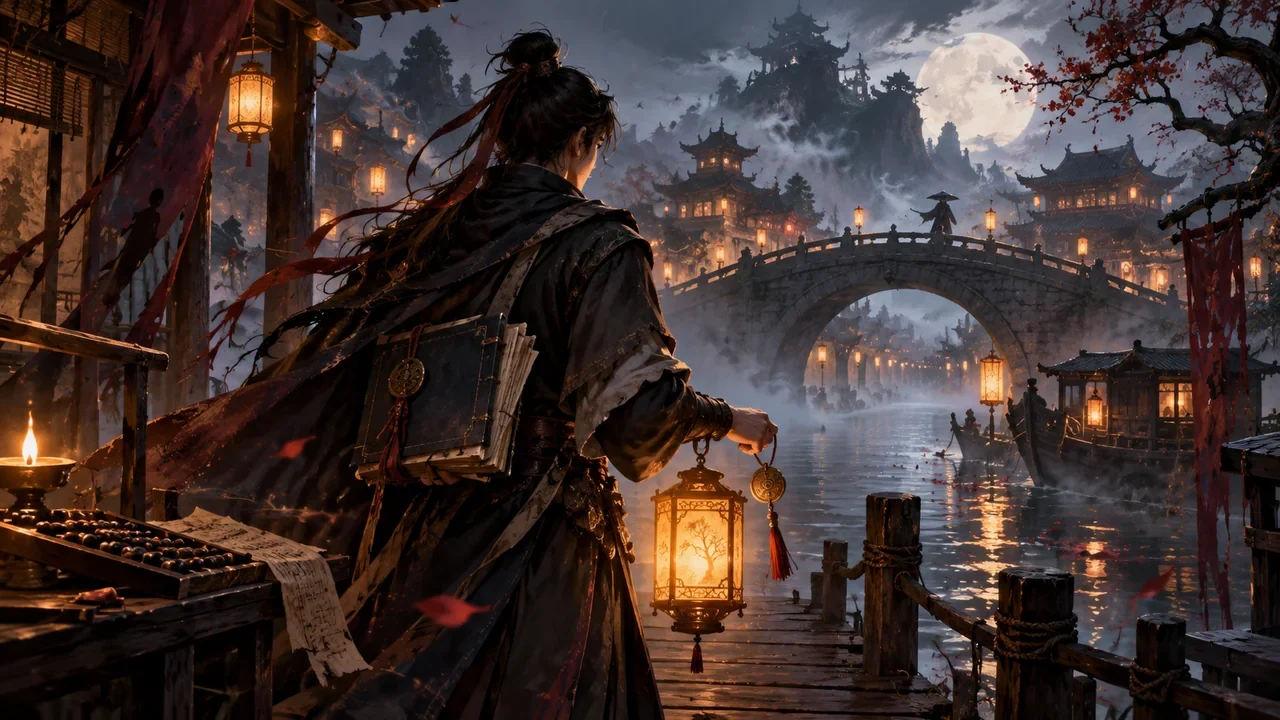
Soulsky: The Other Shore is a Chinese-style fantasy suspense interactive film-game. Players follow Shen Jin, a “person without source code,” as he investigates the life-stripping case. In a world on the Other Shore where soul lamps, the ghost market, the old underworld office, and cyber order overlap, players judge testimony, trace ledgers that have been rewritten, and use choices to change relationships and the direction of fate.
Simply put, what it wants to create is not “watch a video segment and click a button once,” but a story jointly shaped by the order of investigation, character trust, and the consequences of choices.
Who this game is for
If you like narratives with complex character positions, clues that need cross-verification, and choices that leave consequences behind, Soulsky: The Other Shore is worth watching. Its currently public focus is suspense investigation, world rules, and character relationships, rather than high-frequency combat or fully free generation.
Why players need to investigate cases, audit accounts, and change fate
“Investigating cases” begins with a corpse that cannot die, the chip Su Yi left behind, and the white life-stripping line. What players face is not a neutral explanation, but different accounts from witnesses, enforcers, and traders.
“Auditing accounts” points to the power structure of the Other Shore. Life contracts, commissions, and death records determine who is recognized and who is erased; the real suspense is not only who did what, but also who is qualified to write the truth.
“Changing fate” is the interactive part. The directions disclosed on the official website include branching fate, dynamic decisions, and relationship bonds. Whether the complete version fulfills these promises still needs to be tested through routes, reloads, and ending differences.
The eight characters are not eight identity cards
The currently revealed characters include Shen Jin, Su Yi, Little Runner, Bai Qi, A-San, Red Lady, Ox-Head, and Horse-Face. The most practical way to understand them is to treat each person as a piece of testimony with interests attached: what they know, what they hope Shen Jin will believe, and what they stand to gain from this version of the truth.
Ox-Head and Horse-Face represent enforcement and account verification respectively, Red Lady controls lifespan trading, A-San controls passageways, and Bai Qi is still carrying out the life-stripping order. The value of character relationships should not be only affection levels; it should determine who is willing to testify, which clues open up, and who is willing to bear the cost at critical moments.
How it differs from ordinary click-to-choose short dramas
| Dimension | Ordinary click-to-choose content | The public direction of Soulsky: The Other Shore |
|---|---|---|
| Choice | Switches to the next video segment | Changes information, relationships, and routes |
| Characters | One-off dialogue or affection | Remembers relationships and hidden clues |
| World | Shots are fixed in advance | The situation and environment respond as progress is made |
This table describes design goals, not third-party hands-on conclusions. There is only one real criterion for judgment: after the player makes a choice, whether the subsequent world remembers it in an understandable way.
What can be seen so far
The official website has already disclosed the world setting, eight characters, and chapter information such as Bloody Strange Plot, Broken Trace of the White Line, Life Contract Black Market, Gray Web Commission, and Dispatch Order Endgame. Test devices, eligibility, and access scope may change, so refer to the announcements for the relevant period.
To judge whether this work suits you, you can first browse the character and chapter materials on the official website, then reserve a test slot through the public entry point. After the experience opens, what is most worth verifying is not the number of buttons, but whether choices truly change information, relationships, or costs.
Entering the entire world through one case, instead of reading a setting encyclopedia first
The way Soulsky: The Other Shore brings players in deserves separate explanation. Many fictional worlds cram large amounts of history, factions, and terminology into the opening; before players have formed questions, they are asked to remember answers. The publicly disclosed chapter structure of this work takes the opposite order: it first lets Shen Jin encounter an inexplicable corpse, chip, and life-stripping marks, then uses those specific anomalies to introduce the ghost market, life contracts, and the old underworld office. The world setting is not a background wall, but the rules that make the case possible.
This design has two benefits for new players. First, you do not need to understand the entire “Other Shore system” in advance; you only need to follow the evidence in front of you. Second, every rule you learn immediately produces new suspicions: if death can be entered into accounts, who can modify the records? If lifespan can be traded, is the transaction voluntary? If Shen Jin has no source code, why can he still be recognized by the system? The suspense therefore expands from “finding the culprit” to “judging whether the order itself is trustworthy.”
How to judge before reserving, without waiting for reviews
First, see whether you accept three experiential orientations. First, the story will ask you to read character positions, not only look at action outcomes. Second, Chinese-style imagery and cyber rules will appear at the same time, so the aesthetic is not a replication of traditional strange tales. Third, the value of interaction depends on whether consequences are delivered, and the final quality must wait for verification in an actual version.
You can also enter the test with a four-item observation checklist: whether the first key choice has enough information; whether there is immediate feedback after the choice; whether old decisions are mentioned later; whether another route provides new information. Only when all four hold true has the work really completed the leap from “video content” to “interactive narrative.”
Three questions about Soulsky: The Other Shore most worth continuing to watch
First, can the order of investigation change the player’s understanding of characters, rather than merely adjust the arrangement of shots? Second, does the relationship system allow trust, use, and jointly bearing costs, rather than single-axis affection? Third, do endings come from states that run throughout the entire experience, rather than being decided by the final button press? The official materials have already set out the direction; what the open test needs to do is verify whether those directions are implemented.
Sources
- Official website of Soulsky: The Other Shore (world setting, interactive experience, characters, and chapters; checked: 2026-09-22)