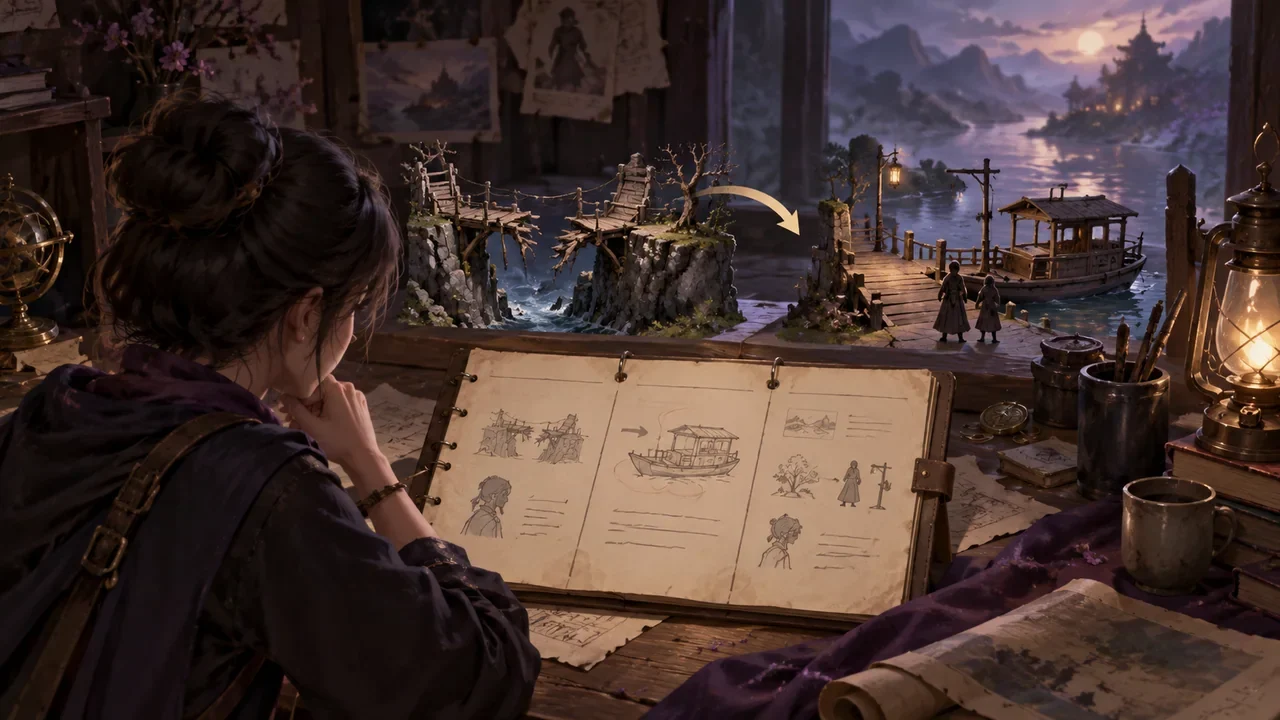
《魂天·彼岸》: Eight Key Characters, Public Identities, and Relationship Clues
Using the official website’s public character guide, this article examines the identities, positions, interests, and observable relationship clues of eight key characters in 《魂天·彼岸》.

Introduction
Understanding the characters in 《魂天·彼岸》 should not begin with labeling them as “good people or villains.” A more reliable approach is to look at three things: what responsibilities they hold within the order of the Other Shore, what identities the official website has disclosed, and what relationship clues this information might suggest.
This article uses only identities publicly disclosed on the official website. It does not judge who is lying or trustworthy, or speculate about hidden factions or relationships tied to endings. Readers can use it as a spoiler-free character index before entering the ensemble story.
Where the Eight Characters Stand
| Character | Public Position | The Question Most Worth Asking |
|---|---|---|
| Shen Jin | A person without source code; the investigative viewpoint | How does his erased origin relate to the case? |
| Su Yi | Witness to the wrongful-death ledger | Is the information she left behind complete? |
| Little Errand Runner | Street witness from the Lower City | Is withholding information a lie, or a way to stay alive? |
| Bai Qi | Executor of lifespan-stripping orders | Does he know where the orders come from? |
| A San | Guide to the Ghost Market | Does he only guide people, or also decide who can pass? |
| Red Lady | Trader at the Red Lifespan Shop | Does she weigh lifespan, price, or value? |
| Ox-Head | Martial judge of the old underworld administration | Are the rules being enforced still just? |
| Horse-Face | Civil judge who audits ledgers | Is the ledger being verified itself reliable? |
Three Key Relationship Groups
Shen Jin and Su Yi connect personal identity with evidence in the case: her records help him investigate the ledgers, while his unusual identity may also explain why records are erased.
Little Errand Runner and Bai Qi represent survival-driven testimony and order-driven action, respectively. The former may tell only part of the truth out of fear; the latter may cause harm without having full authority to exercise judgment.
A San, Red Lady, Ox-Head, and Horse-Face control passage, trade, enforcement, and ledger verification. Help does not equal unconditional goodwill, and order does not equal fairness.
How to Distinguish Facts from Characters’ Claims
Public information is insufficient to support the conclusion that “someone is absolutely trustworthy.” A relationship diagram should divide information into three layers:
- Confirmed facts: directly shown on the official website or in the game;
- Characters’ own accounts: statements made by characters without independent evidence yet;
- Reader speculation: interpretations that may change with the order of investigation and shifts in relationships, and must not be presented as facts about characters.
A truly trustworthy character is not necessarily someone who never lies. What matters is whether their statements, actions, and the costs they bear corroborate one another.
How to Draw a Relationship Diagram
Place Shen Jin at the center. Use solid lines for confirmed connections, dashed lines for transactions or temporary cooperation, two-way arrows for trust that can change, red markers for conflicting testimony, and lock symbols for undisclosed identities. This allows readers to understand relationships without having speculation spoil the story in advance.
A Relationship Diagram Must Show More Than “Acquainted or Unacquainted”
Relationships in interactive mysteries have at least four dimensions: who gives information to whom, who can command whom, who exchanges resources with whom, and who is willing to take risks for whom. Even two people who have never met directly may be causally connected through ledgers, commissions, or orders. Conversely, characters who frequently appear together may not trust each other.
A relationship diagram should therefore not draw every connection with the same type of line. Information relationships can indicate the direction of testimony; power relationships can use one-way arrows; transactional relationships can specify what is exchanged; and trust relationships should remain states that can change with player choices. Readers will then see a diagram they can use for investigation, rather than a collage of character posters.
A Four-Step Method for Assessing Character Credibility
First, distinguish what a character “knows” from what they “believe.” Second, look for motives to conceal information. Third, check whether their statements agree with their actions, objects, and third-party records. Fourth, observe what telling the truth would cost them. Testimony that comes with a willingness to bear a cost usually carries more weight, but it still does not automatically equal the complete truth.
This method also explains why a character’s lies do not necessarily make them a villain. Little Errand Runner may conceal information to survive; an enforcer may sincerely believe an erroneous order; a shopkeeper may be honest only about the transaction. The pleasure of interactive storytelling comes precisely from the fact that “credible motives” and “correct facts” are not the same thing.
What Narrative Function Each of the Eight Characters Serves
Shen Jin provides the investigative objective and the mystery of identity; Su Yi gives erased records a human cost; Little Errand Runner represents the Lower City’s rules of survival; and Bai Qi turns abstract orders into harm. A San controls the routes into spaces of information; Red Lady turns lifespan into a price; Ox-Head embodies enforcement authority; and Horse-Face embodies the authority to interpret and verify ledgers.
These functions are not plot truths, but a reading framework based on public information. Only relationships explicitly shown on the official website can be drawn as factual connections; speculation, twists, factions, or ending conditions should not be added prematurely just to fulfill the title.
How Character Relationships Affect Player Choices
When players decide whom to believe, the actual changes may occur on three levels: which clue they obtain immediately, who is willing to continue cooperating later, and who can ultimately authenticate a particular record. A good relationship system allows small early choices to turn into testimony, assistance, or refusal later. If a choice only changes a form of address, it should honestly be described as localized feedback, rather than “changing destiny.”
Sources
- 《魂天·彼岸》 Character Guide and World Setting (Verified: 2026-09-22)
The Final Step in Reading a Relationship Diagram
Do not only remember who is close to whom. Also record why a relationship changes, who witnesses that change, and at which later point it will be read by the system. The same words of help may increase trust while reducing obedience. Separating changes across multiple dimensions makes it possible to understand character conflicts without reducing characters to affection scores.