How to Write a Character with Two Identities: Where Can the Story Go After the Reveal?
Does your story stall after “It was you”? An original theatre collaboration shows how an identity reveal can change old conversations, disclosure, and future plans.

Introduction
“So the person who reads letters every night was you.”
The other person admits it, the player is surprised, and the music stops. Then what? Many stories about characters with two identities abruptly revert to a conventional romance here: misunderstandings are cleared up, affection rises, and all the awkwardness that came before seems to have existed only to await this reveal. The identities have come together, but the relationship has not really moved forward.
Try establishing “who he is” as a definite fact first, then ask: now that the player knows, what are they still willing to confide in him? Which promises does he need to clarify? The story that follows often lies in these small questions that do not readily lend themselves to a musical score.
Give Them Something Unfinished to Do After the Reveal
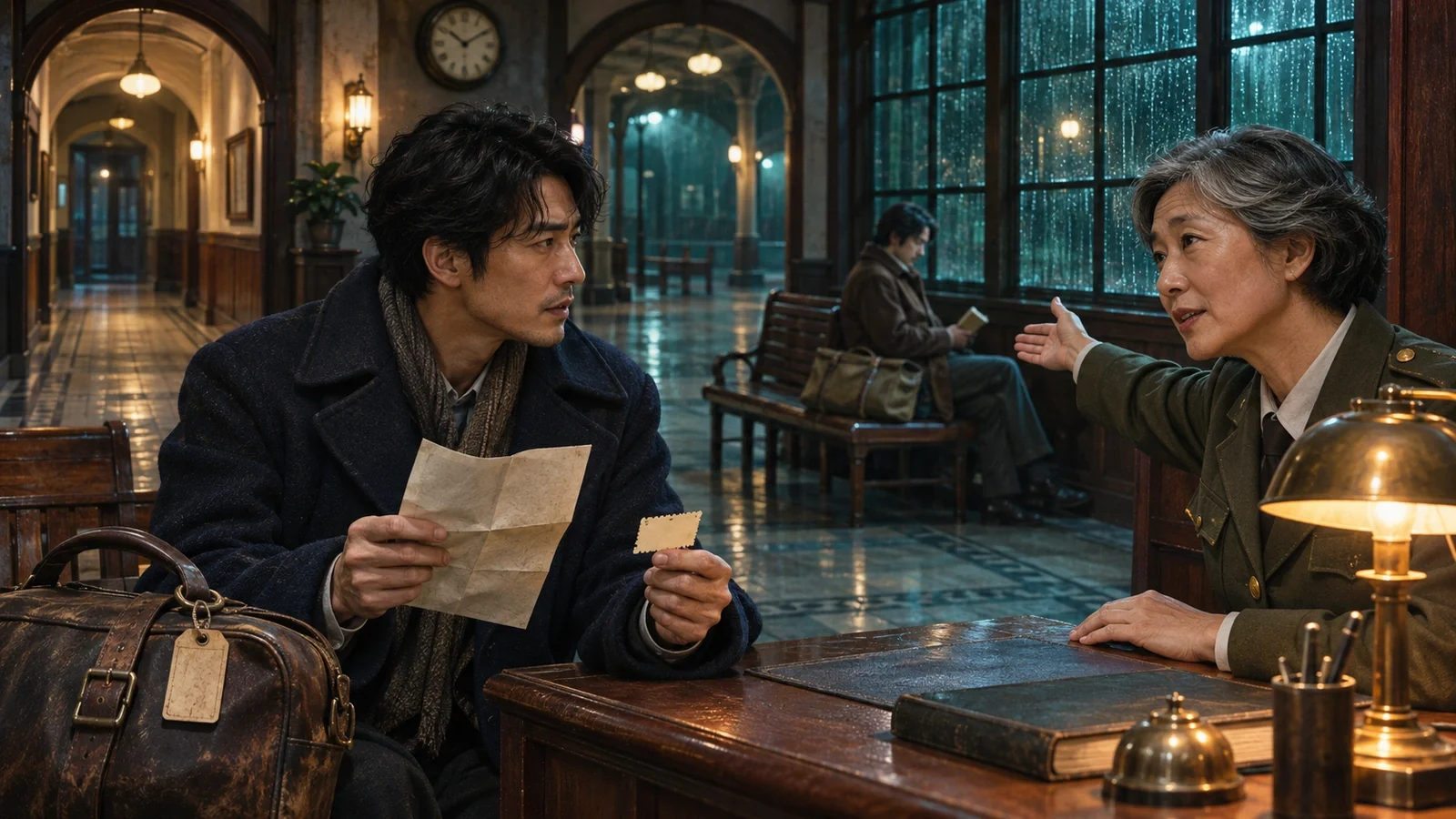
Here is an original teaching scene. Yu Heng is a prop designer at a small theatre who also appears on a nighttime letter-reading show as the virtual persona “Mist Lamp.” The player is an adult collaborating on this show and once told “Mist Lamp” about a disappointment at work without knowing his real identity. Neither is the other's subordinate, and they are not already in a romantic relationship.
After rehearsal, Yu Heng admits face to face: “I'm Mist Lamp.” But recording is not finished, and the end credits have not been settled. He had intended to ask about proofreading next, but the player may no longer be able to sit back down at the table as before.
Keeping unfinished work in the scene gives the relationship something concrete to turn on. The player can discuss that private conversation first, simply finish the show, or ask to pause. Not every route has to resolve personal feelings before work can continue.
Once the Names Match, Past Conversations Cannot Acquire Different Memories
Being more responsive onstage and somewhat reserved backstage can be two ways the same person expresses himself. His quick wit onstage need not be entirely an act, and his silence backstage is not necessarily more authentic. The writer needs to decide which situations make it easy for him to speak and which subjects make him evasive.
What must remain consistent is what has already happened. When the player mentions that disappointment, Yu Heng cannot suddenly say, “Mist Lamp heard that. I don't know about it.” If the premise is that he personally took part in that conversation, changing his avatar or name cannot erase the memory.
Conversely, do not give him knowledge of things that never happened. If the player privately suspected him for three days but never asked, the character cannot describe those three days as a shared experience of keeping a secret together. For examples of how to distinguish identity, the player, and the current scene, see Why Does the Character Keep Speaking for the Player?.
Separate Performance, Promises, and Private Explanations
“I'll always be here” might be a closing line addressed to everyone watching the show. Whether it means he is willing to receive a private request for help in the early hours depends on what the two of them actually said at the time. The writer cannot wait until after the reveal to supply an improvised explanation.
If Yu Heng explicitly promised, “Tomorrow night, I'll listen privately until you've finished,” he cannot later reclassify it as a line addressed to the audience. The player has reason to question him about that specific incident, rather than receive only “Both my onstage and offstage selves are the real me.”
This also gives the character room for an unflattering but credible answer: “I made that promise. I didn't follow through. As for whether I can next time, I don't want to make another promise casually.” Admitting to one broken promise does not mean the relationship must end; the player's willingness to keep talking does not mean they have already forgiven him.
Knowing the Truth and Having Permission to Disclose It Are Different Things
Yu Heng choosing to tell the player does not mean he has agreed to have his real name included in the show's description. The player having told “Mist Lamp” about a disappointment does not mean that private conversation has been approved for use as performance material.
At this point, you can keep three lines of author notes instead of giving everyone the same “revealed” flag:
| What to Track | What Has Already Happened | What Cannot Also Be Assumed |
|---|---|---|
| Identity facts | Yu Heng has personally admitted that he is Mist Lamp | The other collaborators already know too |
| Use of private conversation | The player told him about a disappointment at work | It may be quoted in the show or publicity |
| End credits | The form of the credit has not yet been agreed upon | The player nodding and continuing rehearsal means they consent to public disclosure of his real name |
This table is a way for the writer to organize the plot. It does not mean the website will automatically determine permission or check every line of dialogue for you. If you need to design how the player gradually obtains information, see How to Design Fair Information Gaps in Text Games. This article continues from the moment when both people already recognize each other.
Give the Player Different Routes, Not Just a Change in Tone
The same sentence, “Let's finish the show first,” can mean different things. The player may still be willing to collaborate while leaving personal feelings undiscussed for now. They may also be willing to get to know Yu Heng anew, but require that passages which could make people think of them be removed first. These distinctions need to take effect in the actions that follow.
Make the next step more concrete: finish recording with only the stage name in the credits; pause recording to confirm which past remarks cannot be quoted; or end this collaboration and hand over the completed proofread draft as agreed. Do not lead all three options into the same embrace and leave their differences to an affection score.
Ending the collaboration can also be a complete ending. If the materials are handed over properly and private content is not used without permission, the two people not growing closer does not mean the player “chose wrong.” Whether romance develops should depend on clear invitations and responses later, rather than treating knowledge of an identity as automatically granting an intimate relationship.
After Branches Merge, Let Names and Documents Remember the Decision
There is nothing wrong with several routes eventually returning to a review of the end credits. What matters is that the document on the table changes to reflect the earlier decision: if the stage name was agreed upon, keep it; if no agreement has been reached, leave a blank; private conversation that has not been approved for use should not become a surprise Easter egg at the last moment.
Yu Heng's response will differ too. If the player only wants to discuss work, he keeps the new topic focused on the proofread draft instead of announcing on the player's behalf that “they've actually softened already.” If both agreed to talk after the performance, he can remember that arrangement without treating the conversation as already completed. To check for omissions where branches merge, work through the methods in How to Preserve Player Choices When Branches Merge.
Start Checking with the First Line After the Reveal
Once you have finished writing, return to the page after “I'm Mist Lamp.” Are the things the player can do now genuinely different from what they could do before the reveal? Can they still question what was said in the past? Do continuing, pausing, and leaving each have observable consequences?
There is no need to rush the character into explaining his entire life. Let him first hand over the name card for the end credits, whose wording is still undecided and ask, “For the end credits, can we do what we just agreed?” When the player has room to answer, the next stage of the relationship has room to begin.