Designing Interaction for a Fictional Clock Exhibition: Three Narrators, One Exhibition Label
The mechanic cares whether the clock can keep running, the collector values the history left by changes, and a family member remembers how its chimes shaped daily life. An evidence and label decisions table brings these meanings into one exhibit while preserving their sources and limits.
First, Decide Which Sentence on the Exhibition Label the Interaction Will Change
When three people tell stories about the same clock, visitors can help write its public exhibition label: what counts as shared fact, what needs attribution, which meaning belongs on the main label, and what stays in the extended reading. The choice concerns how to allocate limited display space, rather than voting for the one trustworthy person.
This article presents an original teaching design. The clock, people, records, and interaction paths are all fictional. The design is not a real user case study, does not report tested results, and does not describe DramaFork product features. Here, “facts” refers only to the materials stipulated for this case; these do not constitute knowledge for authenticating real clocks.
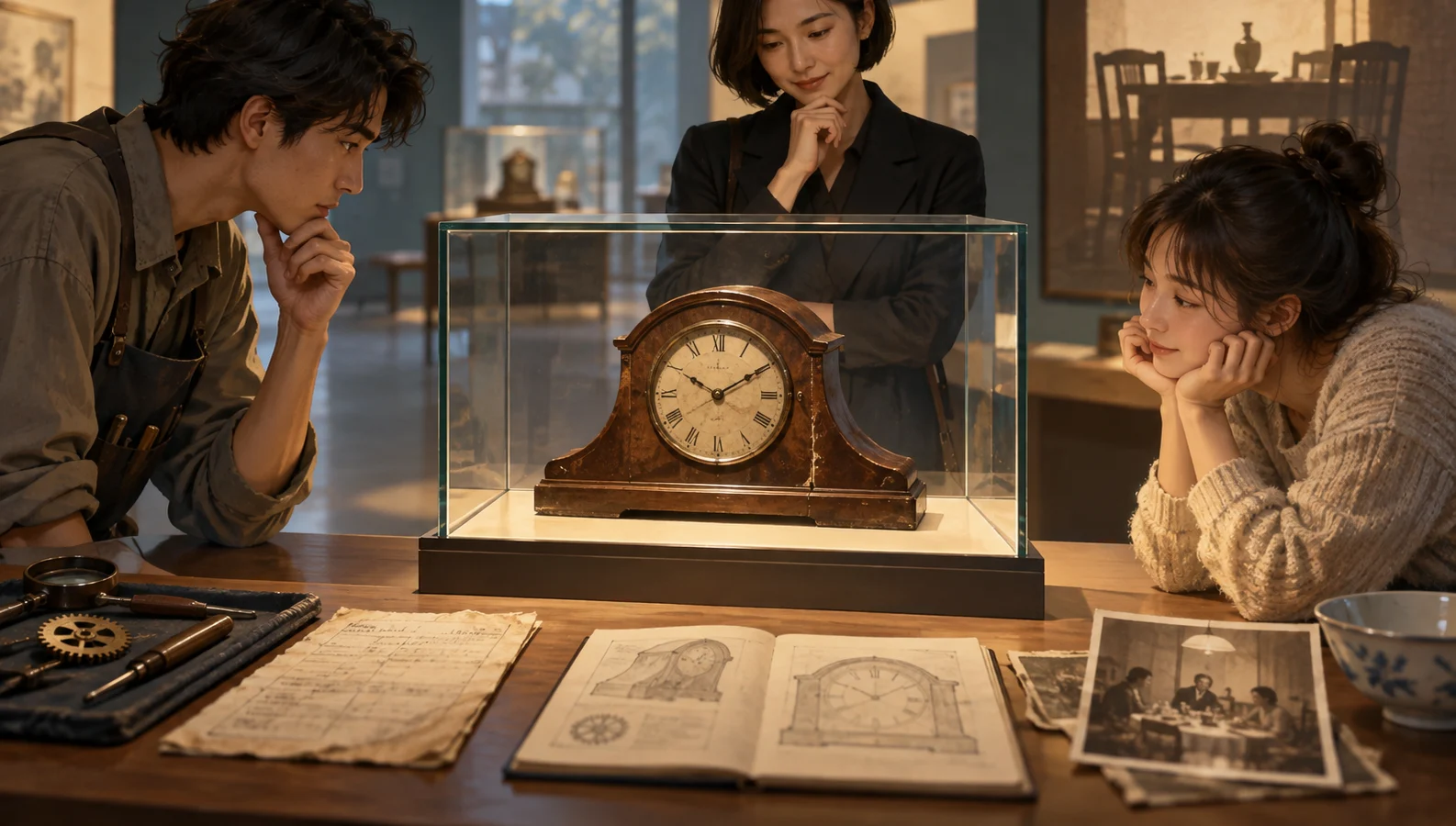
The exhibit is called the “Waiting-for-Dinner Clock.” In this fictional case, it has a wooden case, a crack on one side, and one replacement gear. A repair slip records the gear replacement but gives no reason for it. The mechanic, Chen He, wants visitors to understand restoration work; the collector, Xu Yan, wants to preserve traces of changes; and the family member, Zhou Ning, wants to explain the clock’s former role in everyday life.
The visitor’s task is to write a short display-case label containing facts, attributed interpretations, and an explanation of the editorial choices. Once it is finished, others should be able to see what the object is, who gives it which meanings, and what the main label leaves untold.
Turn Shared Facts and Personal Meanings into Reusable Records
Start by making an “evidence and label decisions table.” Its purpose is not to collect more memorable quotations, but to define the limits of what each statement can say publicly. The same fields can be used for exhibitions of letters, furniture, or toys.
| Material and narrator | What the label may say | What cannot be inferred | Display location |
|---|---|---|---|
| Object observation card | There is a crack on the side of the wooden case | Moving house caused the crack | Shared facts section |
| Fictional repair slip | One gear was replaced | The clock had stopped when the gear was replaced | Shared facts section |
| Chen He’s account | He interprets the replacement as a way to extend the clock’s use | Every restoration should prioritize restoring operation | Attributed interpretation section |
| Xu Yan’s account | She values the historical traces left by changes | Replacement necessarily reduces an object’s value | Attributed interpretation section |
| Zhou Ning’s memory | The chimes once reminded the family to prepare dinner | Every family member remembers it in exactly the same way | Attributed memory section |
When filling in the table, add a “materials still needed” field for each record. For example, the cause of the crack can be marked “no material available yet.” There is no need to invent a moving-house story to complete the narrative. An absence of information can itself become an honest sentence on the label.
Personal meanings do not have to become shared facts before they deserve a place in the exhibition. Zhou Ning’s memory can stand as “how she remembers this clock,” but it must not quietly become “how this family always lived.” Attribution limits the scope of a statement; it does not diminish its importance.
All Three Viewing Paths Return to the Same Object
At the entrance, ask just one concrete question: “Would you like to start with how this clock was used, how it was preserved, or how it was remembered?” Visitors can move freely among the three paths. Whose account they see first does not affect whether they can access the other materials later.
The mechanic’s path first shows a close-up diagram of the replacement gear, followed by Chen He’s words: “What matters to me is that someone wanted to keep it part of everyday life.” Clearly mark this as the character’s interpretation. The repair slip supports only that a replacement occurred, not the motive he imagines.
On the collector’s path, visitors see side-by-side diagrams of the crack and the replaced part. Xu Yan says: “I want to preserve these changes so the next person who sees it will know it hasn’t always been this way.” Here, you can also explain what she and Chen He share: both care about the clock’s continued existence. Their disagreement concerns whether the exhibition should begin with use or with change.
The family member’s path presents an attributed memory: “When I heard it chime, I knew it was time to set out the bowls.” It then asks: “What meaning does this sentence suggest the clock held?” Possible readings include the rhythm of family life, waiting, and companionship. None should be designated the correct answer, and the memory must not be treated as proof of accurate timekeeping.
At the end of each path, visitors select one candidate sentence for the label and examine the material supporting it. Changing narrators thus provides different content for writing the label, rather than merely changing the voice-over.
Rehearse the Choices from Source Material to Public Label
Suppose a visitor, Lin Cen, listens to the family member first, then looks at the mechanic’s account, and finally reads the collector’s. His first draft says: “After restoration, this clock began running again and gathered the whole family for dinner every evening.” The sentence flows well, but it turns an unproven restoration outcome and one person’s memory into unconditional facts.
After checking the table, Lin Cen removes “began running again” and attributes the dinner memory. He chooses family life as the main thread because this small exhibition explores “how objects structure a day.” That curatorial aim sufficiently explains the priority; there is no need to claim that the family member’s interpretation is more truthful.
The public main label could read:
Waiting-for-Dinner Clock|A wooden-cased clock with a crack on one side. The fictional repair slip records the replacement of one gear. Zhou Ning recalls that its chimes once reminded the family to prepare dinner. This display follows that memory of everyday life; see the accompanying page for the technical meaning of the replacement and the considerations behind preserving traces of changes.
The accompanying page would say: “Chen He interprets the replacement as a way to extend the clock’s use; Xu Yan wants visitors to notice the changes the object has undergone. The available materials do not explain the cause of the crack.” Both narrators remain accurately represented, without being reduced to supporting roles in the family narrative.
The decision record also preserves the following: “Kept: observable features, repair record, attributed memory. Moved to the accompanying page: the mechanic’s and collector’s interpretations. Removed: the unsupported claim about restored operation.” This record is the reusable deliverable. The next editor can use it to check the revisions.
If the small exhibition instead focused on repair work, the same materials could produce a different main label: begin with the gear replacement, then quote Chen He’s interpretation, and move the family memory to the accompanying page. The evidence stays the same while the emphasis changes. Both versions should explain the reasons for their choices.
When Handling Disagreement, Keep What Cannot Be Merged
When there is little material, an alternative is to place three attributed accounts side by side and let visitors compare them. There is no need to force in a label-writing activity. If space allows, you can also display two versions of the curatorial label together and invite visitors to identify what each leaves out. The amount of interactive work should match the differences that actually need to be expressed.
The approach most likely to fail is to cast the three people as witnesses who take turns debunking one another’s accounts. Multiple meanings do not inherently make a truth-or-lie puzzle. If every path ultimately proves the mechanic right, the family member and collector serve only to mislead. Conversely, blending all three statements into “it holds time and love” also erases the distinctions among use, preservation, and memory.
If a conflicting memory from another member of the same family is added later, a vote should not decide which account becomes fact. Present both accounts and their differences side by side, while leaving “a habit shared by the whole family” unconfirmed. If two records contradict each other, flag the conflict and suspend the use of definite claims that depend on the disputed detail.
Before delivery, review the label with three questions: Would removing the names pass personal accounts off as facts? Can someone reading only the main label tell that other perspectives exist? Can each sentence’s basis be found through the decision record? This proposal addresses only the organization of narrative in a fictional exhibition. It does not provide real artifact authentication, restoration procedures, or judgments about permission from the people represented.