One Cup Across Three Branches: How to Make a Minimal Prop Continuity Table?
For every prop that needs to cross branches, build a four-column table with the columns "time point, location, holder, visible state and movement action." Fill it out once for each branch, compare them side by side before the merge, first determine location and holder and fill in the necessary handoffs, then fix visible state, and finally polish the scale of movement. Below, a fictional teaching example walks through the full process; the characters, numbers, and dialogue are all invented and do not correspond to any real project.
Introduction
For every prop that needs to cross branches, build a four-column table with the columns "time point, location, holder, visible state and movement action." Fill it out once for each branch, compare them side by side before the merge, first determine location and holder and fill in the necessary handoffs, then fix visible state, and finally polish the scale of movement. Below, a fictional teaching example walks through the full process; the characters, numbers, and dialogue are all invented and do not correspond to any real project.
First determine the scope of props to track
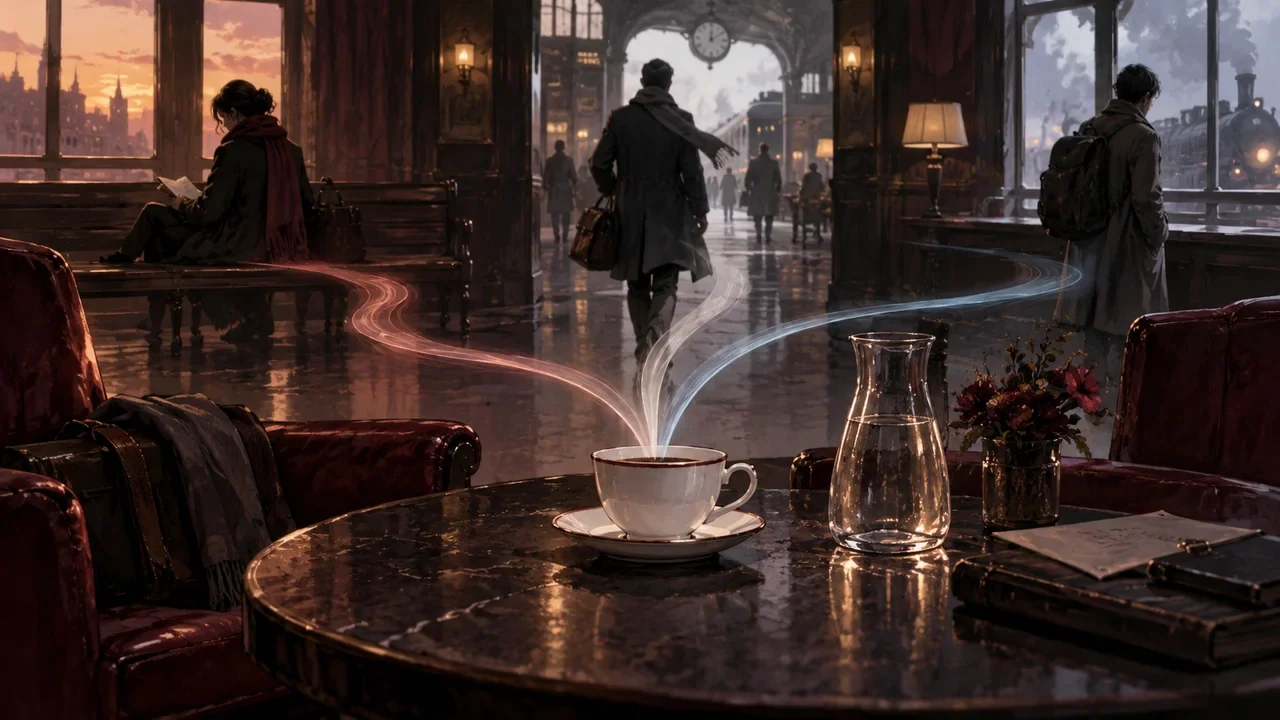
Not every prop is worth putting in the table. There are two criteria: it crosses at least two branches, or it must be seen in the merge shot. In the fictional example The Last Bus Lounge, all three branches take place in the same station lounge, and only one white porcelain teacup satisfies both: in branch A, Lin Wan puts it on the armrest of the bench; in branch B, she carries it to the window; in branch C, Zhou Chi pushes it from the center of the coffee table to the edge. There is also a jug of clear water on the coffee table, already placed before all three branches begin; the wall clock, newspaper, and umbrella do not participate in state changes and are not put in the table for now.
Once the scope is small, number each time point. The numbers are only used for alignment and do not need to be equal in length. In the example, T1 to T5 are used: T1 is the shared state before the branches begin, T2, T3, and T4 are the middle sections of the three branches, and T5 is the merge shot.
How to fill in the four-column state table
First fill in the shared starting point, then fill in branch by branch. When filling in the table, write only what can be seen in the shot, not inferences such as "she put the cup down because she was in a bad mood."
| Time point | Location | Holder | Visible state and movement action |
|---|---|---|---|
| T1 (shared starting point) | Center of the coffee table | No one holding it | Rim facing up, handle facing left, full cup, still |
| T2-A | Bench armrest | No one holding it | Lin Wan picks it up from the coffee table, drinks until it is seven-tenths full, then puts it down, rim facing up |
| T3-A | Bench armrest | No one holding it | Seven-tenths full, rim facing up, no movement |
| T2-B | In Lin Wan's hand by the window | Lin Wan | Picks it up from the coffee table, drinks until it is five-tenths full, then walks to the window, rim facing up |
| T3-B | In Lin Wan's hand by the window | Lin Wan | Drinks two more sips, three-tenths full remains, rim facing up |
| T2-C | Edge of the coffee table | No one holding it | Zhou Chi pushes it from the center to the edge, full cup, rim facing up |
| T3-C | Edge of the coffee table | No one holding it | Zhou Chi knocks the cup over, water spills out, the cup flips and the rim faces down |
| T5 (merge) | ? | ? | ? |
Leave T5 blank for now; this is intentional. The merge shot should be filled in only after all three branches are finalized, otherwise it is easy to mistake a temporary state from one branch for the conclusion.
Do one comparison using the three branches
Look at the three T3 entries side by side: A is on the bench armrest, no one holding it, seven-tenths full; B is in Lin Wan's hand by the window, three-tenths full; C is at the edge of the coffee table, no one holding it, empty cup with the rim facing down. The location, holder, and amount of water are all different. Note that "Zhou Chi moved the cup" does not equal "Zhou Chi is holding the cup at this moment"; the table records the state at the end of that beat.
At this point, do not rush to revise. First ask a preliminary question: in the story, do these three branches happen simultaneously, one after another, or are they mutually exclusive hypothetical branches? In the example, they are set as mutually exclusive hypothetical branches, with only one taken during the same period of time. Mutually exclusive branches do not need to be unified at T3; they only need to provide a state at the T5 merge that can explain how it got there.
Suppose the merge shot is Lin Wan returning alone to the lounge and seeing the teacup in the center of the coffee table, rim facing up, half full. Then each of the three branches needs an added explanation, and even the water amount must connect:
| Time point to be added | Location | Holder | Visible state and movement action |
|---|---|---|---|
| T4-A | Center of the coffee table | No one holding it | Lin Wan picks up the cup, drinks until it is half full, brings it back to the coffee table and puts it down, handle facing left |
| T4-B | Center of the coffee table | No one holding it | Lin Wan carries the cup back to the coffee table, uses the already placed water jug to top it up to half full, then puts it down, handle facing left |
| T4-C | Center of the coffee table | No one holding it | Zhou Chi sets the empty cup upright, tops it up to half full, moves it back to the center, handle facing left |
| T5 (shared target) | Center of the coffee table | No one holding it | Rim facing up, handle facing left, half full, still |
T4 entries are all newly added actions, not existing facts. First put them on the to-be-added list; only after they are actually written into the storyboard and checked can T5 be changed from a shared target to a confirmed state. Writing only "brings it back to the coffee table" cannot explain why A's seven-tenths full and B's three-tenths full both become half full.
Revision priority after discovering a jump in position
The easiest error to find during comparison is a "jump in position": T2 is in one place, and T3 changes place without any movement action. In the example, if T2-A is on the bench armrest and T3-A is written as the windowsill, with no "picks it up and walks over" in between, that is a jump in position.
Revisions are ordered by three levels:
- Location and holder. If these two are wrong, the audience will directly see that a person suddenly has one more or one fewer thing in their hand. First add the movement action, or change the later time point's location back to the previous one.
- Visible state. Rim direction, remaining amount, and whether it is damaged belong to this category. It is more forgiving than location, but if the rim direction in the merge shot is opposite to the branch ending, it will still be seen.
- Movement action. Action is the means of explaining location changes; after location is settled, polish the scale and speed of the action, avoiding changing location just to make the action look good.
Priority means: a lower-level revision cannot overturn a higher-level conclusion. If, to make the action of "picking it up" prettier, you change the cup from the coffee table to the windowsill, then the tail is wagging the dog.
Review path
After filling in the table, go through it in a fixed order, checking only one thing at each step.
Step one, check each column vertically. Read the location column from T1 to T5 and see whether there is any jump without an action; check the holder column for anyone taking over out of nowhere; check the visible state column for whether rim direction and remaining amount are continuous.
Step two, check each row horizontally. At the same time point, can the location, holder, and visible state all hold at once? If a row mistakenly says "rim facing down" and "still full," go back and look at the spilling action; if it says "already placed on the bench armrest," the holder cannot still be Lin Wan.
Step three, return to the storyboard text and check item by item whether the actions in the table are actually written into the corresponding shots. If the table has "picks it up" but the storyboard does not have this action, add it; if the storyboard has "puts it down" but the table does not record it, fill it back in.
Step four, check only the merge shot. Pair T5 with T3 from each of the three branches and confirm that every path can explain T5's state. For any branch that cannot be explained, either add an action or change T5.
Step five, mark the to-be-added items. The added actions, dialogue, and prop positions must all be listed separately, noting which branch they belong to and which shots they affect. This list is for the next round of revision and is not mixed into the finalized table.
Completion check
A minimal prop continuity table counts as filled in only when it simultaneously satisfies:
- Every prop has a shared T1 starting point, and the starting state is consistent across the three branches;
- Every time point in every branch has location, holder, and visible state, with no blanks;
- Every location change can be matched to a corresponding movement action between adjacent time points;
- The merge shot's state can be explained by every branch, and any that cannot be explained have been put on the to-be-added list;
- Every item on the to-be-added list states the branch it belongs to and the shots it affects.
If AI-assisted generation of storyboard text is involved, it can be treated as a proofreading prompt after filling in the table: have the model compare item by item according to the four columns and point out inconsistencies, but the output is not guaranteed to be correct and still requires a human to review the original storyboard text to confirm. AI cannot see the picture in your head; it can only judge based on the locations and actions you write into the text.
Finally, do one small action: pick out the one prop in your current project that crosses the most branches, build just one four-column table for it, and fill it in up to the merge shot. Once one table works, then decide whether to build a table for a second prop.