When a Space Changes, How Should Old Directions Be Retired?
When a temporary partition blocks a corridor, adding “This way is closed” is not enough. A directions handover sheet connects the moment of change, invalidated cues, alternative routes, and return-visit checks so that old instructions stop serving as current navigation.
Introduction
Once a partition blocks a corridor, stop providing old directions that depend on that corridor, then offer a usable alternative from the character’s current position. Update dialogue, arrows, maps, task summaries, and choice buttons. Old instructions may remain as historical information, but they must no longer function as current navigation.
The following fictional teaching example, “Paper Lantern Gallery,” illustrates the method. Its characters, setting, and branches are original fictional creations, not a real user case, tested results, or a product feature overview. The handover sheet is for authors to organize and check their work manually; it does not imply that the platform handles spatial changes automatically.
1. Make the Closure an Event with a Clear Effective Time
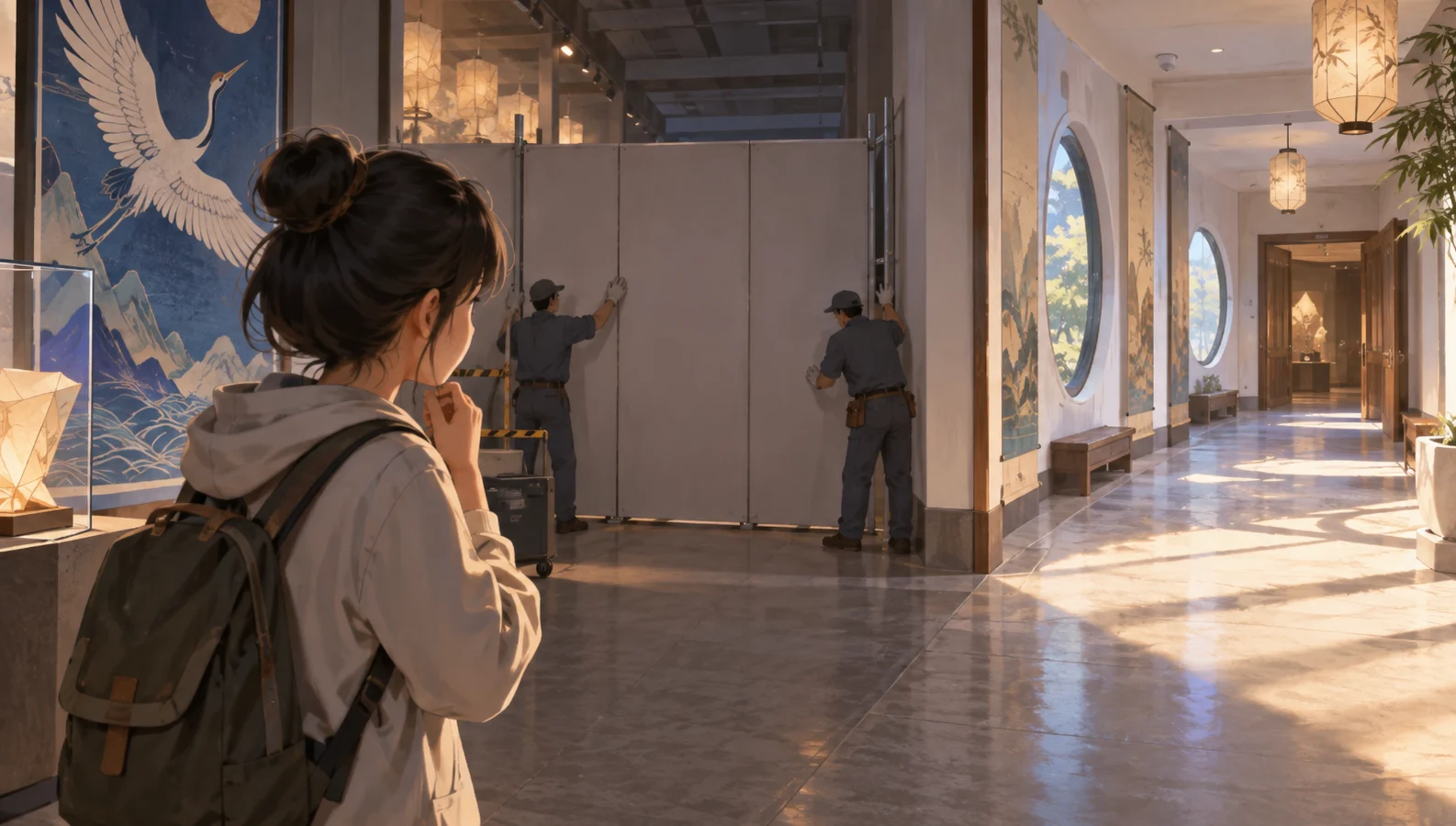
The protagonist, Xiaohe, needs to get from the entrance hall to the archive room. The original route is: “Face the blue display panel, turn left through the west corridor, and continue to the end.” Later in the story, staff slide a temporary partition closed, blocking passage midway along the west corridor. The archive room remains accessible from the entrance hall via the loop corridor on the right.
First, the author must establish exactly when the change takes effect. In this example, the boundary is the shot in which the partition closes and is secured: the west corridor is passable before that moment and cannot be crossed afterward. A staff member saying “We’re about to close this off” is only advance notice and must not invalidate the route prematurely. Nor can the corridor remain open simply because the character did not witness the closure.
On paper, record “Has the space changed?” separately from “Does the character know?” If the partition has closed but Xiaohe has not learned about it, her old memory can remain, but system prompts must no longer recommend turning left. If the plot requires her to follow her memory in the wrong direction, label the choice “Check the west corridor based on your earlier memory” and connect it to a scene where she discovers the partition. Do not promise that she can pass through.
Also define the scope of the change: passage through the west corridor is no longer possible, but the entrance hall, archive room, and blue display panel still exist. Do not remove the entire map or all destinations because one section of the route is blocked.
2. Use a Handover Sheet to Retire Invalid Navigation Cues One by One
First, find every expression that depends on the west corridor being open, then decide whether to remove it, rewrite it, or retain it as history. Do not search only for “turn left”: map connections, arrows without text, and dialogue such as “Take the same route as before” may also continue directing the character toward the partition.
The table below is a reusable directions handover sheet. For another setting, keep the fields and replace the event, locations, and contents.
| Check item | Entry for this example |
|---|---|
| Change event and effective time | The partition is secured, blocking passage midway along the west corridor |
| Conditions for the old directions to be valid | The character is in the entrance hall, facing the blue display panel, and the west corridor is open |
| Elements containing invalid directions | Doorway dialogue, left arrow, map connection, task summary, corridor-crossing button |
| Current action | Disable the corridor-crossing button, replace the arrow and summary, rewrite current dialogue, and mark the map connection as broken |
| Prerequisites for the alternative route | The entrance to the loop corridor on the right is open and leads to the archive room |
| New directions | Face the blue display panel, turn right, pass the round window, reach the wooden door, and enter the archive room |
| How to retain historical information | Keep previously heard dialogue in the recap, with a note that the route it describes is now closed |
| Entry points to check | First arrival, returning to the entrance hall, resuming earlier progress after the closure |
Ideally, give each element containing invalid directions its own row, with the specific node and revised text. They are grouped in the table for ease of presentation. In actual use, a single “Everything updated” cell cannot replace checking each item.
The handover sheet must record both “When do the old directions stop being used?” and “When do the new directions become usable?” If the loop corridor’s connection has not yet been confirmed, first show “The west corridor is closed. Check the loop corridor entrance.” Do not promise access to the archive room prematurely. You do not need to finish writing the alternative route before withdrawing an incorrect promise.
3. Walk Through the Entire Alternative Route and Check Where Each Instruction Starts
Now unfold the sequence in which Xiaohe has already heard the old directions and the partition closes afterward. When she returns to the entrance hall, the task summary changes from “Turn left through the west corridor” to “Take the loop corridor on the right instead.” Frame the blue display panel and the closed west corridor together to explain why the route has changed.
Next, provide an actionable instruction: “Face the blue display panel, turn right into the loop corridor, and walk to the round window.” This sentence only needs to take the character to the next recognizable location. At the round window, follow with “Walk along the wall to the wooden door. The archive room is inside.” Do not leave the entrance hall’s “turn right” instruction on screen throughout, because once the character turns around, left and right have a different frame of reference.
Suppose Xiaohe reaches the round window and then turns back. The directions shown now should start from her current position. The author can have her return to the blue display panel before restoring the entrance-hall directions, or write separate return directions for the round window. Either approach works; the key is not to copy the same short directional instruction into every return node.
After completing this example, check the route backward from the archive room: does the wooden door connect to the archive room, does the round window connect to the wooden door, and can the character enter the loop corridor from the entrance hall? Checking backward can reveal gaps where the instructions read smoothly but the scenes do not connect. This is only a script walkthrough, not validation through actual play.
4. Choose an Alternative That Fits the Narrative Purpose
The first approach is a direct reroute. It suits passages where the closure is simply a spatial change and reaching the archive room remains the focus. It requires the least new information: where the route is blocked, which way to go instead, and which landmark to look for next.
The second approach preserves the old memory and lets the character discover firsthand that it is no longer valid. This suits a plot that needs to show the gallery undergoing changes. After the character reaches the partition, provide new directions promptly instead of merely repeating “You can’t get through.” The map and task panel must also distinguish historical information from the current route, or the audience may struggle to tell whether the contradiction is intentional.
The third approach is to pause navigation. If the loop corridor entrance is also closed, the current task can become “Return to the entrance hall and ask about a new passage,” with follow-up nodes written for what happens after the question. Do not invent an unexplained doorway or use “Find another way” to hide a route the author has not yet written.
If the partition is later removed, record the restoration of access as a separate change. Simply deleting the word “closed” is not enough. Also check whether the old route’s other conditions still hold, such as whether the archive room entrance has also moved.
5. Complete the Update Check with Counterexamples
Before the handover, read through the script under each of the following four conditions, recording the prompts shown and the nodes that follow.
- Arriving before the closure: turning left is still possible, and rerouting instructions should not appear early.
- Arriving for the first time after the closure: provide the current route directly, without first making the character hear incorrect directions.
- Returning after hearing the old dialogue: make it possible to learn that the original instructions are no longer valid and join the new route from the current position.
- Resuming earlier progress after the closure: the summary, map, and buttons should match the space as it is now, without mixing content from before and after the closure.
One common failure is updating the dialogue while leaving a button labeled “Cross the west corridor.” Another is marking the closure on the map while the summary still orders a left turn. Both indicate that one of the elements presenting directions has not completed the handover. The standard is not whether a new prompt has appeared at least once, but whether every expression still serving as current navigation can be valid at the same time.
This method addresses route consistency in fictional narratives. It is not a wayfinding plan for real venues, nor can it guarantee that generated content or software execution will inherently be correct. As a next step, authors can select one spatial change, fill in the handover sheet, and read through the script under the four arrival conditions. Any current directions that still lead the character toward a disconnected passage should be revised wherever they appear.