Waiting Should Do More Than Skip Time: Turn Reflections, People, and Wind into Observable Rounds
When watching a signal lamp, players need to know what changed this round, what remains unknown, and when leaving makes sense. A waiting-round outline turns reflections, people, and wind into information they can compare, with clear conditions for continuing, changing course, and stopping.
Introduction
To make waiting meaningful, first give players a question that requires comparing earlier and later states. Then let reflections, people, and wind each change the evidence available. At the end of every round, players should be able to answer: What did I just see? What information is still missing? What could another round reveal? Under what conditions should I leave? Timing only moves events forward; observable differences give waiting its substance.
Start with the specific question that watching should answer
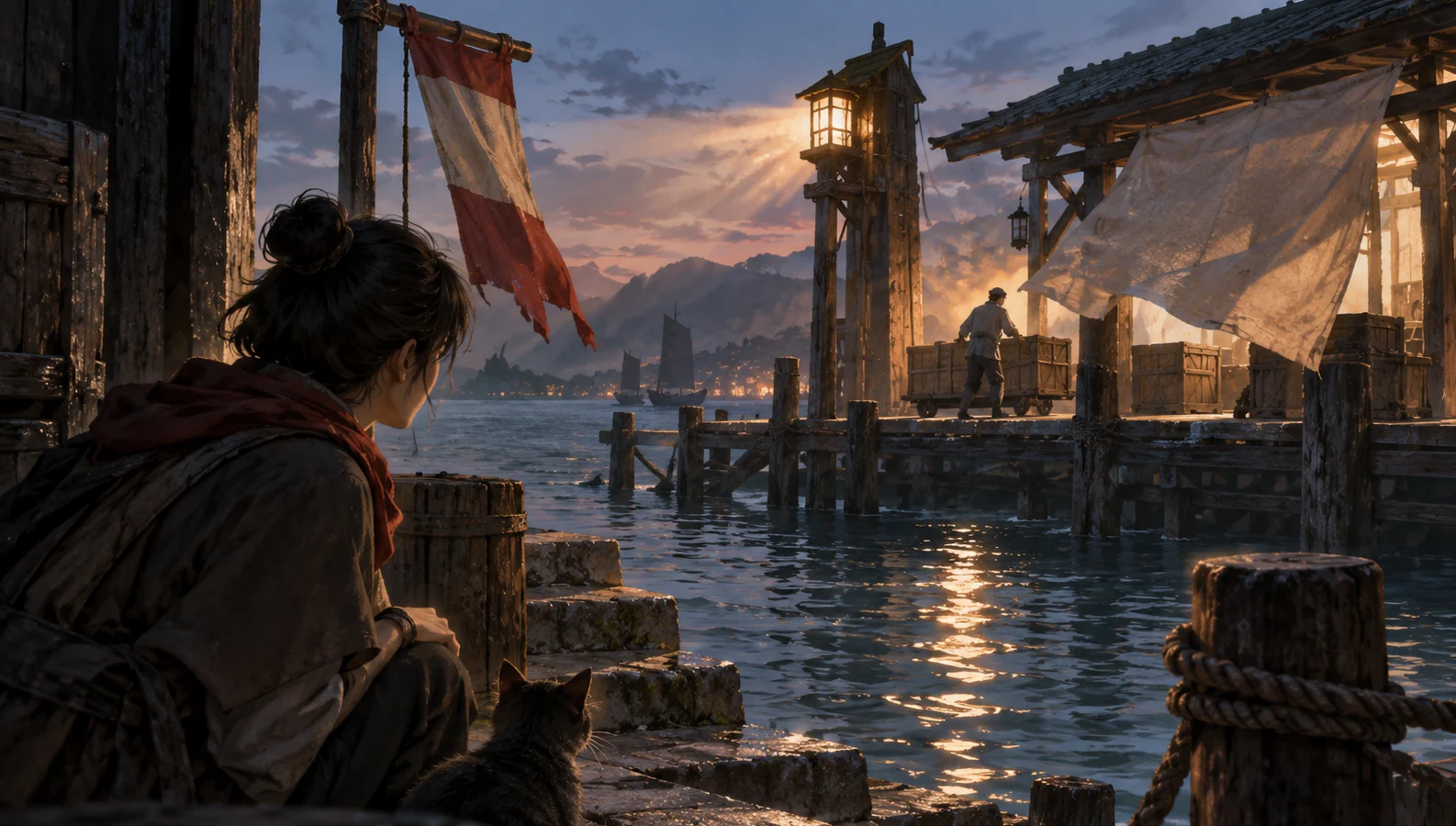
This article uses a fictional teaching example: the protagonist watches a signal lamp at an old ferry landing, trying to determine whether it is signaling to a particular crate carrier. The answer will help them decide whether to ask questions on the pier or look for the light source in the covered walkway. This is not a real user case or a tested result, and it does not represent any product feature.
At the start, players know only that bright patches occasionally appear on the water, someone passes by carrying crates, and a wind flag hangs at the landing. The task is not to “wait for the story to trigger,” but to “observe whether the bright patches correspond to the person's actions.” A negative or inconclusive answer is valid.
First, establish a static baseline: the lampshade points toward the pier, casting a vertical line of light on the water; the crate carrier pauses beside the second post; the wind flag hangs down. Without a baseline, even constant visual changes may leave players unable to say exactly what is different.
Also establish the observation window's limit in advance: the carrier is moving the last two crates and will leave afterward. Players then know there is a deadline without having to watch a countdown that carries no narrative meaning.
Three kinds of change should provide different information
Reflections reveal the relationship between light and obstruction. For example, a gap in the line of light could result from a change in the lamp or from someone stepping into the light's path. The shot should also retain a stable reference, such as stone steps beside the water, so players can compare the gap's position rather than merely admire ripples.
People provide information about who did what and when. Whether the carrier looks up, pauses, or changes direction must be presented within time spans that can be compared with changes in the light. Do not simply write, “He received the secret signal.” That would make the judgment for the player.
Wind direction helps test an alternative explanation. In this example, a loose piece of canvas in the covered walkway may block the lamp when the wind rises. Both changes in the flag and the movement of the canvas must be visible; the canvas cannot be introduced only at the reveal. The flag is merely a clue to the wind and does not itself prove that the lamp was blocked.
All three need not change every round. If the wind rises, the bright patch disappears, and the person turns around simultaneously, with no opportunity for another comparison, players have only correlation. A round of observation after the wind dies gives them a chance to distinguish obstruction from a person's response.
A reusable waiting-round outline
Write the scene using the following table before choosing shots and durations. Each round needs only one main change; the remaining information serves as reference. Together, the columns must support reasoning that players can explain in their own words.
| Stage | Reflections, people, and wind | What players can do | Conditions for stopping this round |
|---|---|---|---|
| Establish a baseline | The line of light is intact; the carrier pauses beside a post; the flag hangs down | Examine the positions of the lampshade, the person, and the canvas | Leave voluntarily, keeping a record of the initial observations |
| Notice something puzzling | The line breaks; the carrier keeps walking; the flag rises and the canvas moves across the lamp | Wait for the wind to stop, or head to the covered walkway to investigate | Switch to investigating the canvas, ending the watch on the lamp |
| Compare explanations | The line returns; the carrier is still moving crates; the flag drops and the canvas moves clear | Record obstruction as an explanation, or wait for the next change in the lamp | Accept the available explanation and leave |
| Spot a new change | With the flag still and the canvas clear, the lampshade turns, shifting the line of light; the carrier looks up and changes direction | Follow the person, or investigate the lampshade | Choose what to investigate; the window closes when the person leaves |
When reusing this outline, complete the same set of sentences for each row: “Previously, __; now, __; this supports __, but does not prove __; another round could reveal __; stop if __; on leaving, retain __.” If you cannot fill in what another round could reveal, consider removing that round.
Stopping conditions fall into three categories: enough information has been gathered, the player chooses a different method, or the observation window closes. Each needs its own exit text; they should not all display “Waiting failed.” Preserve observed facts after an exit, and do not add unseen changes to the record.
A walkthrough: how players decide to wait another round
Suppose a player sees the line of light break in the “Notice something puzzling” round. Their first thought is, “Someone sent a signal.” Yet during the same interval, the carrier does not react, while the flag and canvas move. The player chooses “Wait for the wind to stop and look again.” This has a clear purpose: to test whether the gap disappears when the obstruction moves away.
In the next round, the line returns, with no obvious change in the person's actions. The record can now say, “This break in the line of light occurred at the same time as the canvas blocked the lamp.” It cannot say, “There are no secret signals here,” because one instance of obstruction explains only this particular change.
Still wanting to establish the relationship between the lamp and the person, the player continues. In the final round, there is no wind, but the lampshade turns, and the carrier then looks up and changes direction. The player chooses to follow. They have reason to suspect a connection more strongly, but still do not know who turned the lamp and cannot assert what the carrier intended.
The departure record could read: “Saw wind blow the canvas across the lamp; saw the lampshade turn without wind; the carrier then headed toward the pier; the lamp operator remains unidentified.” Later questioning can therefore offer “Why did you look up just then?” rather than immediately accusing the carrier of taking part in a secret rendezvous.
Another player might head to the covered walkway in the “Notice something puzzling” round. They can inspect where the canvas blocks the lamp at close range, but miss the person's actions in the final round. This route should produce a different, clearly defined information record, and should not be judged inferior simply because the player waited less.
Alternative presentation, failure cases, and limits
Players do not need to sit watching the screen in real time. Clicking “Continue observing” round by round can preserve the same comparison process. If short shots play consecutively, provide opportunities after key changes to decide whether to stay or change course. If skipping is offered, explain beforehand that it means missing this round's observations; do not then assume the character knows everything that was skipped.
When visual differences are subtle, factual text can help: “The flag drops, the canvas moves clear of the lamp, and the line of light returns to the water.” Such descriptions supplement visible information without adding conclusions like “Therefore, it was not a secret signal.” Reviewing earlier observations should allow the baseline and current state to be compared side by side, so remembering small details is not the only way forward.
One failure case is a cycle of wind, flashes, and movement that never reveals a new relationship. Reduce the repetitions or introduce an explanation that can be ruled out. Another is requiring players to wait through every round before gaining anything. Let players who change course midway take useful facts with them. A third is having a person leave without warning; show signs of packing up tools or finishing the final crate in the preceding round.
This outline suits scenes where observation itself can support the next action. If someone is simply waiting for a vehicle to arrive and there is no question to resolve along the way, a brief transition is enough. After writing, check every row: What judgment does this round change? What can the player take away if they leave? What more could they learn by continuing? Waiting that answers none of these questions does not warrant a round of its own.