Adapting Character-Decomposition Puzzles Across Languages: Preserve the Reasoning, Redesign the Answer’s Form
Translating the clue is not enough for a character-decomposition puzzle. First record how players identify components, perform an operation, eliminate candidates, and verify the answer. Then choose target-language text or a visual mechanism. Includes a reusable adaptation card and a complete teaching example.
Preserve the reasoning chain first, then decide how much text to retain
When localizing a puzzle built on Chinese character structure, first specify what clues players see, what operation they perform, and how they confirm the result. Then look for a suitable form in the other language. The literal meaning of the answer may change, but a task that originally required deduction must not become a simple search for a synonym.
A useful deliverable is a “puzzle adaptation card” that records the mechanics that must remain unchanged, the materials that may be replaced, and the experiences that cannot be preserved. If the original puzzle’s entire appeal comes from the structure of a particular Chinese character and the target language offers no suitable counterpart, acknowledge that a replacement puzzle is needed. Reaching the same plot outcome alone does not make it an equivalent translation.
This article demonstrates the method through a single fictional task: opening a cabinet in an archive room. The setting, puzzle, and feedback are all teaching examples, not real user cases, measured results, or features of any product. Proposed dialogue for the foreign-language version is presented in the source as Chinese back-translations, rendered here in English. These illustrate a design proposal, not translations that have already been reviewed.
Break the original puzzle into four checkable steps
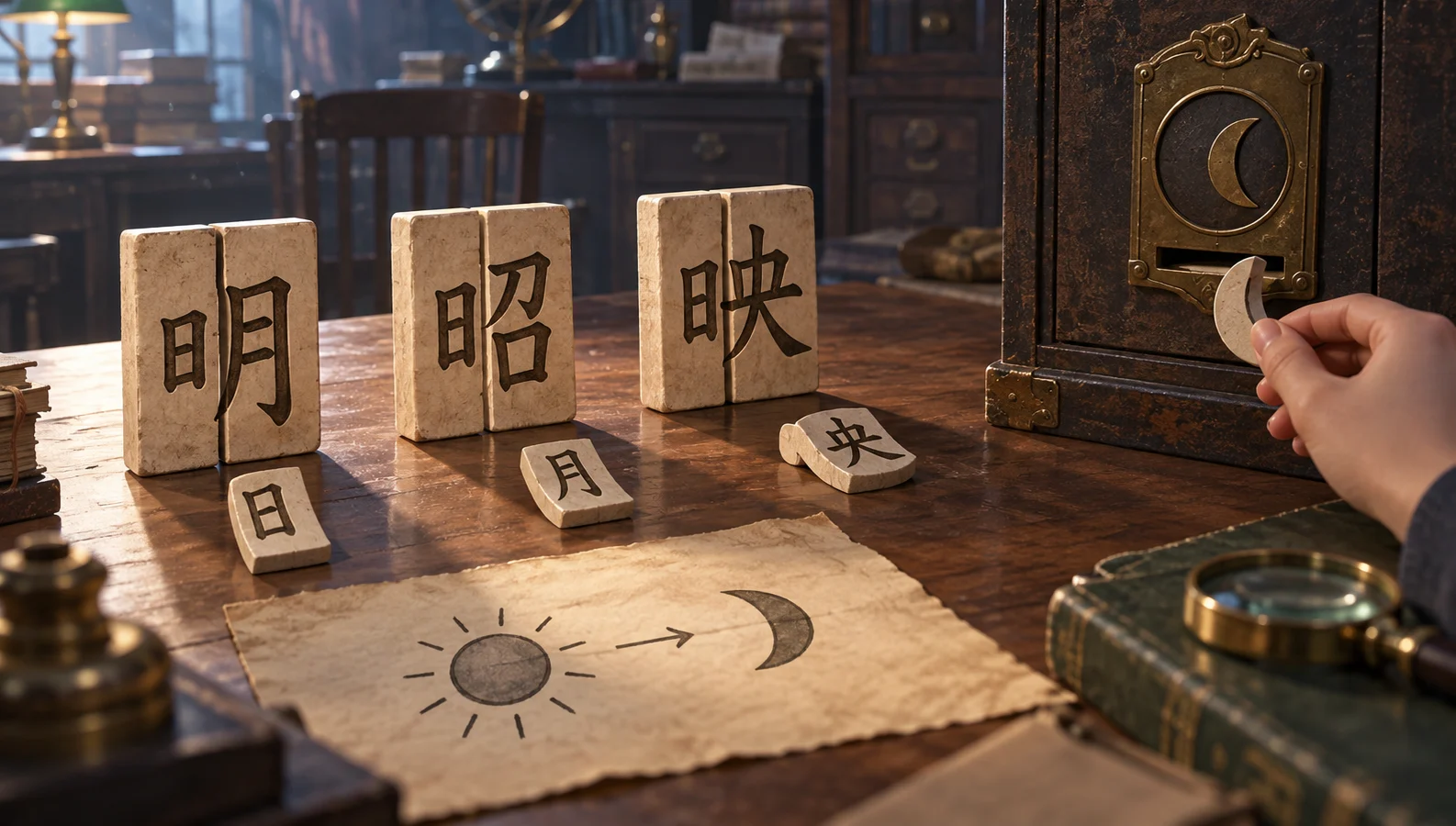
An archivist has left three character tiles that can be taken apart: “明,” “昭,” and “映.” The “日” on the left of each tile is a separate component joined along a seam. A note on the desk reads: “Remove the daylight, then check the shape that remains.” Separate instructions for the cabinet lock read: “Submit one piece left after taking a tile apart; its shape must match the mark beneath the lock.” That mark is “月.”
The intended solution is to associate “daylight” with “日”; remove the left-hand component along the seam; compare the remaining “月,” “召,” and “央”; and submit “月,” the remainder of “明,” to the cabinet lock. Obtaining “月” is not the complete answer. The player must actually hand over the remaining piece.
There are two sources of evidence with different roles. The note specifies the operation; the lock instructions and mark specify the acceptance criteria. From the mark alone, players may guess that “明” is relevant, but they cannot pass by submitting the whole tile. Nor should the design pretend to eliminate every shortcut: finding “月” first and then working out how to take the tile apart may also work.
What needs preserving, then, is not a fixed order of thought but three observable requirements: use a clue to choose a removal operation, retain the correct remaining piece, and verify it against an independent condition. Whether knowledge of Chinese characters must also be retained is a separate decision.
Use an adaptation card to constrain the replacement version
The following table can be copied and reused. The middle column explains what to record for each adaptation; the last column shows the decisions for this example.
| Item | What to record | This example |
|---|---|---|
| Plot outcome | What state changes after the puzzle is solved | Open the archive cabinet and retrieve a letter |
| Invariant mechanics | Which reasoning steps and actions must be completed | Interpret the clue, remove a component, verify the remaining piece |
| Replaceable materials | Which text or objects may be replaced | Character tiles, clue wording, mark beneath the lock |
| Information distribution | What each source provides | The note gives the operation; the lock gives the acceptance criteria |
| Distractors | Why incorrect candidates are worth considering | All can be taken apart by the same rule, but leave different pieces |
| Verification evidence | How to prove the player did more than guess a name | Submit the detached object and compare its shape |
| Experience lost | Which pleasure cannot be fully carried over | The insight that connects a word’s meaning to a Chinese character component |
Do not list “equal difficulty” under invariant mechanics. That is a judgment requiring later observation, not a property established by the author writing it down. The adaptation card can constrain the design, but it cannot stand in for how readers of the target language actually understand it.
This example adds one asset constraint: the seams where all three tiles come apart must be equally clear. If the correct tile has a brighter seam, players may select the answer based on differences in how the assets were made. Even the most carefully designed wording cannot fix that.
A complete replacement example: turn character tiles into celestial-symbol tiles
Suppose the target-language version does not require players to know Chinese characters. The three character tiles can become three composite tiles: sun plus crescent, sun plus triangle, and sun plus ring. Each consists of a left piece and a right piece joined together, with a sun on the left. The mark beneath the lock becomes a matching crescent, and the lock still accepts only the remaining piece after disassembly.
The proposed note, presented in the source as a Chinese back-translation, reads: “Let daylight leave the stage; give what remains to the cabinet lock.” Add an ordinary environmental description nearby explaining that this archive room uses the sun to represent daylight. This establishes only the symbol convention; it does not identify the tile to choose. The final translation must be checked to see whether “leave the stage” naturally suggests removal in the target language. Poetic wording alone is not enough.
Players first connect daylight with the sun, then remove the sun to obtain a crescent, a triangle, and a ring, and finally confirm the crescent against the mark beneath the lock. This preserves clue interpretation, component manipulation, and independent verification. It also lowers the barrier of Chinese character recognition and replaces a linguistic insight with symbolic reasoning.
Prepare two kinds of failure feedback. When a player submits the complete sun-and-crescent tile, display: “The cabinet lock accepts only one piece.” When a player submits the detached triangle, display: “This is a remaining piece, but its shape doesn’t match.” The first identifies an unfinished operation; the second identifies failed verification. Neither directly names the correct candidate.
If the narrative can display only text and cannot represent how the pieces fit together, this replacement is unsuitable. A puzzle that deletes letter sequences in the target language is another option, but it requires separate checks: whether the sequence is contiguous, whether the deletion position is unique, and whether the remaining string requires additional vocabulary knowledge. If no natural material can be found, redesigning the entire small puzzle is more honest than forcing words to fit.
Compare difficulty at sticking points, not by character count
Before delivery, write a complete solution for both the original and the replacement that requires no guessing about the author’s intent. Then check four potential sticking points: understanding the metaphor, finding where the tile comes apart, distinguishing the candidates, and understanding what must be submitted. The same number of candidates does not mean each sticking point is equally difficult. In the visual version, the operation may be easy to spot while “whole tile or remaining piece?” still causes confusion.
Use the checklist below and record “passed,” “needs revision,” or “not yet observed.” Do not fill in successful conclusions in advance.
- Does the metaphor have support within the scene, or does it depend on an unexplained cultural association?
- Can every candidate undergo the same operation, or does a structural difference allow an incorrect option to be ruled out early?
- Can the answer be submitted directly without reading the operational clue? If so, does the task still meet its intended teaching purpose?
- Does failure feedback distinguish an operation error from a matching error while leaving room for further reasoning?
- Are the original tile and its remaining piece consistently visible before and after removal, avoiding an extra burden on memory?
If readers are later invited to attempt the puzzle, record which clues they cite, where they revise their judgment, and whether they succeed by trying every option. Recording only whether the cabinet ultimately opens cannot establish whether the reasoning process has been preserved. No such observations are available for this example, so it remains a design awaiting validation.
One further boundary cannot be overlooked: if “明” later becomes a character’s name or a clue to their identity, replacing it with a crescent breaks the story’s evidence chain. In that case, retain the Chinese character and teach its necessary structure within the scene, or rewrite the later foreshadowing as well. Check how the answer is used in the story before approving a change of materials, so that a locally solvable puzzle does not undermine the work as a whole.