Leaving the Last Lamp Unlit: Giving Waiting and Saving Different Outcomes
Still having an item does not mean the story has acknowledged your choice. Use a seven-field resource consequence card to separate actions, resource changes, and closing opportunities. Specify where each route follows through and which actions remain available, so leaving the lamp unlit changes the story too.
Introduction
Leaving the last lamp unlit should change what happens next. Track resource consumption separately from character actions: waiting advances the situation, saving preserves a possible use, and leaving may end an immediate opportunity. Make those changes visible so players understand what they kept and what they passed up.
1. When the Lamp Stays Unlit, First Distinguish the Actions
The following “Night Journey through the Old Station” is a fictional teaching example, not a real user case, a tested outcome, or a product feature. The recording method is a design tool authors can use manually.
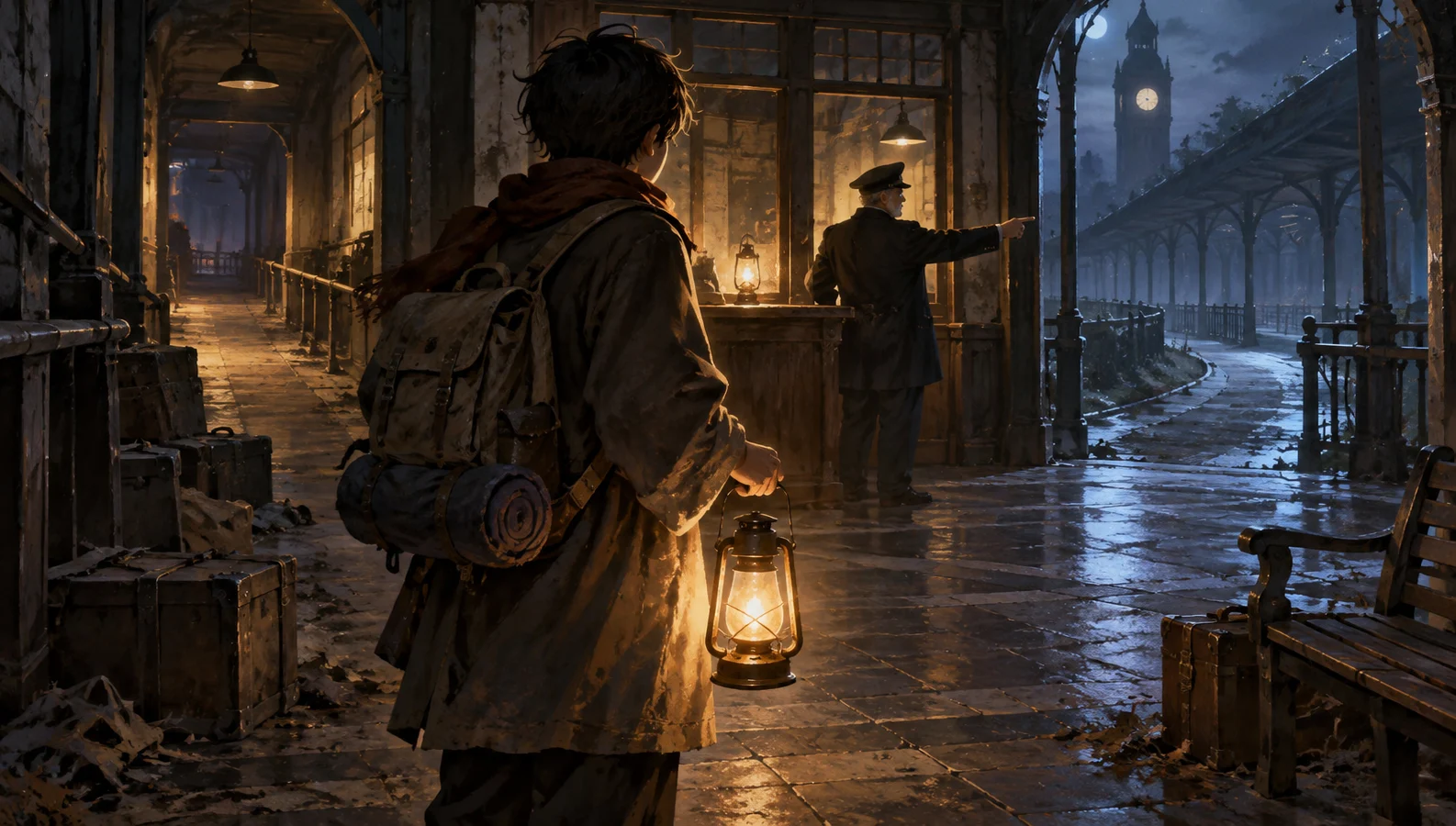
A traveler named Aran arrives at an abandoned station carrying one last oil lamp that can burn only briefly. An attendant is still inside, and the old timetable board outside the entrance is too dark to read. Aran’s companion says, “Besides the order of stops, that board has directions around the station and facility notices. There’s only enough oil to light up this spot or the fork in the north corridor. After the next bell, the attendant changes shifts and locks the near entrance to the north corridor. Then we’ll have to take the long outer corridor to the clock tower.”
The companion points to the handrail at the entrance. “Both corridors have a continuous handrail leading all the way to the exit. The north corridor’s handrail continues through the fork, too. We can move slowly along it without lighting the lamp, but we’ll have to feel our way around the clutter underfoot.” This is the example’s established basis for moving through the station; it does not rely on reading door signs in the dark.
The three actions are “Light the lamp and read the board,” “Put the lamp away and take the north corridor,” and “Stay by the window until the shift changes.” The latter two consume no oil, but they change the journey and the timing of an encounter, respectively. Do not treat time spent in a menu, slow reading, or the absence of a click as saving resources. If you need a waiting branch, provide an explicit action and an event that ends it.
2. Use a Resource Consequence Card to Separate Retention, Consumption, and Forgetting
Retention and consumption describe an item’s state; forgetting describes a use that is never addressed again. These are not mutually exclusive item states: the lamp may remain available after the opportunity to read the board has passed.
For each route, fill out this seven-field card around the resource’s most important current opportunity.
| Field | What to record | Entry for this example |
|---|---|---|
| Known before the decision | What the player can base a judgment on | Oil is limited; the board has directions and notices; the near entrance locks at the shift change; both corridors have continuous handrails leading to the exit |
| Explicit action | Describe an action without guessing its motive | Light the lamp to read the board, put it away and proceed, or wait for the shift change |
| Resource change | Quantity or availability | Reading the board uses up the oil; the lamp remains usable after proceeding or waiting |
| Immediate change | What differs in this scene | Learn the directions and the out-of-service notice, enter the north corridor early, or meet the attendant but have to take a detour |
| Later follow-through | Specify locations and actions for each route | Those who read the board move slowly along the north corridor’s handrail and cannot light their way; those who saved the lamp can illuminate the door sign and clutter at the fork or move slowly along the handrail; those who waited can light the outer corridor or move slowly along its handrail, without passing that fork |
| Opportunity closes | Which event ends the earlier use | After passing through the one-way exit ticket gate, the traveler cannot return to read the board or illuminate this station’s corridors |
| Closure feedback | State which uses went unfulfilled | Those who did not read the board confirm it remains inside the gate; those who did not light their way confirm that opportunity at this station has ended; those with oil left confirm the lamp is not depleted |
The final three fields are crucial. If all you write is “The oil lamp is unchanged,” saving it remains an empty gesture. If all you write is “It will be useful later,” fulfilling that promise can easily be postponed until the ending. Locations, actions, and ending conditions must be specific. A depleted lamp must not provide light again.
3. Write All Three Routes through to the Same Station Exit
On the consumption route, Aran lights the lamp and reads the board. The directions indicate that the left side of the north corridor leads to the clock tower, while a facility notice reads, “Clock tower out of service.” The order of stops does not provide directions. As the lamp goes out, the companion repeats the directions and notice. At the fork, Aran knows the left side leads to the clock tower but cannot see the old luggage clearly. He must follow the continuous handrail and feel his way forward. Using the lamp has bought directions and background information, while leaving the inconvenience of darkness ahead.
On the retention route, Aran fastens the lamp cover and immediately enters the north corridor, neither reading the board nor waiting for anyone. At the fork, he can light the lamp to read “Clock Tower” on the left-hand door sign and see the luggage clearly. If he does, this uses up the oil, and he still does not know the clock tower is out of service. Saving the lamp changes where it is used; it does not extend its burning time.
If Aran still does not use the lamp here, he follows the previously established continuous handrail, feeling his way forward and continuing along it through the fork to the exit without needing to identify a door sign. This route preserves the lamp but provides neither the door-sign information nor a clear view of the obstacles. Do not light the lamp on the player’s behalf.
On the waiting route, the bell rings and the attendant comes out, explains that the left side of the north corridor leads to the clock tower, then locks the near entrance as announced and points out the entrance to the outer corridor. Aran receives spoken directions but loses the shorter route. The outer corridor bypasses the north corridor’s fork and rejoins the other routes before the same exit. He can light the lamp to avoid the clutter or move slowly along the handrail and keep saving it. The attendant does not mention that the clock tower is out of service.
All three routes reach the exit leading to the clock tower. They differ in how much Aran knows, which route he takes, and where he spends the oil. Dialogue where the routes meet should reflect the route taken: those who waited can mention the locked entrance, while those who read the board can ask why the clock tower is out of service. Those who did not read the board cannot acquire that knowledge out of nowhere.
4. Bring Forgotten Uses to a Close without Assigning Regret to the Player
A sign beside the one-way ticket gate states, “No re-entry after leaving the station.” If the player has never lit the lamp or read the board, feedback after passing through might read: “The iron gate closes. The timetable board and both dark corridors are behind you, now beyond reach. In your bag, the lamp cover knocks against the rim of a cup. The oil is still there.” This confirms that the opportunities to read the board and light the way at this station have closed while the resource remains. Inventory feedback must be rewritten for anyone who has already used the lamp.
Do not follow this with “You finally realize you made a mistake.” Players may have saved the lamp deliberately or may not care what the board said. “Forgetting” is an author’s label for checking uses that have not received follow-through, not a judgment about the player’s psychology.
In the next scene, the companion might ask to borrow the lamp to sort scattered letters, first explaining that light is needed to read the writing on the envelopes. If oil remains and the player agrees to lend it, retention changes an interaction. If the player keeps it put away, packing at the chapter’s end can establish that the lamp is still unused. Those who have depleted it cannot lend it for illumination, and a leftover item need not earn a large hidden reward.
If there is no room for a new use, make clear in advance that the lamp’s usable situations are limited to exploring this station. Bring those opportunities to a close when the traveler leaves; there is no need to improvise a compensatory side branch.
5. Use Four Manual Walkthroughs to Eliminate Empty Consequences
First, follow the consumption route. Check that the directions and out-of-service notice are actually read and acknowledged later. If there is no immediate benefit but the lamp is needed everywhere afterward, add a benefit or reduce the loss.
Next, follow the retention route. If keeping the lamp still grants all the information, the shortcut, and an extra relationship reward, the other choices lose their purpose. Retention should involve an understandable sacrifice, such as not knowing that the clock tower is out of service, rather than an arbitrary punishment.
On the third pass, choose only waiting. Check that locking the entrance at the shift change follows the clues, that the detour bypasses the north corridor’s fork, and that the option to light the way appears in the outer corridor. Additional scenery description alone does not constitute development.
Finally, never use the lamp. Check that the handrails were established beforehand, that they run continuously to the exit, and that the clutter can be navigated by feeling the way around it. Check the opportunity-closure feedback and whether dialogue wrongly assumes the player read the board or lit the path. These are suggestions for manually reviewing a fictional draft, not results of completed tests.
Give the card to another author. They should be able to identify what changed after the player left the lamp unlit. If their only answer is “The item is still there,” return to the immediate-change and later-follow-through fields and add actions that fit that route’s location and resource state.