When Two Reliable Reports Conflict, How Can You Design a Review Without Forcing a Single Truth?
Different water-level reports do not require a search for a liar. Use a time-by-location table to establish how the readings were taken, then let players decide whether to keep checking or submit a record with the disagreements clearly stated.

First, Check Whether Both Reports Answer the Same Question
When two reliable observation stations report different water levels, break each report down into “when, where, using what measurement rules, and what value” before designing the review. Different values only become a disagreement that needs explaining once the comparison conditions align. The player’s task can be to narrow down what remains unknown; it does not always have to be choosing a single truth.
The following fictional teaching example is called The Two-Station Water-Level Ledger. Qingqiao Station reports forty-eight divisions, while Liuwan Station reports thirty-nine. Both record keepers take their work seriously. The characters, locations, readings, and subsequent records are invented for explanation. They are not a real user case, tested results, or product features, and are not intended for assessing real-world hydrological conditions.
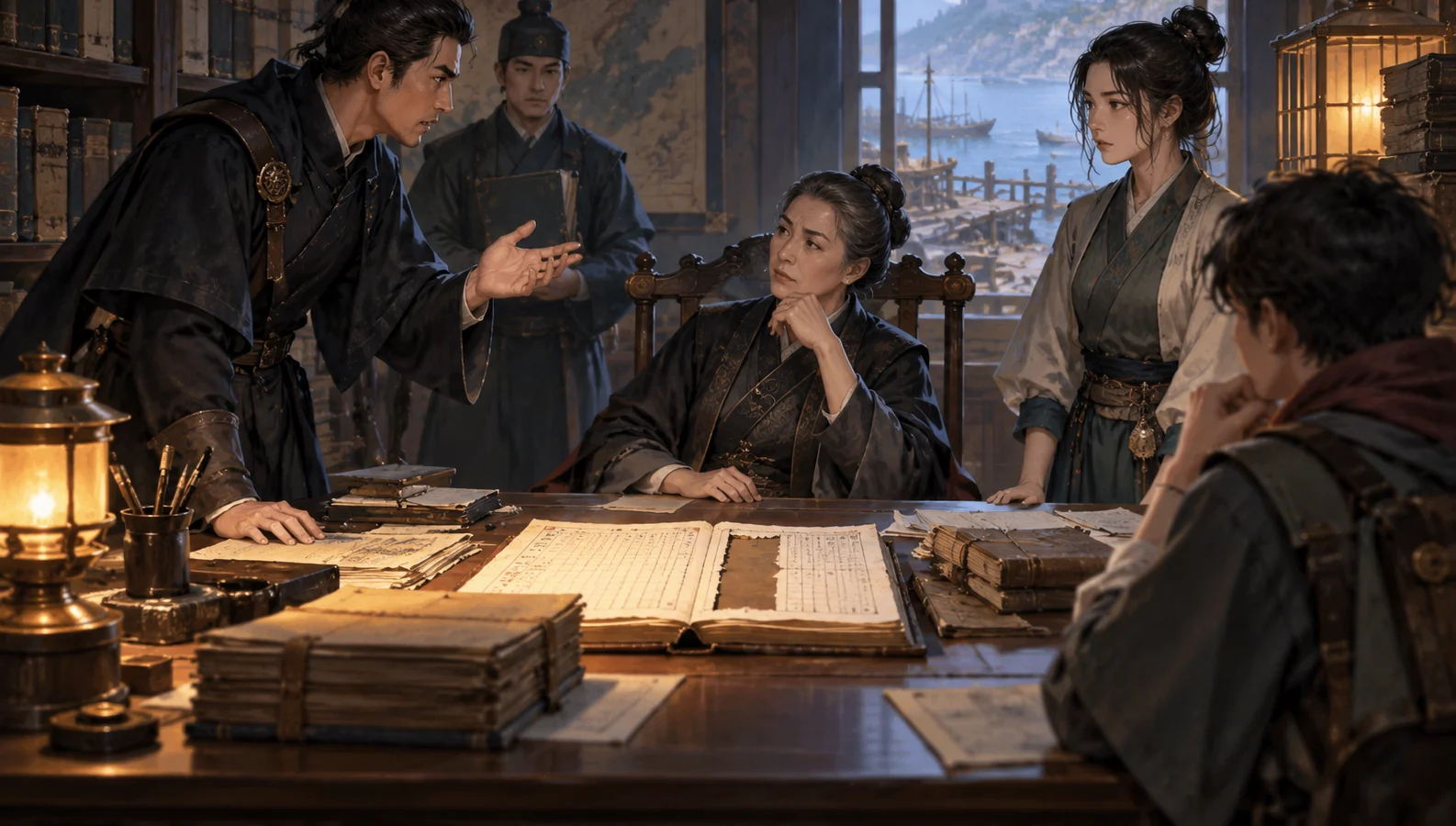
The player is a copyist organizing river records and preparing an explanation of that day’s water levels for an exhibition. The dispute begins with two letters that both say “afternoon water level.” If the author offers only “trust Qingqiao” and “trust Liuwan,” a problem of missing comparison conditions becomes a vote on personal credibility.
The opening task could be: “Find out what forty-eight and thirty-nine divisions each refer to, and decide how much the exhibition label can say.” Completion depends on the clarity of the record, not on making the two numbers match.
A Reusable Review Sheet: Record the Fields, Then Assign Actions
Copy the following sheet into your story draft. Each row represents a field to check. Enter the Qingqiao and Liuwan reports in their respective report columns, and use the final column for the action that checks that field. Mark unknown fields as “missing”; do not guess on the characters’ behalf.
| Field | Qingqiao report | Liuwan report | Review action available to the player |
|---|---|---|---|
| Original source and record keeper | Qingqiao original ledger, A-Lu | Liuwan original ledger, Shi Cen | Examine the relevant pages and signatures or annotations |
| Actual measurement time | 13:00 | 14:00 | Distinguish measurement time from mailing time |
| Measurement location | Gauge A, east side of Qingqiao bridge pier | Gauge B, inner side of Liuwan wharf | Check location sketches and gauge identifiers |
| Value and unit | Forty-eight divisions | Thirty-nine divisions | Establish what one division means |
| Reference level and reading method | Not yet established | Not yet established | Examine the zero-point explanation and reading rules |
| What can currently be stated | The two records differ | Comparison conditions are incomplete | Do not yet decide who is wrong |
Every action should return specific material. For example, “check the time” should produce the measurement field in the original ledger, not another assurance from the record keeper that “I remember correctly.” Mailing time tells you only when a letter was sent; it cannot be entered as the measurement time.
Locations must also be specific enough to identify the measurement point. “Both are on the same river” does not establish that the two people measured the water level at the same spot. Station names help locate people; the side of the bank and the gauge identifier establish which gauge was read.
At a minimum, specify the unit, zero point, and reading method. This example stipulates that divisions on both gauges have the same length, that their zero points use the same reference, and that each entry records a single reading at the specified time. These are comparison conditions supplied by the author for this example. If the story does not provide that information, the player cannot assume those conditions hold.
Use a Time-by-Location Table to Separate Time Differences from Location Differences
After the first ledger check, the player discovers that the original two values differ in both time and location. Comparing them alone cannot establish which condition the difference relates to. At this point, “find the other two records for those times” is a clearer action than a vague “investigate further.”
The author establishes that both stations retained their original entries for 13:00 and 14:00, using the shared measurement rules described above. Consulting them gives the player:
| Measurement point | 13:00 | 14:00 |
|---|---|---|
| Qingqiao Gauge A | Forty-eight divisions | Forty-four divisions |
| Liuwan Gauge B | Forty-three divisions | Thirty-nine divisions |
Read across the rows first: Qingqiao falls by four divisions between the two times, and Liuwan also falls by four. This compares times while holding the measurement point fixed. Then read down the columns: at both times, Qingqiao is five divisions higher than Liuwan. This compares locations while holding the time fixed.
You can now write: “The original letters quoted Qingqiao’s 13:00 reading and Liuwan’s 14:00 reading respectively. With the records completed, readings at the same point differ by four divisions over time, while readings at the two points differ by five divisions at the same time.” Following one comparison path through this table, the original nine-division difference can be split into four and five divisions. This is only a relationship between readings, however; it does not establish what caused the water-level changes.
The story still has not explained why the two points differ by five divisions, or shown that this gap remains constant all day. Do not follow up with “so it was all caused by the tides” unless other story material specifically supports that explanation.
This step must also distinguish checking old ledgers from taking new measurements. Measuring again the next day provides the next day’s readings; it cannot fill yesterday’s missing entries. If the author establishes that an old ledger was lost, the time-by-location table must retain its empty cells. The player can arrange for the next readings to be recorded simultaneously, but cannot insert new results into the past.
Let Different Evidence Conditions Lead to Different Endings
Prepare at least three possible outcomes for the review, each allowing the player to complete an explanatory note to submit with the records.
Conditions are established, and the differences can be presented side by side. This is the branch used in the example: the player submits the time-by-location table, and the exhibition label identifies each location and time separately. Both letters are retained, but they are no longer summarized as the water level of the entire river at a single time. Relationships between characters can change through how the player explains the misunderstanding; there is no need to expose a liar.
A key entry is missing, so some comparisons remain unavailable. If Liuwan’s 13:00 entry is missing, the player can still compare Qingqiao across time and the two stations at 14:00, but cannot write “both stations fell by four divisions.” By stating exactly which cell is missing and which comparisons are established, the ending makes the investigation’s progress clear.
The records still disagree after the conditions align. If another story branch supplies two different records for the same time, measurement point, and measurement rules, it leads to the “unresolved” outcome. Retain the originals, state the numerical difference, and add a task to check the copying or reading process. Without new material, narration cannot simply declare the more popular record keeper correct.
When space is limited, you can replace the full time-by-location table with one targeted check that answers only “were the measurements quoted in the original letters taken at the same time?” The trade-off is a narrower conclusion. If the story focuses on relationships, players can also choose how to explain the situation to both parties, but their wording cannot alter the boundaries of what is known and unknown in the records.
Check Whether the Ending Quietly Claims More Than the Evidence Supports
One especially easy mistake is taking an average. Averaging forty-eight and thirty-nine into a single number erases the two sets of observation conditions without resolving whether the readings are comparable. Unless the story’s task specifically calls for aggregation under explicit rules, do not present an average as a truth reached by compromise.
Another failure is adding investigations indefinitely. Every review task should state “which field this fills” and “which conclusion this changes.” Adding more characters and rumors without reducing any empty cells keeps players busy without advancing their judgment.
You can use this completion note directly: “Checked: __. Currently comparable: __. Remaining disagreements or gaps: __. This explanation uses: __. Reopening the review requires: __.” In this example, the final field could say “new original entries using the same measurement rules, or grounds for correcting the originals.” Mere pressure to continue does not count as new evidence.
Before submitting your draft, cover one row of the time-by-location table and then one column, checking whether the conclusions narrow as evidence is removed. Ask once more: if players choose to stop investigating, can they still submit an honest, useful explanation? A review has a meaningful stopping point when it can preserve clearly identified unknowns.