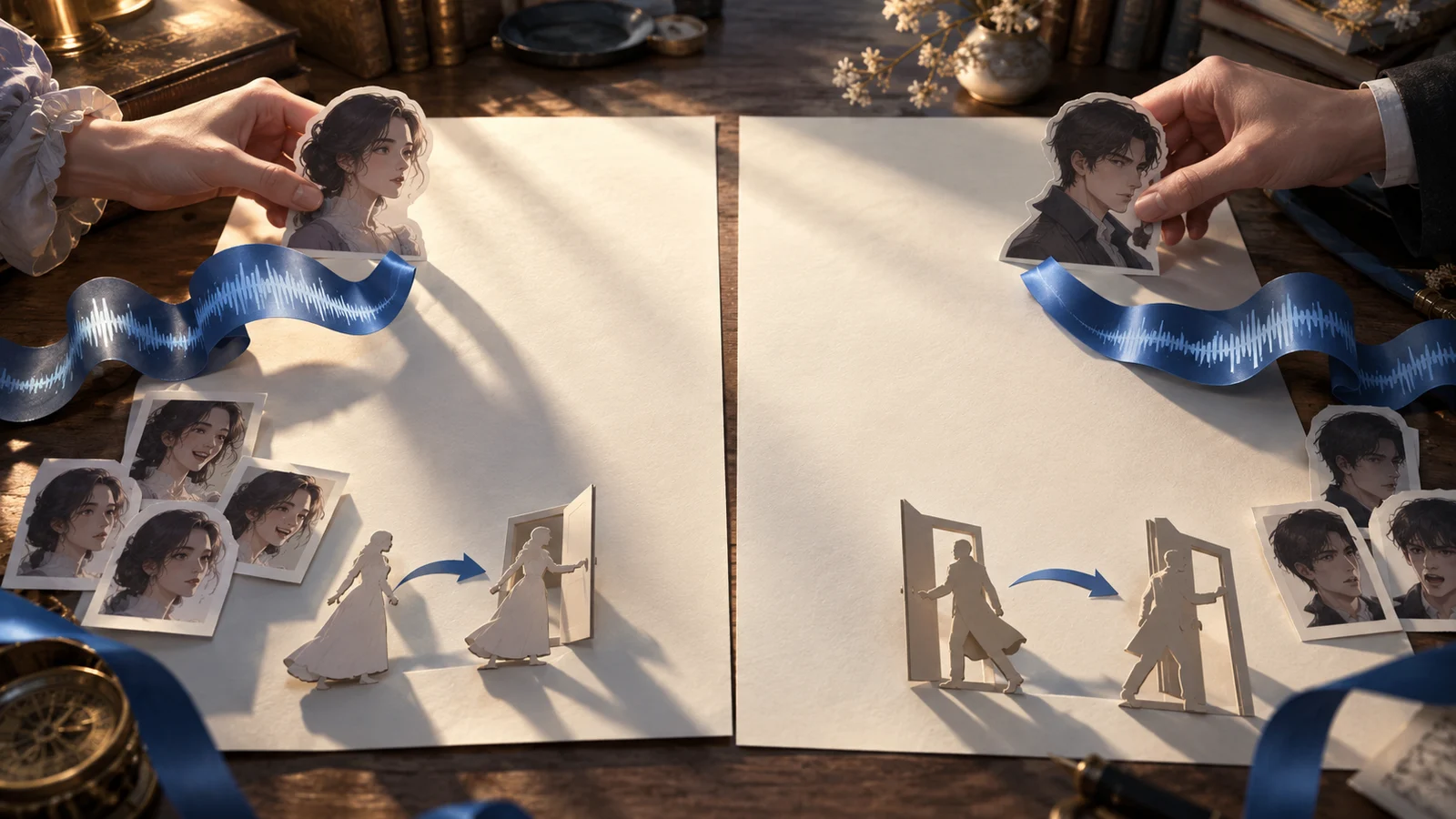
When a Visual Novel Is Missing an Expression: Substitute, Restage, or Draw It?
Before replacing a missing expression, identify the information it needs to convey. Use a fictional scene in which a gatekeeper refuses to lend a key to compare smiles, surprise, obscured faces, and pauses, then complete an expression gap record ready for handoff.

Introduction
When an expression variant is missing, first state the attitude the face must convey. Then decide whether to substitute an existing variant, change the staging, or draw the missing expression. An existing expression qualifies only if it introduces no conflicting meaning. Restaging is an option only if movement and composition can carry the necessary information. If a crucial attitude would still be lost, the expression needs to be drawn. Keeping production moving temporarily does not make a version ready for final approval.
1. Reframe “a missing face” as “missing information”
The gatekeeper scene below is an original, fictional teaching example. It is not a real user case, an empirical finding, a firsthand test report, or a DramaFork product feature. The decision record and alternative versions are design examples for production discussions.
A traveler asks to borrow a key. The gatekeeper knows the traveler is in a hurry, but he must keep the key in his own possession. He holds it close to his body and says, “I can’t lend you the key. I’ll go with you to open the door.” The scene requires him to refuse to hand over the key while taking the request seriously. He is neither alarmed nor mocking, and he is not waiting for the traveler to keep pleading.
The script calls for a “restrained but caring” expression, but only smiling and surprised variants are available. What is missing is not a vague sense of seriousness. It is the combination of a clear boundary and continued concern for the other person. The first sentence refuses the request; the second offers help. His face needs to make both statements part of the same earnest response.
Write three things beside the script: what must remain, what may be softened, and what must not be added. Here, the refusal and concern must remain; emotional nuance may be reduced; mockery, shock, and wavering must not be introduced. This gives the person responsible concrete grounds for rejecting a candidate.
A neutral face needs the same scrutiny. With an apology, it may seem perfunctory; with a farewell, it may weaken the sense of reluctance to part. A face without an obvious smile or scowl still conveys an attitude. Whether it works depends on how detached the character can appear in this context.
2. Compare candidates with the full dialogue in the scene
Do not judge an expression solely by whether its thumbnail looks suitable. Put each candidate into the same written scene description and compare how readers might interpret the character. The judgments below apply to this example; they do not claim that every smile or surprised expression has a fixed meaning.
Candidate one: a smile throughout both sentences. “I can’t lend you the key” might read as lighthearted teasing, and the offer to accompany the traveler might then seem like a deliberate attempt to keep them guessing. The smile preserves friendliness but weakens the sense that the request is being taken seriously. The available smile in this example has noticeably upturned mouth corners, so it is rejected as a final substitute.
Candidate two: surprise throughout both sentences. This might make the refusal seem like a reaction to finding the request itself unexpected, as though the traveler had asked for something out of bounds. The gatekeeper then offers to accompany them without a corresponding emotional transition, leaving an extra question: “What exactly surprised him?” The scene does not call for that information, so this candidate is rejected.
Candidate three: surprise followed by a smile. Using both expressions does not automatically fill the gap. This sequence also adds an emotional progression from being taken aback to relaxing, whereas the script requires a clear boundary and concern throughout.
If the character habitually uses humor to ease tension, a smile might work. If borrowing the key really does touch on a secret, surprise might be necessary. But those choices alter the character’s intent or the story information. They cannot quietly be treated as equivalent substitutions just to fit the available assets. If you decide to change the intent, revise the scene description first, then review what follows.
3. What obscuring the face and adding pauses can preserve—and lose
You can start by drafting a version that needs no new expression: the gatekeeper turns sideways, with the doorframe hiding his face and the key still held close to his body. After saying, “I can’t lend you the key,” he turns toward the doorway and adds, “I’ll go with you to open the door.”
This preserves the fact that the key is not handed over and makes his intended movement to accompany the traveler visible. The cost is that viewers cannot see how he responds to the traveler’s urgency; the dialogue carries more of the concern. Turning sideways too early might also look like avoiding the conversation. If the doorframe’s placement feels contrived, viewers may notice the concealment itself.
Another version has him raise a hand to cover half his face. That action needs a reason: wiping away rain means something different from covering his face with his hand, which could add fatigue, shame, or irritation. If the existing pose has no raised hand and a plausible crop cannot achieve the effect, this approach creates another asset gap. It cannot be recorded as resolved.
A pause also needs careful placement. Breaking up the line as “The key… I can’t lend it to you” might make the refusal sound like a moment of hesitation. A short pause after the complete refusal, before the offer to accompany the traveler, is more likely to preserve the boundary, but it could also make the help seem reluctant. These are possible shifts in meaning, not a claim that any particular duration will necessarily work.
This example requires viewers to see the gatekeeper face the traveler earnestly, so concealing his face can only serve as a temporary way to keep the production sequence moving. In another scene, if all that matters is “the key was not lent, and they went to open the door together,” and his facial attitude is not needed for later interpretation, the sideways version might qualify for final approval.
4. Complete this expression gap record before handoff
The right-hand column below is the completed record for this example. To reuse it, replace the scene and candidates while retaining the reasons behind each judgment. Do not write only “needs a serious face” or “draw later.”
| Field | Decision record for this example |
|---|---|
| Scene location | Key request at the door; from the refusal through the end of the offer to accompany the traveler |
| Required intent | Keep firm custody of the key while taking the traveler’s urgency seriously |
| Must preserve / must not add | Preserve refusal and concern; do not add mockery, alarm, or wavering |
| Available candidates | Obvious smile and wide-eyed surprise; neither approved as a final substitute |
| Shifts in meaning | Smile may downplay the request; surprise adds the sense that the request is unexpected; using both adds an emotional turn |
| Restaging plan | Temporarily turn him sideways and hide his face behind the doorframe; keep the key close to his body and finish the refusal before the offer to accompany the traveler |
| Tradeoffs | Concern is conveyed mainly through dialogue; whether the concealment and sideways turn look natural still needs checking |
| Drawing requirements | Retain the existing body pose; no pronounced upturn at the mouth corners, no excessive tension in the brows, gaze directed toward the traveler; assess seriousness and concern with the full dialogue |
| Current decision | Draw the missing expression; the obscured-face version only keeps the production sequence moving and cannot serve as grounds for final approval of this scene |
| Temporary-use status | Expression gap remains open; clear this status after replacing the temporary version with the new expression variant and completing the scene review |
| Review responsibilities | Artist checks drawing scope; staging lead checks the meaning conveyed by the image; writer checks character intent |
The brow and eye descriptions in the drawing requirements are starting constraints, not a guarantee that the result will convey concern. Once delivered, the expression still needs to be judged alongside the dialogue, character positioning, and surrounding reactions. If the body must actually face a different direction, list that as a separate scope item so a new pose does not get folded into a delivery described as “one expression.”
5. Give temporary stand-ins explicit exit conditions
Record temporary status in the working script, asset records, and handoff notes, and tie it to the specific scene. Adding “temporary” to a filename is not enough. After a file is copied or renamed, the next person may not know why it has not been approved.
For this example, the handoff can say: “This passage temporarily uses a sideways pose with the face obscured to connect the sequence. The refusal to lend the key is preserved; concern shown while facing the traveler is still missing. Review again after the new expression is delivered.” Even if someone feels that the scene already flows smoothly, they can still see what remains unresolved.
After replacement, read continuously from the traveler’s request to the end of the offer to accompany them. Restate what the gatekeeper refuses, what he is willing to do, and whether he seems to be teasing or hesitating. If his earnest concern still requires an explanation from outside the scene, send it back for revision. This review supports an editorial judgment about the current draft only; it does not verify how players will understand it.
If production constraints prevent drawing the expression, the person responsible may formally reduce the scene’s requirement to show concern through the face and approve the sideways version. They must record which layer of expression was removed and check whether later material still depends on it. Budget and schedule can change the delivery plan. They cannot make an unresolved gap in meaning disappear along with a temporary file.