How to Return Naturally from a Visual Novel Event CG to Backgrounds and Sprites
Work backward from the last visible pose in an event CG: account for letting go, stepping apart, and where props end up before resuming the next conversation. Use a CG exit continuity card to turn the final state, unfinished actions, target sprites, prop positions, and dialogue resumption point into an actionable staging handoff.
Introduction
Before switching from an event CG back to a background and character sprites, check what the characters are still doing. Then decide which actions to resolve while the CG remains on screen and which to explain during the transition. The regular scene can resume once the characters’ hands, distance from one another, and prop positions all connect coherently. A fade cannot let go on a character’s behalf. Record these changes in a “CG exit continuity card” before scheduling the next exchange, so each beat has a clear job.
The tool-room scene below is an original fictional teaching example. Its characters, dialogue, and available assets were devised for this explanation. It is not a real user case, a tested result, or a description of DramaFork features. The ladder serves only as a narrative prop; this article provides no guidance on using one.
Identify unfinished actions in the CG’s final state
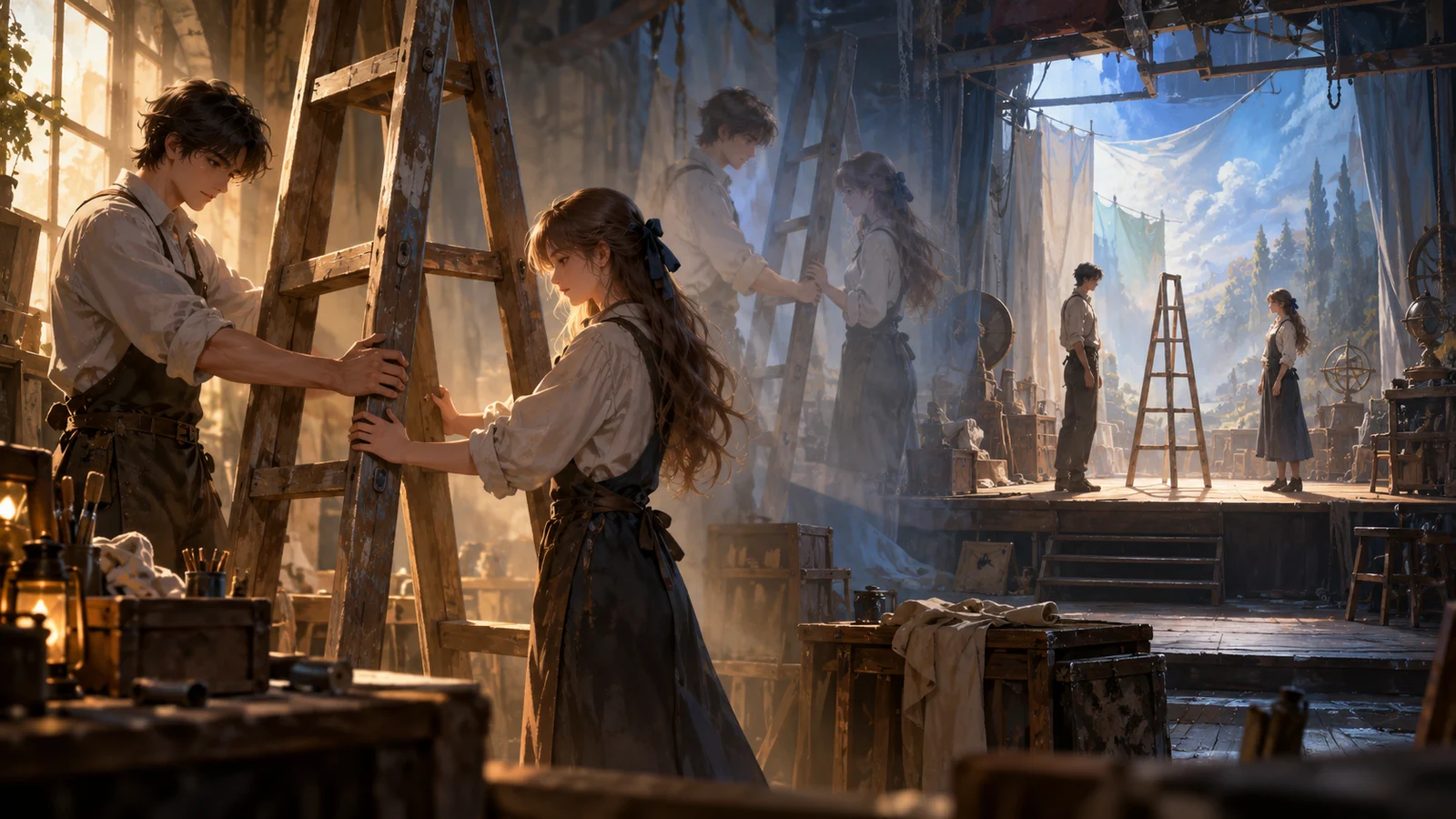
Suppose the CG ends with Lin He on the left of a wooden ladder, holding it with both hands. Zhou Cen stands on the right, with one hand on the ladder and the other lowered. Both lean forward, close to one another across the ladder. The ladder has stopped wobbling, but neither character has let go. The tool-room door is at the rear right, and light enters through a window on the left.
The next scene calls for the two to discuss a borrowed logbook in the tool room. The available sprites show only ordinary standing poses with both hands lowered; there are no poses for holding the ladder, withdrawing a hand, or stepping back. In the background, the wooden ladder stands toward the rear, near the center of the frame. The first problem to solve is therefore not the transition effect, but how the three hands holding the ladder in the CG become empty hands in the regular scene.
Comparing the states reveals three gaps: contact has not ended, the characters have not straightened up, and their close proximity has not become separate positions on the left and right. The ladder itself does not need to move, so it should stay where it is. Do not casually remove it when restoring the background just to tidy up the composition.
“The ladder has stopped wobbling” establishes only the prop’s state. “The characters are now standing apart” still requires letting go and stepping away. One cannot stand in for the other.
Use the continuity card to define the destination and where to explain each change
Start with the target sprites, then work backward to the actions required to reach them. You can reuse the card below by replacing the characters, props, and dialogue. Every field should describe a specific state rather than simply say “smooth transition.”
| Field | Entry for this example |
|---|---|
| Final state | Lin He holds the ladder with both hands; Zhou Cen holds it with one. Both lean forward and stand close together. The wooden ladder is stationary between them. |
| Unfinished actions | Zhou Cen withdraws his hand from the ladder first. Lin He then lets go with both hands. Both straighten up and step outward, away from one another. |
| Target sprites | Lin He stands on the left and Zhou Cen on the right, both with their hands lowered. A visible gap separates them, and neither is pressed close to the ladder. |
| Where the prop ends up | The wooden ladder stays where it is, matching its position toward the rear, near the center of the background. No one holds it; it is not carried, folded, or made to disappear. |
| Dialogue resumption point | Lin He asks where the logbook is only after both have let go and their separate standing positions have been established. |
| Presentation breakdown | Confirm that the wobbling has stopped while the CG is on screen. After the CG clears, use narration over a brief black screen to establish the withdrawal of hands and the steps apart. Begin the new topic after the background and target sprites appear. |
“Complete” on this card means that both the story and its presentation have accounted for the change. It does not require a separate image for every movement of every joint. However, narration must not contradict a pose that is still visible. If the CG clearly shows her holding the ladder with both hands, do not simultaneously announce that she has put her hands in her pockets.
Also check the card against the available assets. If the background contains no ladder, the handoff is not yet ready to present. Add the prop to the background, or adjust the composition so its original position plausibly falls outside the frame. Writing it on the card does not mean the audience has seen it.
Turn the card into a complete staging handoff
This example uses a brief black screen to bridge the actions, avoiding the need for existing standing poses to convey hand movements they cannot depict. Here is the staging script:
[Hold the event CG] The wooden ladder no longer wobbles. Both characters still have their hands on it.
Zhou Cen: “There we go.”
[Clear the CG and transition to a brief black screen. Do not show the ordinary standing sprites yet.]
Narration: Zhou Cen withdraws his hand from the ladder first. Lin He also lets go with both hands and straightens up. They each step outward, away from one another. The wooden ladder stays where it is.
[Show the tool-room background] The wooden ladder remains toward the rear, near the center of the frame. The window light continues to come from the left.
[Show Lin He’s ordinary standing sprite on the left and Zhou Cen’s on the right] Both have their hands lowered, with a gap between them.
Lin He: “Oh, where did you put the logbook you borrowed yesterday?”
Zhou Cen: “On the upper shelf of the cabinet by the door. I’ll get it.”
“There we go” closes out the original action and can be spoken while the CG is still on screen. The question about the logbook introduces a new topic and should wait until the target state has been established. The dialogue resumption point is therefore not the first voice heard in the entire scene. It is the point where the regular scene takes up the conversation again.
The final line expresses only Zhou Cen’s intention to fetch the book; he has not moved yet. If the staging continues, walking to the cabinet, picking up the book, and returning still need to be written. The logbook cannot simply appear in his hand on the next line.
Decide what to omit when you have no pose variants
Cutting straight back to the default standing sprites and having Lin He ask about the logbook leaves the reader to infer all three actions: letting go, straightening up, and stepping apart. If their earlier closeness arose only from moving a prop, this omission may still be understandable. But when a lingering hand or a body reluctant to step away carries emotional weight, omitting the action changes what the moment says about their relationship.
This example uses one passage of narration to make the order of actions explicit, at the cost of briefly letting text take over from visual presentation. The black screen should serve only to conclude this action. Do not add memories or explanations to it, or you risk turning a continuous moment into an apparent time skip.
Alternatively, before producing the CG, you can design its final image with both characters already having let go and about to step away, reducing the work the exit must do. The tradeoff is losing the shared act of holding the ladder as the final tableau. If the CG is already fixed, another option is to crop out the hands and add narration describing the action. Check, however, that the crop does not remove the expression or contact that truly matters here.
If “who lets go first” is the scene’s emotional turning point, preserve an explicit account of the order and add a dedicated image if necessary. A soft crossfade connects images; it cannot explain who actively ends the contact. While both images are visible, it may also briefly superimpose the poses of holding the ladder and standing with hands lowered.
Review backward to find gaps in the handoff
Start with the first line of the new topic and read backward. Where are the characters when they speak? Are their hands empty? Where is the ladder? Which beat established each state? If you cannot find the corresponding action, return to the continuity card and fill the gap instead of extending the fade again.
Next, hide the narration over the black screen and look only at the images before and after it. If the background places the ladder by the door while the text says it “stays where it is,” correct its position. If the ordinary sprites still overlap, the image also fails to support the text’s claim that they “each step outward, away from one another.” Finally, check the window light, the characters’ left-right arrangement, and spatial landmarks separately, so the actions connect without making the room seem to have changed.
This card is suited to connecting an event CG and a regular scene at adjacent moments in the same location. If the intention is to jump to the next day or another location, establish that change in time or place clearly; there is no need to stage every action involved in leaving. If the contact itself determines the meaning of a confession, rejection, or conflict, do not compress it solely to save assets. The handoff is complete when readers can explain, from what is actually presented, how the characters move from the CG’s final state to the next line of dialogue.