When Does a Visual Novel Need Event Art? Are Character Sprites Enough?
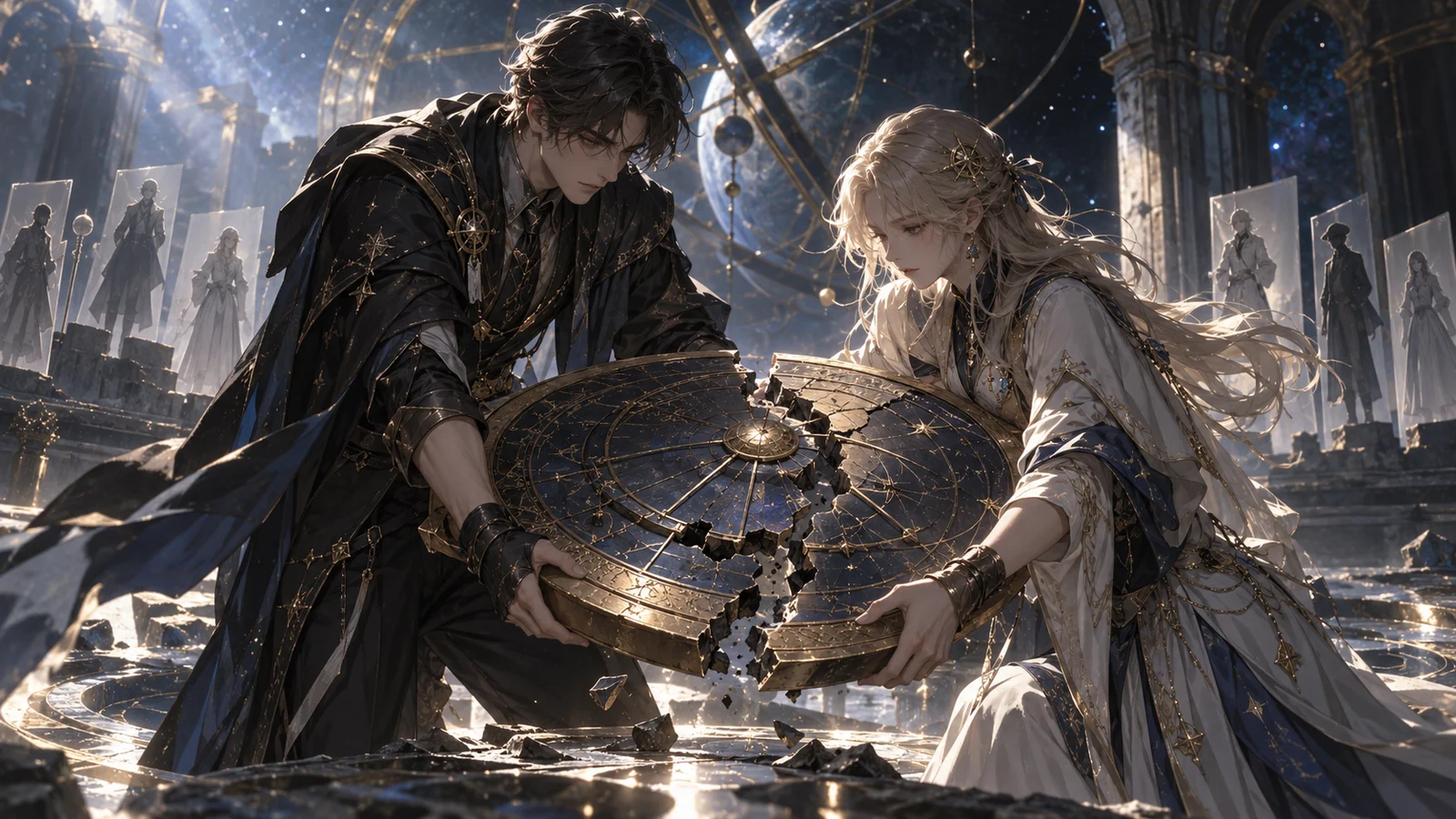
An emotionally important scene does not automatically need event art. First list the contact points, weight-bearing relationships, and spatial positions players must see, then decide whether standard character sprites, a hand close-up, or an illustration of the complete action can convey them. A fictional astrolabe repair scene shows how to fill out an event-art decision card you can hand directly to the lead artist.
Introduction
A clear reason for a visual novel to use event art is that the physical relationships players must see in a scene exceed what the existing character sprites can express. Strong emotion can motivate an artistic choice, but it cannot determine the deliverable on its own. First specify who touches what, who supports whom, and how position affects the action. Then choose standard character sprites, a detail illustration, or a complete event illustration.
Turn “this scene matters” into relationships players must see
This article uses a fictional teaching example: an adult restorer and an adult apprentice jointly supporting a damaged astrolabe. The characters, actions, and proposed deliverables are original demonstrations. They are not a real user case, tested results, or a description of DramaFork features, and they are not tied to any particular engine.
The setup is this: the astrolabe’s outer ring has broken, and the restorer supports its main body with both hands. The apprentice initially steadies the outer ring, then moves to the restorer’s right, braces the restorer’s forearm with their shoulder, and catches the sinking end from below. The story needs to convey more than two people happening to reach out at once. The apprentice deliberately changes position to share a weight the restorer cannot sustain alone.
The director first breaks that meaning into three relationships the player must see: where each person’s hands touch the astrolabe; how the apprentice’s shoulder supports the restorer’s forearm; and how both people stand around the tilted astrolabe. Crack patterns, tool arrangements, and clothing details can add atmosphere, but they do not determine this decision.
Calling something essential to see requires a reason. If the later story only needs players to know that the repair is complete, text can summarize the action. If the turning point in the relationship comes from the apprentice actively taking some of the load, the specific way they do so deserves to be visible. Establishing the narrative requirement first prevents every action from becoming an illustration request.
Compare three visual options against the same relationships
Suppose the available assets are two separate, front-facing character sprites in standing poses, with arms hanging naturally and no poses for holding objects or touching one another. The comparison below concerns only these assets. It does not imply that character sprites as a format are generally incapable of showing complex actions.
| Option | What it can establish clearly | What is still missing in this example |
|---|---|---|
| Standard character sprites with dialogue | Who is speaking and who is willing to help; narration can describe the action | No visual evidence of the contact points, shoulder-to-forearm support, or shared load |
| Hand detail illustration | Where both pairs of hands sit against the astrolabe’s edge, and the direction of support from below | The shoulder support and character positions remain outside the frame, leaving their full-body coordination unclear |
| Complete action illustration | The spatial relationships among the hands, shoulder, forearm, and astrolabe | One image still cannot establish the sequence by itself; preceding text must explain the change |
Simply saying “Let me help” conveys willingness, but does not distinguish between steadying the outer ring and taking the weight of the main body. Moving two standing sprites closer together only changes their positions on screen. In this example, their hands and shoulders still do not form the necessary contacts.
A hand close-up provides more evidence of contact than dialogue alone, but four hands in the frame do not automatically make shared weight clear. If the palms merely rest against the edge, players may still read the gesture as steadying the object or pointing something out. The supporting hand positions need to make sense in relation to the object’s tilt.
Whether a detail is enough depends on what the crop removes
Start with a narrower candidate: show the astrolabe’s lower edge, the restorer’s hands, and the apprentice’s hands supporting it from below. Keep the cuffs distinct so players can tell whose hands are whose. If the scene only needs to establish that the apprentice catches a falling component, this detail already shows the object of contact and the direction of the action. There is no need to add both full figures merely for completeness.
This example, however, retains a further requirement: moving closer and bracing the forearm with a shoulder is what enables the apprentice to share the lift. Showing only the hands crops out that relationship. Adding a line such as “Rest your arm on my shoulder” makes the information readable, but the image still does not perform the visual task originally assigned to it.
The choice here is therefore a complete action illustration. “Complete” means that all essential physical relationships are present. It does not require visible toes, the entire workshop, or every tool. The composition can include only the two figures from head to hip, the whole astrolabe, and the necessary section of table edge, provided their positions and body lean remain legible.
State the cost as well: a wider composition requires character proportions, contact positions, and overlaps to be checked together. A detail illustration is more focused, but loses information about how the bodies work together. Choose according to the meaning this scene needs to retain, rather than ranking the options by image size.
Record the decision on an event-art decision card
The following card can serve directly as the art brief for this example. For another scene, keep the fields and replace the relationships and reasoning, rather than leaving the artist with “Important story moment—make it spectacular.”
| Field | Entry for this example |
|---|---|
| Scene objective | Let players see the apprentice actively take some of the load as the two stabilize the astrolabe together |
| Relationships that must be visible | The restorer supports the main body with both hands; the apprentice catches the right end from below; the apprentice’s shoulder braces the restorer’s forearm |
| Gap in standard sprites | The existing standing poses show neither lifting nor shoulder-to-forearm contact; repositioning them still cannot depict a shared load |
| Detail alternative | A close-up of the hands and the astrolabe’s lower edge; use only if the shoulder-support requirement is removed |
| Illustration scope | Both figures from head to hip, the entire astrolabe, and a small section of table edge; sleeves and the astrolabe’s face must not hide contact points |
| Condition for starting the illustration | Confirm that shoulder-to-forearm support must be shown and that the existing assets cannot express it clearly |
| Condition for displaying the image | Earlier text has established the broken outer ring and the restorer’s difficulty holding it alone; display the image when the apprentice has taken some of the load |
| Acceptance question | Can viewers identify who each hand belongs to, the shoulder-to-forearm contact point, and who supports the sinking end? |
First, the scene writer confirms the relationships that must be visible. Next, the lead artist marks the contact points in a sketch. Finally, the director checks that the composition retains every required relationship. There is no need to discuss lighting effects or intricate patterns yet: prettier colors cannot recover a hidden point of support.
The proposed deliverable for this example is one complete action image, with no additional hand close-up. If it is unclear who each hand belongs to in the sketch, first adjust the angle and overlaps. Reconsider adding an image or splitting the action only if one composition truly cannot accommodate all the essential information. This is a plan awaiting execution, not a record of work that has already passed review.
Check the scope through misreadings, and keep revision criteria
When reviewing the sketch, temporarily cover dialogue that explains the action and try to describe who supports what with which part of their body. This checks which information the image carries; it does not require the entire scene to work independently of text. Then restore the preceding text and check whether the change in action follows coherently.
Three misreadings would require revision in this example. If the apprentice appears to push the astrolabe away, the direction of support is unclear. If the shoulder merely sits near the forearm, the contact has not been established. If the two seem to be fighting over the astrolabe, their body orientations or the implied forces conflict with a shared load. Revise the sketch to address the misreading, rather than adding an explanation that conceals the same visual contradiction.
Also beware of squeezing an action sequence into a single instant. One image can show the state after the apprentice takes some of the load, but it cannot automatically prove that the apprentice first released the outer ring and then changed position. If that order itself affects how the story is understood, add the necessary text or split the sequence across images, then revise the stated deliverable scope.
This card suits scenes whose actions and spatial relationships are already defined. If the writer has not yet decided exactly where a character provides support or why they must move closer, revise the action design first. If the focus is entirely on inner monologue, or the existing poses already express the necessary relationships, there is no need to adopt this example’s conclusion that a complete illustration is required.