How to Avoid Conflicting Expressions in Modular Visual Novel Character Sprites
Matching the positions of eyebrows, eyes, and mouths only suggests that the parts may fit together; it does not mean the performance works. Using a fictional watchmaker’s apprentice with tearful eyes, tightly furrowed brows, and a smiling mouth, this article builds a constraint table that separates geometric compatibility, expressive intent, prohibited combinations, and additional artwork.
Introduction
When a visual novel character sprite is split into eyebrows, eyes, and mouths, first check whether the parts fit together, then judge whether the whole face serves the intended performance in the scene. The person assembling the scene should receive an expression-combination constraint table that lists permitted pairings, conditions of use, and missing artwork. Matching positions is only the first hurdle. Unreviewed combinations cannot automatically be treated as usable.
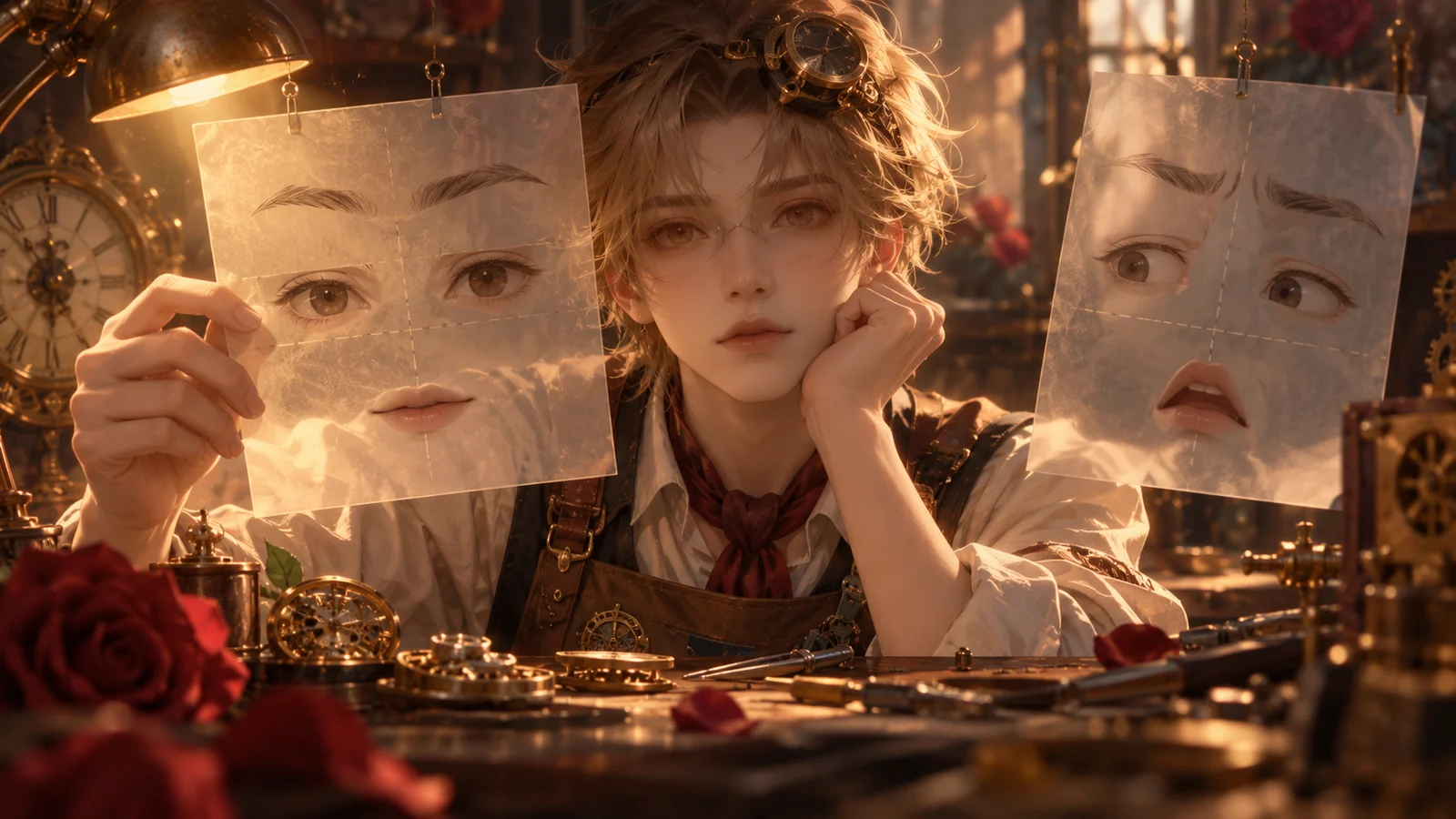
The example below features Heng, a fictional watchmaker’s apprentice. He has damaged a customer’s pocket watch and is trying to remain polite despite the tears in his eyes. The character, scene, parts, and judgments are all teaching constructs, not a real user case, measured results, or DramaFork product features. The combinations discussed here are written thought exercises; they have not been drawn or visually validated.
First, define what the face needs to convey
Write the scene’s objective in one sentence: “Heng is about to cry, but still wants to reassure the customer.” This defines both his inner emotion and his outward attitude, making it more useful for choosing parts than simply writing “sad.” A smiling mouth can help convey his effort to remain polite. The presence of a smile alone does not make the expression wrong.
Start by listing the candidate parts: level brows, tightly furrowed brows, and gently furrowed brows; forward-looking eyes and tearful eyes; a neutral mouth, a smiling mouth, and a restrained smile. Here, the smiling mouth has noticeably raised corners, while the restrained smile uses a shallower curve. These represent different performance choices and should not be handed off merely as “smile 1” and “smile 2.”
This example covers only static combinations on the same front-facing portrait. Profile views, upward head tilts, and exaggerated distortions need separate sets of parts; do not assume they share components. Otherwise, an editor may see identical file dimensions and mistakenly assume the parts are interchangeable.
Check geometric compatibility at the joins and in accompanying strokes
First, choose a base face and fix the canvas, head position, and scale. Then record reference positions such as the point between the brows, the inner and outer eye corners, and the mouth’s centerline. These points are for checking alignment, not for insisting that every brow stroke remain fixed. Furrowing the brows can naturally change the distance between the brows and eyes.
Overlay the candidate parts on the base face. Check whether the inner ends of the brows intrude into the upper eyelids, tear highlights extend beyond the eye contours, lines around the mouth collide with the base of the nose, or traces of an old expression remain on the base artwork. Also check occlusion: if the fringe covers the brows, changing the brow shape must not suddenly bring them in front of the hair.
For this example, assume the tightly furrowed brows include a downward stroke of shading between them, while the tearful eyes include raised upper-eyelid lines. When overlaid, these details crowd into each other. This is a geometric conflict. Moving the entire brow component upward might remove the overlap, but it could also weaken the intensity of the furrow. Review the whole face rather than checking only whether the overlap has disappeared.
Define which component owns each accompanying detail. Here, tear highlights and wet lower-eyelid lines belong to the tearful eyes; tension lines beside the mouth corners belong to the mouth. Remove these details from the base face to avoid duplication. If a cheek shadow depends on both the eyes and the mouth corners, list it as additional artwork specific to that combination instead of forcing it into a reusable component.
Separate permitted, needs-fixing, and prohibited combinations in a constraint table
The table below is a planning draft for this example. “Permitted” means a combination can be considered a candidate in this thought exercise; the actual assembled artwork still needs checking before final delivery. “Needs fixing” does not mean temporarily usable.
| Part combination | Geometric compatibility conditions | Expressive intent | Prohibited combinations or states | Additional artwork required |
|---|---|---|---|---|
| Level brows + forward-looking eyes + smiling mouth | Mouth-corner tension lines must not duplicate those on the base | Routine, polite customer service | Do not use for the key response in this scene, where he is holding back tears | None |
| Tightly furrowed brows + tearful eyes + neutral mouth | Shading between the brows must clear the raised eyelids; currently needs fixing | Self-reproach on the verge of tears | Entire combination prohibited until corrected | Redraw the shading between the brows and save a separate compatible brow component |
| Level brows + tearful eyes + smiling mouth | Tear lines remain intact; no overlapping lines around the mouth | A possible candidate for a forced smile | Do not use for the reassurance to the customer until the whole face has been reviewed | Switch to the restrained smile if necessary |
| Gently furrowed brows + tearful eyes + restrained smile | Appropriate space between brows and eyes; mouth-corner tension is not excessive | Upset but remaining polite; preferred candidate for this scene | Do not directly substitute tightly furrowed brows or the smiling mouth | Draw the gently furrowed brows and restrained smile separately |
| Tightly shut eyes + open crying mouth + cheeks pulled by the expression | Eyes, mouth, cheeks, and jaw must work together as a whole | Finally unable to maintain his polite composure | Do not force this expression together using the static parts above | A dedicated full-face crying variant |
When reusing this method, fill in the expressive intent first, choose the parts next, and then document geometric conditions and restrictions. State whether a prohibition is due to “parts colliding,” “not yet reviewed,” or “unsuitable for this scene’s performance.” Do not reduce all three to “unnatural.” The same combination may work in another scene. A scene-specific prohibition does not mean the combination must be discarded permanently.
Work through selection and revision using one line of dialogue
Heng says, “I’ll fix it. Please give me a little more time.” The first version uses tightly furrowed brows, tearful eyes, and a smiling mouth. Start by checking the brow–eye junction against the table: the shading overlaps the eyelid. The combination has failed the geometric check, and the dialogue cannot explain that away.
For the second version, replace the brows with the compatible component. Assuming the overlap has been resolved, examine the performance. Strongly furrowed brows together with visibly raised mouth corners might make him seem reluctant as he offers this reassurance, or they might be read as an effort to hold back emotion. At this stage, record the risk of differing interpretations. Do not claim that the combination necessarily signifies anger or insincerity.
If the scene needs to convey politeness more clearly, use gently furrowed brows, tearful eyes, and a restrained smile, and place the objective sentence beside the complete portrait. Review it together with the dialogue: does he still look close to tears, and does the smile draw attention away from the apology? If the expression only works after a lengthy explanation, keep adjusting the parts or switch to a dedicated expression.
This choice adds two pieces of artwork in exchange for a clearer performance option. If the state appears only once, a dedicated full-face expression may be easier to manage. Keeping separate brows and a mouth is useful for reuse only if several moments call for the same restrained politeness. Let the actual usage determine whether the expression should be split into parts.
Deliver selectable combinations and mark where redrawing is required
In the handoff package, each approved combination should include a complete portrait preview, a combination name, its component parts, suitable dialogue or situations, and reasons for any restrictions. When the editor selects “remaining polite through tears,” they should be able to find the prescribed pairing without guessing again what the brows, eyes, and mouth mean. Mark every unlisted combination as awaiting review. The absence of an explicit prohibition does not make it usable.
After modifying a component, list the combinations that reference it and review their previews again. For example, changing the upper eyelids of the tearful eyes means rechecking their relationship with the level brows, gently furrowed brows, and compatible brow component. Old previews can no longer stand in for the revised parts.
Consider redrawing the full face when a change affects the cheeks, nasal wings, jaw contour, or head perspective. Emotional intensity alone is not the deciding factor. The key question is whether local replacements can still preserve both facial structure and a coherent performance. Even a faint, rueful smile may need dedicated cheek lines, while obvious tears do not necessarily require a full-face redraw.
This table supports planning static modular artwork and handing it off between people. It does not specify how blinking or speaking mouth shapes switch at runtime. It can preserve reviewable reasons for the choices made, but it cannot guarantee that every reader will interpret the result in the same way. The actual artwork still needs to be checked at its intended display size, as a complete portrait, and alongside the specific dialogue.