Are Resource Costs Just Stalling? Check What Each Cost Changes
If repeated searches drain stamina but always lead only to “keep searching,” you may be charging repeatedly for the same turn. Use a resource-cost review sheet to check whether each cost changes information, access, commitments, or risk. If a turn serves only emotion, pacing, or deliberate futility, assess separately why it should stay and why it should cost resources.
Hide the stamina numbers first and check whether the next move changes
To identify searches that go nowhere, first hide the stamina loss and descriptions of exhaustion. Then compare the situation before and after the action: has anything concretely changed in what the player knows, can reach, has promised, or must face? If the result is still “nothing found; you can keep searching,” flag the turn for review. Spending resources proves that a cost was paid. It does not, by itself, prove that the turn deserves to exist.
This review examines the purpose of repeated actions; it does not require every search to yield an item. Ruling out a thoroughly searched area, opening a passage, owing someone a favor, or even losing an escape route can make failure a meaningful result. What matters is whether the change affects later choices. If the turn serves only an expressive purpose, explain separately why it should remain.
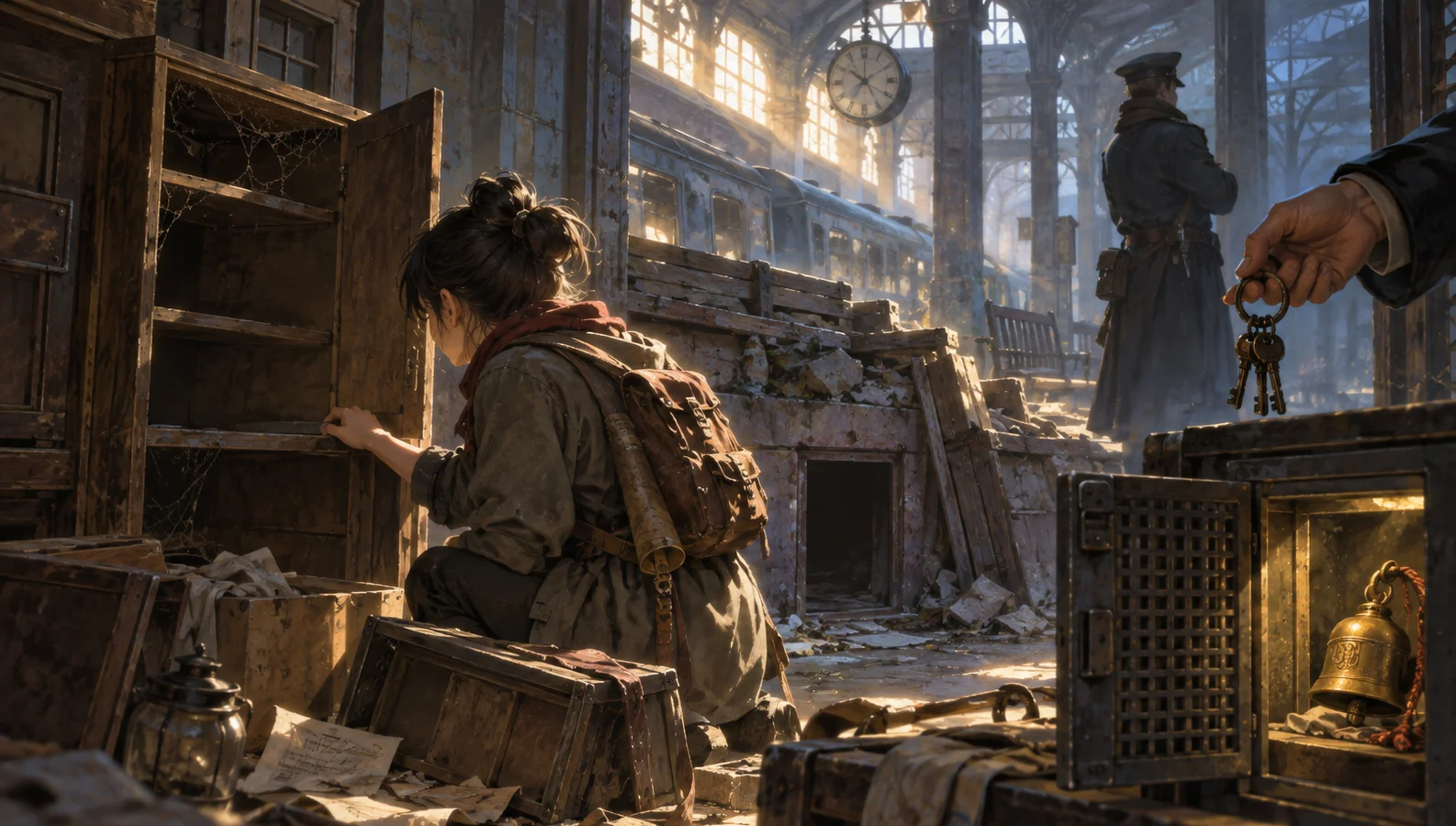
The fictional teaching example below is called The Bell at the Old Station. A messenger named Ahe must find a copper bell in an abandoned station. Ahe starts with six stamina points, and each search costs two. The characters, rules, and outcomes were constructed for this explanation. They are not a real user case, measured results, or product features, and they do not imply that DramaFork performs these checks automatically.
Review each turn with a resource-cost review sheet
Divide turns by action and target, not by paragraph. “Search the west cabinet” may occupy three paragraphs and still be a single action. For each turn, record the cost, evidence of change, and effect on the next move, then identify the category of change. You do not need all four categories; one well-supported change is enough. If none applies, examine the turn’s expressive purpose.
| Category | Review question | A valid record | Common false change |
|---|---|---|---|
| Information | Which unknown has been narrowed down? | The west cabinet has been fully searched and can be ruled out | Another feeling that the bell is nearby |
| Access | Which place can now be entered, or can no longer be entered? | Clearing the debris makes the maintenance opening passable | Moving to another corner of the same room |
| Commitment | Who now has to do what? | In exchange for a key, Ahe promises to deliver a letter for the caretaker | The other person sounds slightly friendlier |
| Risk | What has changed about the conditions that trigger a consequence? | Noise from the search draws the caretaker over; staying will lead to questioning | The atmosphere feels more dangerous |
To use the template, fill in this line for each turn: Action and target|Explicit cost|Fact before → fact after|Player-visible feedback|Change to the next move or expressive purpose|Editorial decision. Choose keep, add evidence, merge, or delete. Do not rush into polishing the prose.
Describe the “change to the next move” as an action. “The search is progressing” cannot be checked; “stop searching the west cabinet and examine the maintenance opening” can. For changes the author has arranged out of sight, note when they become apparent. A secret the player can never perceive cannot justify repeated charges. If the turn serves only an expressive purpose, specify its particular contribution too.
Turn three fruitless searches into a causal chain
In the old draft, Ahe searches the waiting room three times in a row. The first search leaves dust all over Ahe’s hands; the second overturns a cardboard box; the third brings a strange sound from far away. Stamina falls to four, two, and zero. The bell never appears, and every turn offers only “keep searching.” The sound has no source or later effect, and the box was not blocking anything. The wording changes, but the conditions informing the player’s decisions do not.
The revision first defines the scope: only the west cabinet and the blocked maintenance opening currently need attention in the waiting room. It then breaks the vague action “search” into actions with specific targets and results.
| Action and cost | Before-and-after change and visible feedback | Change to the next move | Decision |
|---|---|---|---|
| Search the west cabinet, stamina six → four | The entire cabinet, including the space between its panels, has been searched and found empty; an inscription on the bottom panel records that old belongings were moved to the maintenance room | Rule out the cabinet and turn to the maintenance opening | Keep |
| Move debris away from the maintenance opening, four → two | The entrance becomes passable; a locked cabinet is visible inside | Enter to inspect the locked cabinet, or stop and leave | Keep |
| Search the west cabinet again, two → zero | No new tool, search area, or question | The maintenance room remains the search target; stopping is still possible | Delete as a separately charged turn |
After deleting the third turn, Ahe still has two stamina points. The author must not quietly open the locked cabinet for the player. Entering to inspect it costs no stamina. Before choosing, Ahe sees the bell through the grille in the cabinet door and can also see that a side panel is missing. A movable partition blocks the gap; once moved, the gap is large enough to reach through and retrieve the bell. The caretaker also explains the terms for borrowing the key.
Two routes are now offered: spend two stamina points moving the partition and retrieve the bell through the side gap; or borrow the caretaker’s key, keeping the stamina but promising to deliver a letter for him before leaving the station. The physical arrangement, costs, and obligations are all explained before the choice. The player may also leave the bell for now.
This does not prove that borrowing the key is better. Moving the partition remains reasonable for someone who does not want to accept the delivery task. If a separate stamina requirement for the return journey has been explained in advance, promising to deliver the letter may be more appealing. The review should confirm that a trade-off exists, not prescribe the correct way to play.
When a search yields nothing, decide whether to merge it or keep it
A fruitless search can provide information that rules something out, but that conclusion needs a defined scope and sufficient grounds. “Touched the cabinet door” does not support “the bell definitely is not inside.” This example rules out the cabinet only after explicitly establishing that every level and the space between its panels have been searched. If the space between the panels remains unchecked, preserve that uncertainty instead of presenting a definitive conclusion.
If you only want to retain the exhaustion of a long search, merge identical clicks into a single “search the west cabinet thoroughly.” State the total cost and scope beforehand, then deliver the results together at the end. Merging does not mean automatically carrying over the combined cost of three separate searches; the total cost still needs to be assessed. Without a new decision point along the way, splitting the action into three turns usually adds no choice.
If the focus is the gradual approach to giving up, you can keep separate stages, but allow the player to stop after each one and show both the searched area and what remains unknown. Falling stamina can also change the situation. For example, you might add a heavy cabinet and explain beforehand that moving it requires four stamina points. Dropping to two would then close that route. Record the specific threshold. Do not merely rename a falling number “risk.”
Another possible purpose is to portray futility: Ahe knows the west cabinet is empty but searches it repeatedly anyway, revealing an unwillingness to accept disappointment. Make sure the player understands this as stubborn persistence, and offer a chance to leave. Do not package it as an ordinary search that may still reveal a clue. If it still costs stamina, disclose that cost beforehand and explain what the repeated expenditure contributes to the portrayal. Calling an action “futile” does not automatically justify charging for it.
Use a deletion check to catch false progress after revision
After revising, temporarily remove a turn and read the turns on either side together. If the known facts, available routes, character obligations, and conditions that trigger consequences all connect unchanged, the turn may be redundant. If removing the debris-clearing action leaves Ahe entering the maintenance room directly, however, a specific gap appears. That shows the action establishes the condition for entry.
The deletion check has limits too. A turn may serve only character emotion or pacing. Removing it may preserve the sequence of events while losing something in the telling. Specify what is lost, then separately assess whether it requires the player to spend additional resources. A valuable narrative passage can also remain as description without a resource charge.
Finally, check whether ruled-out areas are still recommended as entirely new targets, whether new commitments are fulfilled later or can be explicitly broken, and whether new risks alter consequences. If the promise to deliver the letter vanishes completely after the key is obtained, the commitment route becomes a free shortcut.
The finished draft should leave a checkable reason for every cost. For turns that affect decisions, state clearly: “This action changes what can be done next, what cannot be done, or what must be considered.” For turns serving only emotion, pacing, or deliberate futility, specify their expressive purpose and explain why they retain a cost, become description without a resource charge, or are merged. If neither kind of reason holds, add evidence, merge, or delete. Do not conceal a lack of progress by deducting more resources and adding descriptions of exhaustion.