How to Design Conversation Order in a Train Lost-Item Story: Each Passenger Provides Only One Necessary Piece of Information
Conclusion first: treat "who speaks first" as part of the elimination process, not as a plot reward. Each passenger holds only one fragment that can verify the ticket stub, seat, or transfer record; players can ask in any order and still get the fragments, but only by combining the three pieces of information "ticket stub missing corner—seat orientation—transfer station name" can they confirm the item's ownership. Below, a fictional teaching example, "Car Twelve," walks through the complete construction; the numbers and dialogue are design examples, not measured data.
Introduction
Conclusion first: treat "who speaks first" as part of the elimination process, not as a plot reward. Each passenger holds only one fragment that can verify the ticket stub, seat, or transfer record; players can ask in any order and still get the fragments, but only by combining the three pieces of information "ticket stub missing corner—seat orientation—transfer station name" can they confirm the item's ownership. Below, a fictional teaching example, "Car Twelve," walks through the complete construction; the numbers and dialogue are design examples, not measured data.
First define three necessary pieces of information, not three suspects
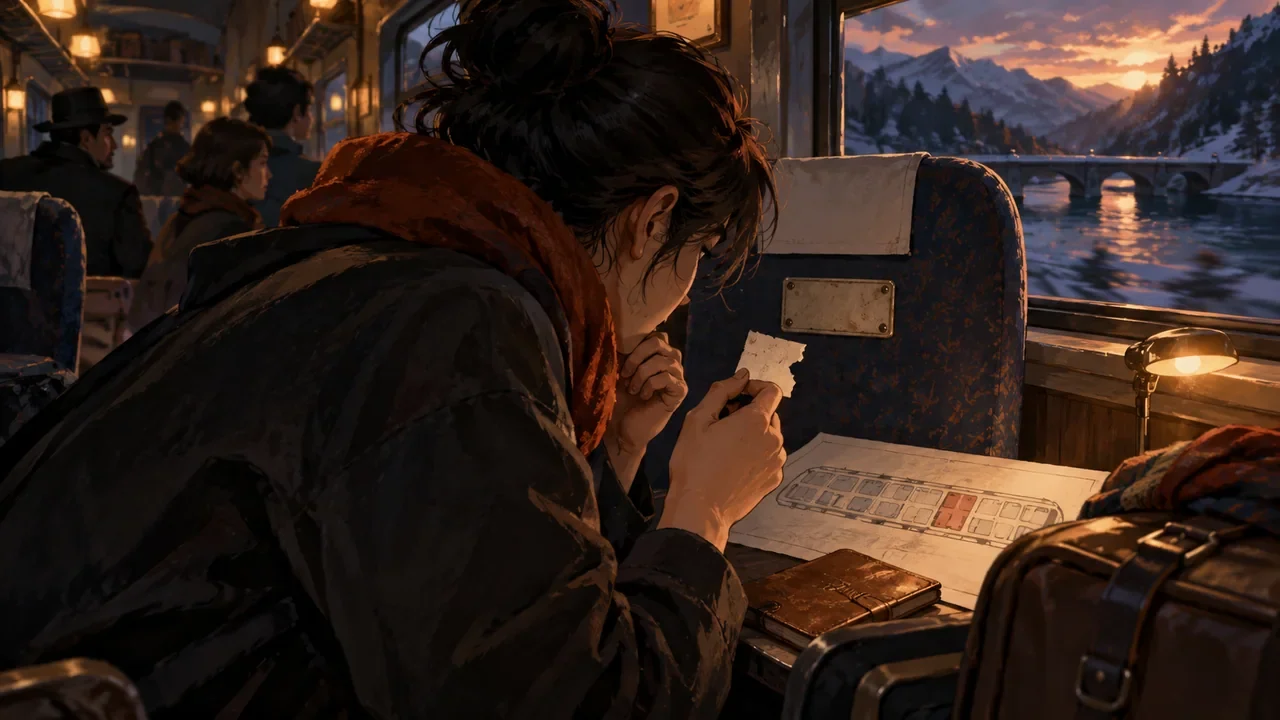
In "Car Twelve," the protagonist is looking for a gray cloth ticket holder with an old ticket stub torn off at one corner inside. The three passengers each know one thing:
| Passenger | Seat | The one piece of information provided | Information type |
|---|---|---|---|
| The old person knitting a scarf | 12A | The ticket stub's missing corner is at the upper left, and the tear faces inward | Object feature |
| The young person holding a instrument case | 12C | The owner originally sat in 12B and changed to 9F midway | Seat change |
| The dozing commuter | 12F | The transfer station is "Liuqiao," not "Liuqu" | Transfer record |
The three pieces of information are independent of one another, and none can confirm the ticket holder's ownership on its own. The old person's mention of the missing corner can only narrow it down to "a ticket stub with a missing corner"; the young person's mention of the seat can only narrow it down to "someone who was once near 12B"; the commuter's mention of the station name can only eliminate the wrong path of "Liuqu." Players must obtain at least two pieces before they can begin cross-checking, and all three before they can confirm.
Two visit orders both work
When designing, first write two orders to ensure there is no deadlock where "you must follow a certain path."
Order one: ask the old person first, then the young person, and finally the commuter. After the old person gives the missing-corner feature, players can inspect the ticket stub in the seating area; the young person adds the seat change from 12B to 9F, and players realize that 12B is now empty; the commuter adds "Liuqiao," and players match the station name on the ticket stub with the transfer record.
Order two: ask the commuter first, then the old person, and finally the young person. The commuter first gives "Liuqiao," and players may first check the transfer table and discover that Liuqiao Station indeed stops Car Twelve; the old person then gives the missing corner, and players return to the object itself; the young person finally adds the seat change, and only then do players connect "who sat in 12B" with "who got off at Liuqiao."
The difference between the two orders is only which clue players check first; it does not change the final confirmation condition. The benefit of writing it this way is that players will not get stuck because they asked the wrong person first, nor will they permanently fail to get key information because they skipped someone.
Exchange information, not continuous interrogation
The continuous-interrogation approach is: ask A, A finishes speaking, ask B, B finishes speaking, ask C, C finishes speaking, and then suddenly draw a conclusion. The information-exchange approach is: after players get one piece, they can take it to ask another person, letting that person supplement or correct it.
For example, players first ask the old person, who says: "The tear faces inward, as if it was pulled when taken out of the ticket holder." Players can take this sentence to ask the young person: "Have you seen anyone pull a ticket stub from 12B?" The young person answers: "I didn't notice the ticket stub, but the passenger in 12B changed seats before Liuqiao." Here the young person does not repeat the old person's information, only adds the seat change. Players then take "Liuqiao" to ask the commuter, who says: "Liuqiao is right; Liuqu is the previous station, don't mix them up." The commuter also does not repeat the seat information, only corrects the station name.
This kind of exchange gives every dialogue segment new content, so players will not feel they are repeatedly asking the same thing.
Final confirmation and misidentification feedback
After all three pieces of information are gathered, the confirmation action must be specific. Players find the ticket stub in the inner layer of the ticket holder and check three points: the missing corner is at the upper left, and the tear faces inward; there is a pencil mark of 12B on the back of the ticket stub; the station name is printed as "Liuqiao." If all three points are correct, the system gives confirmation feedback: "The ticket stub matches the owner's description." If only two pieces are obtained, the feedback is: "The missing corner matches, but the station name is still one step short." If what is obtained is "Liuqu," the feedback is: "The station name does not match; it may be the previous station."
Misidentification feedback must also be written clearly. Players may mistake 12C's instrument case for the ticket holder because both are gray cloth. At this point the young person will say: "This is my instrument case, not the ticket holder." This sentence is not a new world fact; it is only the character correcting a misidentification. Players will not gain a new clue from it, but they will know that "gray cloth" is not the only feature and that they need to keep looking for the missing corner.
When writing dialogue, list the information first, then write the lines
Do not first write "the old person is very suspicious" or "the young person is very nervous," because that will lead players to focus on emotions rather than information. First list the three pieces of information, then give each piece one line of dialogue. Put only one piece of information in a line; do not stuff in a second piece.
Old person: "The tear faces inward, missing corner at the upper left." Young person: "The passenger in 12B changed to 9F." Commuter: "Liuqiao, not Liuqu."
All three lines are short, easy for players to remember, and convenient to quote in later dialogue. If the lines are too long, players will not be able to tell which sentence is the key one.
Completion check
After writing the conversation order, use the following five checks:
- Does each passenger provide only one necessary piece of information, with no one saying two?
- Do at least two visit orders exist, and can both obtain all three pieces of information?
- Can players take one piece of information to ask another person, rather than only asking in a fixed order?
- Does the final confirmation depend on the combination of three pieces of information, rather than on a single line of dialogue?
- Does the misidentification feedback only correct the error without adding new world facts?
If all five pass, the conversation order is sound. Next, you can write a minimal test: have a friend go through order one and order two once each, and see whether both can confirm the ticket holder's ownership. If one order gets stuck, first check whether some passenger has been written as "must be asked last."
Write the three passengers' lines on cards, shuffle the order, draw two first, and note what has been eliminated and what is still missing. Then add the third and check whether ownership confirmation can be completed. Two cards cannot produce the final answer, which matches this example's design of "three necessary pieces of information"; if all three are present and there are still multiple equally reasonable ownerships, then verifiable distinctions should be added.