How to Write an Interactive Story Collaboration Proposal: How Character Samples, Text Turns, and Playable Segments Showcase Creative Direction
A collaboration proposal should let reviewers quickly understand three things: what experience you want to create, which materials already prove your creative ability, and what problem you hope to solve together in the next stage. Character creators can submit character cards and dialogue samples, text authors can submit complete turns, and interactive film/game teams can submit playable segments; you do not need to complete all forms at once.
Introduction
A collaboration proposal should let reviewers quickly understand three things: what experience you want to create, which materials already prove your creative ability, and what problem you hope to solve together in the next stage. Character creators can submit character cards and dialogue samples, text authors can submit complete turns, and interactive film/game teams can submit playable segments; you do not need to complete all forms at once.
This article was organized by DramaFork and provides methods for preparing materials. The sample proposal is fictional teaching material and does not represent an actual collaboration case, admission standard, or support commitment.
First determine which kind of creation this proposal wants to discuss
"We want to make a global AI content universe" expresses a vision, but it does not explain what reviewers can judge right now. Narrow it down to one character, one player action, and one stage goal.
For example, the proposal for Rain Harbor Lost and Found could be: "Create a suspense prototype centered on an abnormal claim slip, let players verify records under a time limit, and decide whether to hand over the item. This round hopes to verify whether the information before the choice is sufficient."
This sentence gives the direction of the work and also explains why interaction is needed. Then write clearly the target readers and experience scenario: for readers who like reasoning, experience one complete event in the browser in the first stage. Do not use "suitable for everyone" to replace a specific task.
Choose representative works according to the ability to be proven
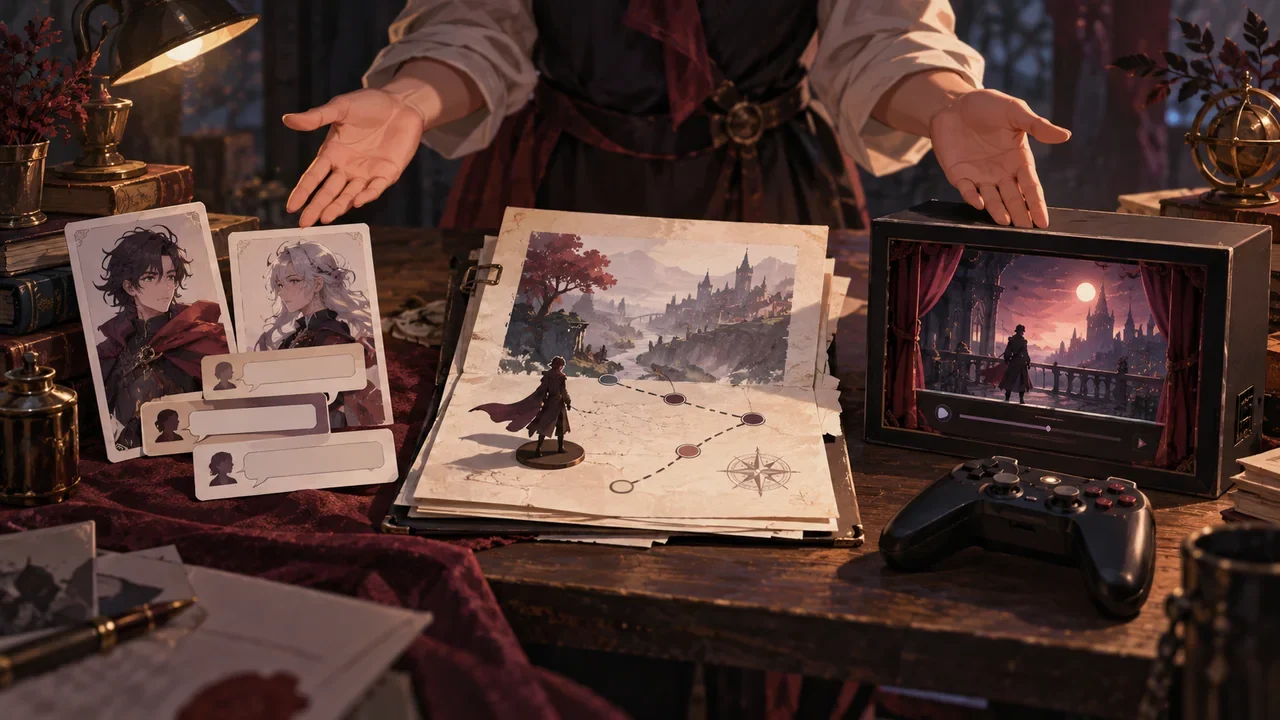
| Creative direction | Representative materials that can be submitted | What reviewers can judge from it |
|---|---|---|
| Character IP | Character cards, public biographies, several groups of dialogue in different situations | Whether goals, tone, boundaries, and responses are consistent |
| Text story | Initial state, complete turn, two action results | Whether player actions, costs, and feedback are coherent |
| Interactive film/game | Playable segment, path explanation, corresponding storyboard | Whether choices, performance, and media transitions can be experienced |
If what is shown is a temporary video or manually written character dialogue, note it directly. Reviewers need to know which content can already run and which only expresses design intent, and should not guess the completion state from polished packaging.
"Playable" in a proposal should also be truly operable. A concept video that can only be watched can serve as a visual sample, but it cannot independently prove that branching choices and endings hold up.
A one-page proposal needs to answer six questions
| Item | How to write it |
|---|---|
| Creative direction | Explain in one sentence the characters, conflict, and what players can do |
| Target readers | Specify interests, knowledge prerequisites, and experience scenario |
| Representative materials | One accessible link, with how to open it and what to focus on |
| Current progress | Write completed, being verified, and not yet produced separately |
| Next stage | Clearly state the specific product to be verified or produced |
| Collaboration question | Which ability, resource, or judgment needs discussion |
When controlling length, prioritize information that affects judgment. The team's full resume, long worldbuilding, and all future business ideas can be attachments; do not make reviewers read many pages before finding the representative work.
Numbers also need a basis. "One route completed" is more explainable than "80% complete." If the latter number has no clear scope of work, it is hard to judge whether it means the text is complete, the assets are complete, or it is actually playable.
A sample proposal you can organize by following
Work: Rain Harbor Lost and Found, a fictional suspense interactive story. The player is a night-shift partner who needs to verify a claim slip with an abnormal time and decide whether to hand over the item before closing.
Target readers and scenario: Readers who want to experience a short reasoning story; in the first stage, complete one key choice in the browser and be able to restart to view another result.
Representative materials: Prepare a character card, one complete text turn, and node explanations. If only one of these is available, submit that one truthfully, and do not write the non-running part as a completed Demo.
What currently needs verification: Whether players can explain the known cost of each choice, and whether they understand why Xu Lan refuses to skip registration.
Next stage: After the setting is stable, produce a playable audiovisual version of the key scene. The scope includes one main scene, one choice, and two explainable feedbacks; additional characters will not be added for now.
Hope to discuss: Prototype review, character expression, and asset production order; actual support scope, arrangements, and rights conditions will be confirmed separately.
The value here is not in the template wording, but in how it connects the idea, existing evidence, and subsequent needs. Each item can let reviewers continue asking questions, and can also let authors discover the materials they currently lack most.
Make links still usable after they leave your computer
Before submission, check the representative materials in a way that does not depend on your own account. If the link requires permission, clarify the accessible arrangement; if the work needs to be downloaded, attach startup instructions and network conditions. You cannot assume reviewers can enter just because the author is already logged in and the page can open.
A short guide can be written in the file: "First experience route A, then restart and choose route B; for this round, please focus on choice information and feedback." This can reduce the time reviewers spend looking for the focus, without needing to explain every action for the work.
If what is submitted is material rather than playable content, it should be clearly marked as "setting sample," "storyboard plan," or "manually written dialogue example." At the same time, explain which materials were created by yourself and which come from existing authorization or temporary resources; rights situations that have not been confirmed should be left for verification.
Complete application materials do not mean collaboration has been reached
DramaFork Creator Collaboration Program accepts character IP, interactive film/game, and text story directions. Representative materials can be public clips, outlines, character settings, storyboards, or Demos. The current page requires a work link and contact information; the creation plan is optional.
The page also explains that the team first evaluates direction and representative works, and suitable proposals are then communicated by email; production support, display, revenue, credits, and rights are confirmed by project. Do not write application success, resource investment, or revenue arrangements as established facts in your own proposal.
Before submission, do one last thing: have someone who does not understand the project look only at the one-page proposal and representative materials, and say what the work wants to let people experience, where it is now, and what is needed next. If they can clearly answer these three points, the materials have the basis to begin discussion.