How Text Adventure Endings Should Respond to Opening Quests: Use a Promise Payoff Table to Check for Omissions
The ending should make readers feel that "this matter has been accounted for." The way to do this is to list the promises planted at the beginning one by one, and at the ending state clearly whether each one is completed, partially completed, abandoned, or intentionally left open. Below, a promise payoff table is used to walk through the entire process, followed by three fictional ending comparisons.

Introduction
The ending should make readers feel that "this matter has been accounted for." The way to do this is to list the promises planted at the beginning one by one, and at the ending state clearly whether each one is completed, partially completed, abandoned, or intentionally left open. Below, a promise payoff table is used to walk through the entire process, followed by three fictional ending comparisons.
First Make a Promise Payoff Table
The opening usually makes promises to readers through four types of content: tasks, relationships, costs, and suspense. Tasks refer to what the protagonist is asked to do; relationships refer to expectations or debts between whom and whom; costs refer to what must be paid to complete this matter; suspense refers to the questions readers are led to ask.
After breaking the opening into entries, fill in four items for each one:
| Promise | Opening original words (example) | Ending handling | Result the reader can see |
|---|---|---|---|
| Bring back the lighthouse letters | "Bring the three letters back to town." | Completed | Two are handed to the recipients, the third is handed to the postman for safekeeping |
| Relationship with the lighthouse keeper | "You fix the lamp, I'll take you to town." | Completed | The lamp is fixed, Old Zhou takes A Che to town |
| Borrowed boat and boat repair payment | "The boat must be returned by the end of the month; after delivering the letters, I'll repair the boat for you." | Completed | The client repairs the boat, A Che returns it on time |
| Suspense: Who is the third letter written to | "The recipient field only says 'to the one who still remembers the tide.'" | Intentionally left open | The postman keeps the letter, the recipient's identity is still not revealed |
This table uses the success route as an example, so that every promise has a corresponding sentence in the ending. Any cell you cannot fill in is a place the ending may have omitted. Also preserve the scope of the opening verbs: "bring back to town" does not equal "deliver every letter into the recipient's own hands." If the original task required hand delivery, then handing the third letter to the postman can only count as partially completed, and you cannot rewrite the task standard through the ending.
Fictional Teaching Case: The Lighthouse Letters
The following example is a fictional teaching case; the characters, numbers, and dialogue are all invented and are not actual test data.
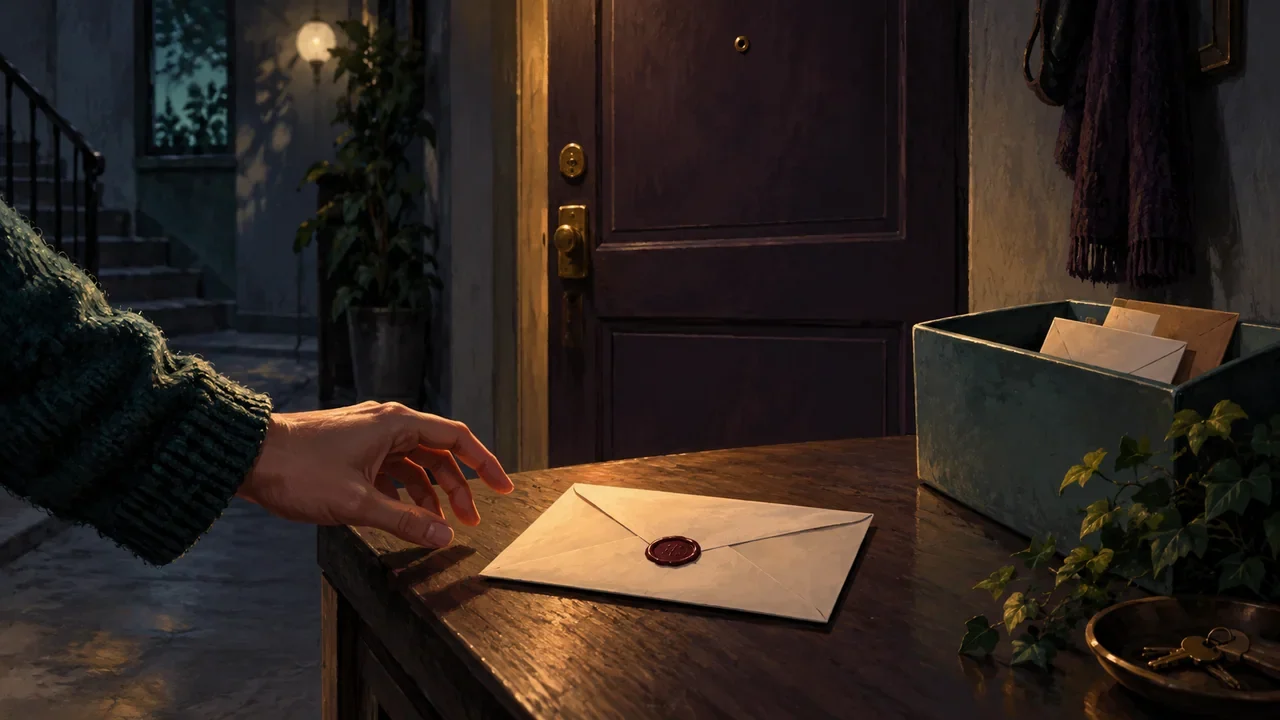
Opening setup: The protagonist A Che is entrusted to bring three letters back to Fog Harbor Town within seven days; letters with names are to be handed to the people themselves, and those without names may be handed to the town postman for safekeeping. The client's payment is to repair the small boat A Che borrowed. The boat owner has already agreed that he may use this boat with old damage, but requires it to be returned by the end of the month. The lighthouse keeper Old Zhou agrees to guide the way, on the condition that A Che helps him repair the lighthouse lamp. The recipient field of the third letter only says "to the one who still remembers the tide."
The promise list has four items: delivering the letters, the agreement with Old Zhou, the cost of repairing the boat, and the recipient of the third letter.
Ending One: Success
On the seventh day, Old Zhou led A Che into Fog Harbor Town. When the first two letters were handed to the two recipients, neither of them opened them immediately. Old Zhou looked back at the lighthouse with its lamp lit. A Che did not open the third letter; he handed it to the town postman and said he would wait for someone to come and claim it. The client checked the handover record and arranged for the small boat to be repaired. At the end of the month, A Che returned the boat to the owner.
Comparison: Bringing back the letters is completed, the agreement with Old Zhou is fulfilled, the boat repair payment is fulfilled and the borrowed boat is returned, and the third letter is left open but handed to the agreed custodian. All four promises have a landing point. "He said it counts" is only a promise; actually guiding the way is completion; boat repair also cannot be written as just one sentence, "someone will repair it later."
Ending Two: Partial Success
A Che handed the first letter to its recipient. The second was soaked and ruined by rain, and he gave the remaining paper to the client to explain the situation. The lighthouse lamp was not fixed, Old Zhou did not guide the way, and A Che returned to town by land instead. He opened the third letter; inside there was only an old boat ticket, with no name. He put the boat ticket back into the envelope and for the time being did not deliver it. The client was only willing to pay part of the boat repair fee, and A Che explained to the boat owner that the boat still had old damage, agreeing to return it on time first and then discuss repairs.
Comparison: The letter task is partially completed, the exchange condition with Old Zhou was not achieved, the boat repair payment is only partially fulfilled, the return still remains to be carried out, and the third letter is undelivered and its identity unresolved. Readers know which things ended and which did not; this ending cannot be marked as all four items completed.
Ending Three: Abandonment
A Che turned back on the third day. He handed the three letters back to the person who had entrusted him, saying he could not do it. Old Zhou did not wait for him, and the lighthouse lamp was still dark. At the end of the month, the boat was returned in the state it had been when lent, and A Che explained that the old damage had not been repaired, and he also did not receive the letter delivery payment. The third letter was never opened, and A Che decided not to ask further who the recipient was.
Comparison: The letter task and the lamp repair exchange are abandoned, the boat repair payment was not obtained, the borrowed boat return is completed, and the suspense is intentionally left open. The ending clearly states that A Che no longer asks further, marking that this route stops the investigation; it does not claim that the mystery has been solved.
The difference among the three endings is not good or bad, but whether the handling of each promise is written clearly. Abandonment is also handling, as long as readers can see it.
Open Endings Must Mark the Parts That Have Ended
An open ending does not mean that all promises are left unaccounted for. It is recommended that while preserving suspense in the ending, you clearly write out the items that have already ended. For example:
Who the recipient of the third letter was, A Che did not know, and he did not plan to investigate further. But the first two letters were delivered, Old Zhou's lamp was lit, and the matter of the boat was made clear between him and the boat owner.
The first sentence leaves it open, and the last three sentences close things off. Readers can distinguish which questions have already ended.
Completion Check Before Writing the Ending
- Read the opening sentence by sentence and list all tasks, relationships, costs, and suspense.
- For each one, fill in one of "completed, partially completed, abandoned, intentionally left open."
- Check whether the ending has a corresponding sentence, rather than only knowing it in your mind.
- In an open ending, at least clearly write out which items have already ended.
- When a character fabricates an excuse, use narration to mark that this is the character's claim, not a new world fact. For example, "A Che said the letter was blown away by the wind, but he did not mention that he had opened one of them"—the second half is the narrator's addition, and readers know the excuse does not hold.
When AI-assisted generation is involved, the output may omit the items you listed. It is recommended to use the promise payoff table as a checklist and go through it manually, rather than relying on one generation to be complete.
A Small Action
Open the ending you are writing, copy one line each for the opening's tasks, relationships, costs, and suspense, and write the handling method beside them. Whichever line cannot produce a corresponding ending sentence, fill in that sentence first.