• Home
  • Blog
  • Gallery
  • Pricing
  • Home
  • Blog
  • Gallery
  • Pricing
Start creating

Creator blog

Better stories start hereBetter stories start here

Discover practical AI tools, interactive storytelling methods, and production lessons—from the first idea to a story people can play.

DRAMAFORKStories · Craft · Possibility
Topics
AllTool comparisonsCreator guidesCreation tutorialsInteractive narrativeGetting startedGalgame Route DesignVisual Novel ProductionInteractive Fiction DesignNarrative Design for Interactive Film GamesInteractive Film AccessibilityInteractive Film WorkflowInteractive Game BasicsInteractive Film Presentation and DeliveryInteractive Film LocalizationInteractive Film ProductionNarrative MechanicsCreative CollaborationGetting startedFictional Case StudyStory LocalizationMobile and AccessibilityActing and StagingExploring Time and SpaceRelationships and GroupsResources and ConstraintsInformation and CommitmentsProduction PracticeProduct workflowChoosing tools
25 articles

Editorial / 02

Search resultsSearch results

Articles related to “interactive film”

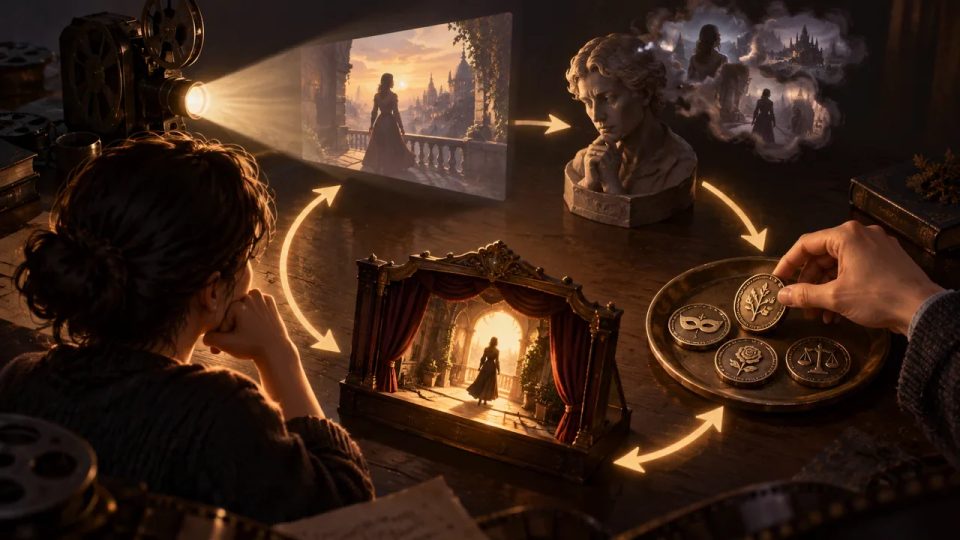
Cover of the blog article “An Interactive Film Game’s Theme Is More Than a Slogan: It Must Become a Recurring Dilemma”Most relevant
Interactive narrative2026.08.20

An Interactive Film Game’s Theme Is More Than a Slogan: It Must Become a Recurring Dilemma

An interactive film game’s theme is not a lesson the author states at the end, but a dilemma the player repeatedly faces. If the theme is “trust,” the work should repeatedly ask players to decide whom to believe with incomplete evidence, making trust a source of both strength and risk; if the theme is “memory constitutes identity,” players should personally choose to preserve, delete, or exchange memories.

DramaFork Editorial Team12 min read
Continue reading

The next move is yours

From a story to a playable world.From a story to a playable world.

Do not wait for every video to be finished before testing the story. Build the characters, rules, and branches first, then let real choices guide what you make next.

Start with one story decision

Try a playable example

From a story to a playable world.

Create interactive narrative games with DramaFork: connect scripts, characters, shots, and choices into a playable first version.

Explore & play

  • Explore gallery
  • Interactive film
  • Text game
  • Character IP
  • Rankings
  • Works index

Create & collaborate

  • My creations
  • Film studio
  • Text-game studio
  • Character studio
  • Creator partnership

Reading room

  • Creator blog
  • Story topics
  • Article archive

Story guides

  • Interactive storytelling
  • Making interactive films
  • Designing text games
  • Character and worldbuilding

Plans & credits

  • Pricing
  • Credits

Policies & support

  • Privacy
  • Terms
  • Cookies
© 2026 DramaFork/DramaFork · Interactive narrative games
Press Enter to send, or drag away and release.
Cover of the blog article “Multiple Endings Do Not Guarantee Replay Value: Four Rewards That Make Replaying Worthwhile”
Interactive narrative2026.08.20

Multiple Endings Do Not Guarantee Replay Value: Four Rewards That Make Replaying Worthwhile

Players will not automatically play four more times just because a store page says “five endings.” The real costs of replaying are watching the same content, repeating actions, and figuring out routes again. A work must offset these costs with new information, relationships, abilities, or perspectives, and provide sufficiently convenient save loading, chapter selection, or skipping of previously viewed content.

DramaFork Editorial Team13 min read
Continue reading
Cover of the blog article “Designing Clues as Resources: How Players Acquire, Misinterpret, and Verify Information”
Interactive narrative2026.08.20

Designing Clues as Resources: How Players Acquire, Misinterpret, and Verify Information

Clues in mystery interactive film games should be more than collectibles. They are resources that change players’ judgments, choices, and ending conditions. A complete clue design records the source, content, credibility, verification methods, mistaken interpretations, and places of use; after discovering a clue, players also need opportunities to compare, question, or apply it.

DramaFork Editorial Team13 min read
Continue reading
Cover of the blog article “Who Exactly Is the Player: Protagonist, Director, Investigator, or Invisible God?”
Interactive narrative2026.08.19

Who Exactly Is the Player: Protagonist, Director, Investigator, or Invisible God?

In interactive film-game design, “who the player plays” matters more than “who the protagonist is.” The player might be the protagonist on screen, a director guiding characters’ actions, an investigator with access to additional interfaces, or an invisible god capable of changing several people’s fates. Different roles change what information the player is entitled to know, what actions they can perform, how choices are worded, and who bears responsibility for failure.

DramaFork Editorial Team14 min read
Continue reading
Blog cover for “How Often Should Choices Appear? More Interaction Is Not Always Better”
Interactive narrative2026.08.19

How Often Should Choices Appear? More Interaction Is Not Always Better

There is no universal rule for offering a choice every few minutes in interactive film games. The right frequency depends on how much information players need to process, whether an emotional response has formed, whether the choice changes a state, and whether feedback from the previous choice is complete. The most practical guideline is that each interaction point should conclude a unit of judgment, rather than interrupt the video at fixed intervals.

DramaFork Editorial Team13 min read
Continue reading
Cover of the blog article “The Core Loop of Interactive Film Games: Connecting Watching, Judging, Choosing, and Feedback”
Interactive narrative2026.08.19

The Core Loop of Interactive Film Games: Connecting Watching, Judging, Choosing, and Feedback

The core loop of an interactive film game is not “play video—display buttons—resume playback,” but “receive information—form a judgment—take action—see feedback—update the next judgment.” Buttons are just an input method. If information, judgment, or feedback is missing, players will feel they are clicking through pages for a video.

DramaFork Editorial Team12 min read
Continue reading
  1. 1
  2. 2

Blog categories

  • All511
  • Tool comparisons6
  • Creator guides2
  • Creation tutorials43
  • Interactive narrative60
  • Getting started11
  • Galgame Route Design25
  • Visual Novel Production25
  • Interactive Fiction Design25
  • Narrative Design for Interactive Film Games25
  • Interactive Film Accessibility10
  • Interactive Film Workflow10
  • Interactive Game Basics10
  • Interactive Film Presentation and Delivery10
  • Interactive Film Localization10
  • Interactive Film Production10
  • Narrative Mechanics11
  • Creative Collaboration11
  • Getting started1
  • Fictional Case Study10
  • Story Localization10
  • Mobile and Accessibility10
  • Acting and Staging10
  • Exploring Time and Space10
  • Relationships and Groups10
  • Resources and Constraints10
  • Information and Commitments10
  • Production Practice59
  • Product workflow34
  • Choosing tools33

From a story to a playable world.

Start with one story decision

Create a project