The Same Workshop, Different Arrivals: What the Mountain Path and River Route Should Leave Behind
Let the information, objects, and unfinished business carried into the workshop shape the first exchange. Includes a reusable arrival-state table and convergence dialogue that changes according to whether the fault has already been explained.
Decide what becomes possible on arrival before planning the journey
Both the mountain path and the river route lead to the workshop. They can share the same scene structure: open the door, meet the craftsperson, and make a request. But the first exchange should respond to what the journey actually left the character with. For each route, establish what they know, what they carry, what they lack, and what actions those conditions allow them to propose. Journey length cannot substitute for these consequences.
This article uses a fictional teaching example: a messenger named Cen travels to Elmwood Workshop with a request to repair a waterwheel. The mountain path is shorter and passes an abandoned kiln shelter; the river route is longer and passes an old unloading platform. All characters, places, objects, and dialogue are original teaching material. They are not real user cases, tested results, or descriptions of any product features.
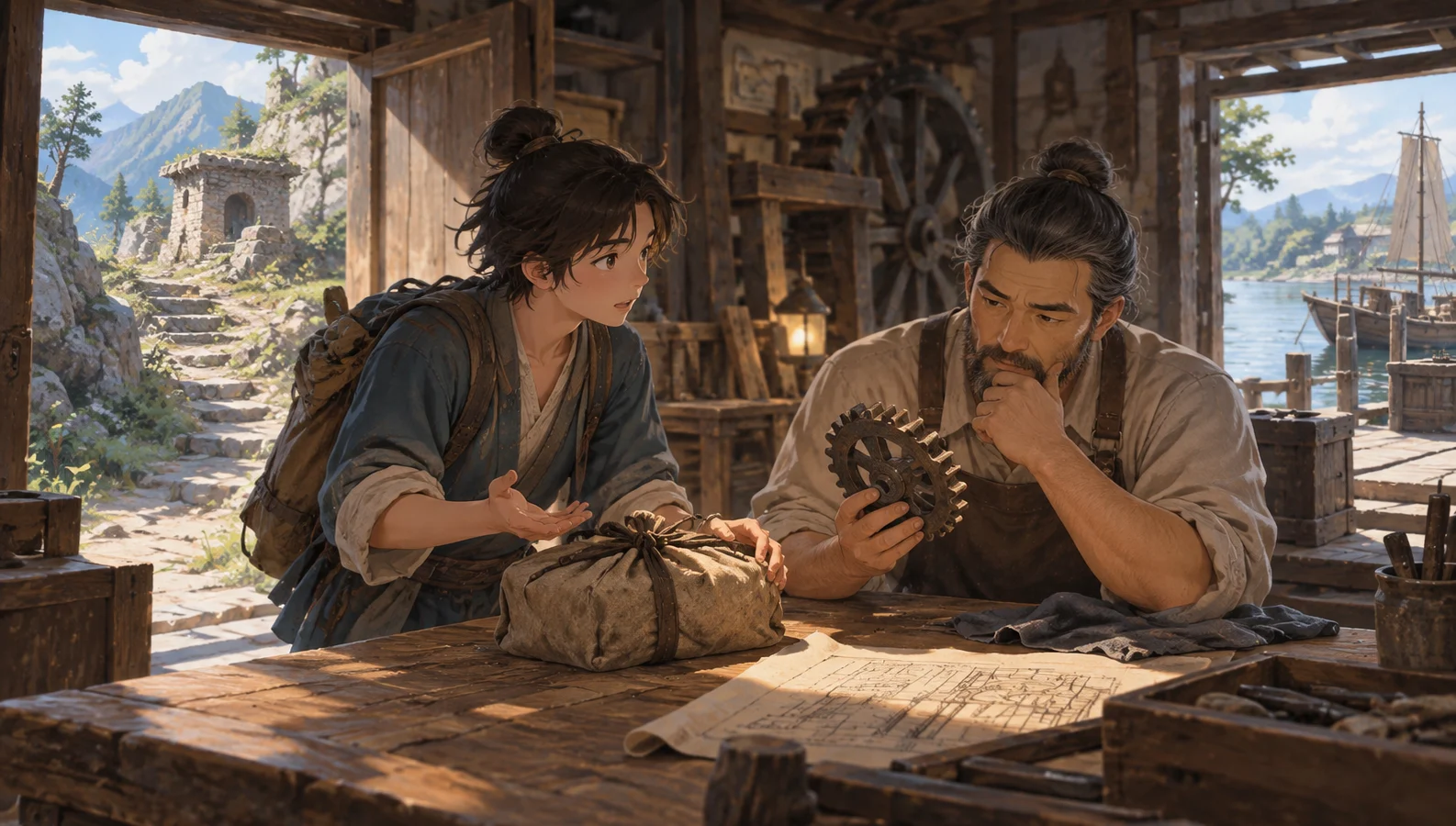
Both routes bring Cen to Master Meng. The mountain path provides a lead for finding old drawings; the river route provides a sample for inspecting a component. The shared goal remains discussing repairs, but the conversation begins from different positions.
Start by writing two arrival responses: “Your information tells us where to look” and “The object you brought tells us what to inspect first.” If both can only be written as “You finally made it,” the events along the way have yet to produce a usable difference.
Use an arrival-state table to preserve information sources and track where objects go
You can reuse the following table by replacing its contents. Each cell should contain facts that can be shown in a scene. Avoid judgments such as “gained a lot” or “improved the relationship.”
| Arrival field | Mountain path | River route |
|---|---|---|
| Action along the way | Spoke with the kiln keeper and accepted a cloth bundle | Accepted the boatman's request and took an old gear |
| Information gained | The kiln keeper said the old drawings had once been stored in the workshop's east cabinet | The boatman said this gear was removed from the old waterwheel last month |
| Object carried | An unopened cloth bundle the kiln keeper asked Cen to deliver to Master Meng | A gear with a conspicuous chip along its edge |
| Still unconfirmed | Whether the drawings are still in the east cabinet | Whether the gear belongs to the waterwheel being repaired |
| Available action on arrival | Relay the information and ask Meng to search the east cabinet | Present the sample and ask Meng to check its dimensions |
| Unfinished business | Deliver the cloth bundle to its designated recipient | Take Meng's assessment back to the boatman |
Information and objects cannot substitute for one another. The bundle's existence does not prove that the drawings are in the cabinet; the chip in the gear does not prove that it belongs to the waterwheel in question. The boatman's account only claims that the gear was removed last month. It does not say when the entire waterwheel was dismantled, and the gear's origin remains unverified.
Every carried item also needs a destination. Once Cen hands over the bundle, it cannot be handed to someone else again. If the gear is only placed on the table for inspection and has not been given to the workshop, retrieving it should remain possible. Information is not forgotten when an object changes hands.
Keep these six rows when reusing the table. If there is no errand, enter “None” in the last row; do not force in a task for symmetry. The table records the starting state on arrival. Deliveries, inspections, and explanations of the fault after entering the scene should update that state as actions occur.
Let convergence dialogue acknowledge differences before moving to the shared problem
The shared opening only establishes the reason for the visit:
Master Meng: “You said the waterwheel has stopped. First, tell me what leads you have.”
The mountain-path version follows with the information source and the handover:
Cen: “The kiln keeper said the old drawings used to be in your east cabinet. He also asked me to bring you this bundle.”
Master Meng takes the bundle, opens it, and recognizes the ruler inside: “This is the ruler he borrowed. I can't quite remember about the drawings. We can search the cabinet, but don't assume he's remembering correctly.”
Available actions: Search the east cabinet together / First explain where the waterwheel is jammed.
The bundle's contents become a newly confirmed fact in the scene only after the recipient opens it and identifies them. This does not confirm the information about the drawings. What the cabinet search reveals still needs its own scene.
The river-route version brings the object into the discussion:
Cen: “The boatman asked me to bring this gear. He said it was removed from the old waterwheel last month and wants you to see whether it's still usable.”
Master Meng: “Put it on the table first. I can compare the dimensions, but I need to know what the waterwheel you want to repair is like.”
Available actions: Help measure the gear / First explain where the waterwheel is jammed.
After the player performs the chosen action, connect the dialogue according to how much of the fault has been explained. Simply saying “the waterwheel has stopped” does not explain where it is jammed.
Location not yet explained: “Tell me exactly where it's jammed first, and then we'll decide what to do next.”
Location already explained: “We've established where it's jammed. Let's discuss what to do next.”
What the routes share after converging is the repair problem and the rules above for connecting the dialogue, not a single line repeated unconditionally. If the explanation is still incomplete, ask only for the missing details. The results of searching the cabinet or measuring the gear must also reflect what was actually done.
If the player explains the fault first, the cabinet search or measurement can be marked “Pending” and remain available in the next exchange. If either has been completed, continue from its result. Record separately that the bundle has been delivered, who has custody of the gear, and that the reply to the boatman is still outstanding. Shared dialogue must not erase these facts.
Provide arrival versions for missing objects and partially heard information
A route name only tells you where Cen came from. It does not prove that every interaction was completed. Taking the mountain path without speaking to the kiln keeper cannot give Cen precise knowledge of the east cabinet. Taking the bundle without hearing about the drawings permits only the handover. Record conversations and item collection separately.
The same applies to the river route. A player who heard the boatman's account but declined to take the gear can relay its reported origin, but cannot conjure a sample onto the table. The dialogue could be: “I heard about an old gear, but I haven't brought it.” Master Meng replies: “Then tell me about the fault first. You can fetch the sample if we need it.” Use this line when the fault has not yet been explained. If it has, continue by discussing whether the sample needs to be fetched.
If objects can be lost, record “Previously obtained” separately from “Currently held.” The story must establish separately whether the errand to bring back a reply still needs to be completed. Losing the gear does not automatically cancel a promise already made.
When neither route provides any extra content, there must still be a basic way into the scene: describe the fault and ask Meng to list the materials needed. Continue directly from anything already described. Unless the story required proof in advance, do not announce at the door that empty-handed arrivals cannot proceed.
Also avoid filling in knowledge on a character's behalf. Master Meng can recognize the ruler after opening the bundle, but cannot know where Cen traveled or what Cen heard without asking. Information should come from the object in front of him, the player's account, or an explicitly established shared past.
Limit the scope of differences and use counterfactual checks to test their logic
When space is limited, you can retain only the information difference and share the handling of objects. When emphasizing hands-on investigation, you can retain only the sample difference. This example demonstrates both; it does not mean every route must include information, a prop, and an errand.
Nor must the routes be forced into equivalence. A shorter route may have one fewer encounter, and a longer route may have one more outstanding task. But distance alone is no reason to offer more rewards. Before the choice, you can mention that the mountain path passes a kiln shelter and the river route passes an unloading platform. This lets players judge which direction to explore without revealing the specific gains.
After writing, check the draft on paper: remove the route names and keep only known information, currently held objects, completed actions, and unfinished business. Can these determine which dialogue to use? If not, the response still depends on the route label.
Next, remove the gear from the river-route state. The options to present and measure it should disappear, while information already heard can still be relayed. Mark the mountain route's information about the drawings as unheard: the request to search the east cabinet should disappear, while handing over the bundle remains possible if it is held. Opening the bundle must precede identifying its contents.
Finally, read through both action orders: “Search the cabinet or measure first” and “Explain the fault first.” Ask where the waterwheel is jammed only when this has not been explained; build on the explanation when it has; and ask only for missing details when it has been partly explained. These checks assess causality in the draft. They do not constitute actual playtesting.
Differences must still be acknowledged after the shared passage: whether the cabinet has been searched, who has custody of the gear, and whether the boatman has received a reply. Track only matters that affect what follows. A ruler that has been delivered and is no longer relevant need not be mentioned in every scene. The two routes can then reach the same workshop while carrying their distinct experiences and completed actions into the rest of the story.