How Can a Distant Character Join the Story Without Suddenly Knowing Secrets at the Scene?
Track what the player sees, what they say, what reaches the navigator over the radio, and what is confirmed as received. Use report IDs, readbacks, and advice withdrawals so the distant character can contribute to decisions on a clear basis.
Introduction
The key to involving a navigator at the other end of a radio is making every suggestion traceable to a player report they actually received. What the player has seen is not necessarily what they have said; what they have said is not necessarily what the other person heard in full. When information is missing, the navigator can ask questions, compare information, and offer conditional advice, but cannot supply answers about the scene.
Below are a communication log card and an example of correcting a misunderstanding. The characters, locations, communication restrictions, and dialogue are fictional teaching examples. They are not real user cases, measured test results, or product features, nor do they represent procedures for actual radio operation.
1. Separate Facts at the Scene from Information Received Remotely
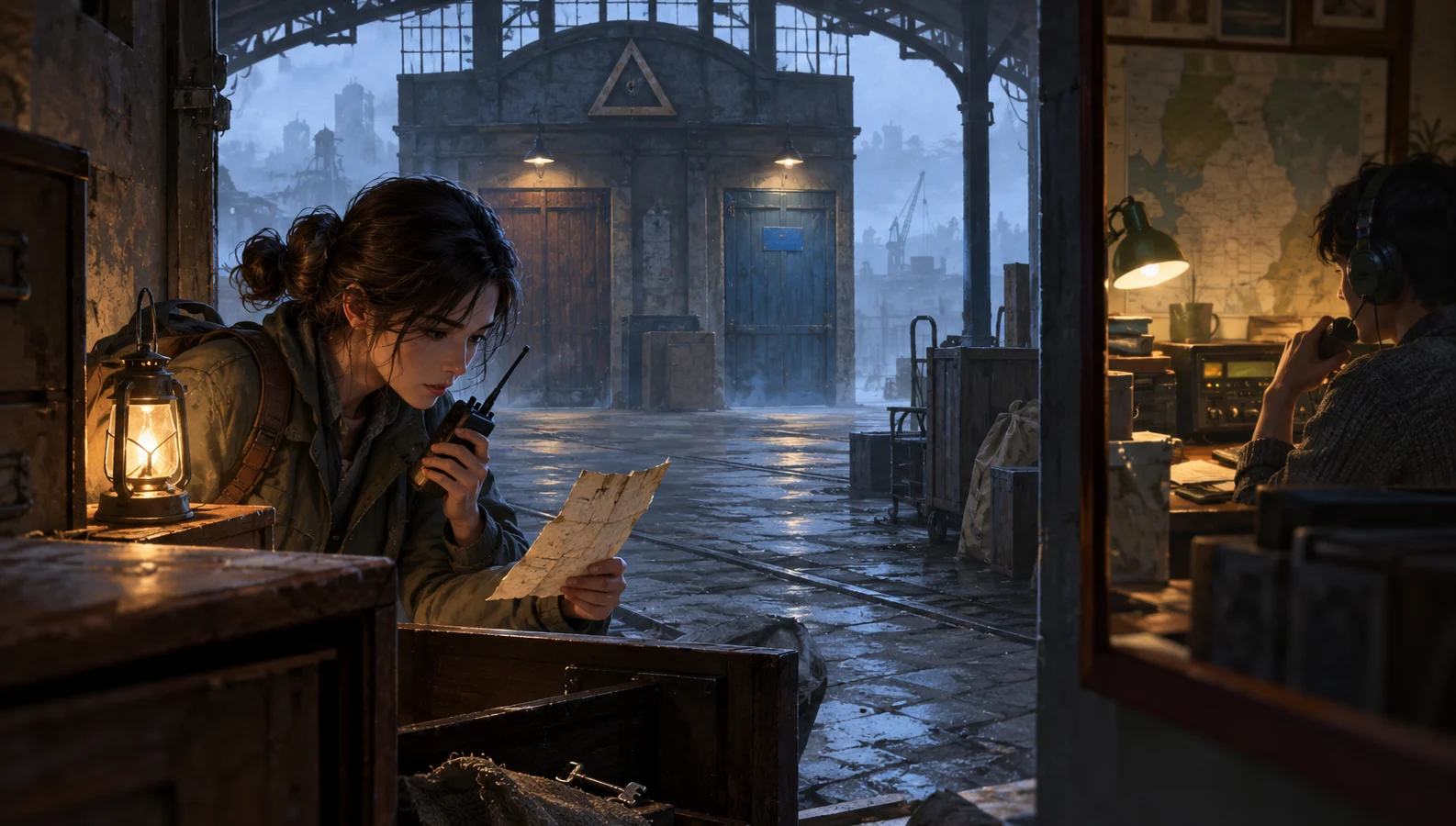
In the fictional story Fog Harbor Transfer Station, the player enters an old station to find a mailbag. The navigator, Hechuan, stays far away and can participate only through the player's radio reports. They have no shared view of the scene, and Hechuan has no maps or records that explain it.
The author has established these facts: the entrance bears a triangular mark, the east door has a blue label, and the west door has no label. A note reads, “Mailbag moved to west room.” A key is also hidden behind a cabinet. The player has seen the note but has not yet discovered the key.
Hechuan cannot use all this information at once. Even though the player has seen the note, its contents still need to be reported. The player does not even know about the key, so it certainly cannot inform remote advice. Hechuan can ask, “What entrances have you found so far?” He cannot ask, “Have you picked up the key behind the cabinet?” Even phrased as a question, the latter reveals a secret.
When writing, label the status of each piece of information: author-only knowledge, known to the player, reported by the player, or confirmed as received by the distant character. An item can move through these stages, but cannot jump straight to the final column simply because it has appeared in the narration.
2. Use a Log Card to Constrain Every Reply
The following card is for authors to fill in manually. IDs connect the exchanges; characters do not have to read every field aloud each time.
| Field | What to Record |
|---|---|
| Report ID and location | Which report this is and where the player made the observation |
| Observations and relayed statements | What the player saw firsthand, and whose words they read or heard |
| Player's interpretation | Which parts are guesses and what supports them |
| Received message | Record exactly what arrived; leave gaps blank |
| Basis for the reply | Which information confirmed as received supports this suggestion |
| Next steps and corrections | What can be done and what changes would invalidate the suggestion |
In particular, distinguish “I read a note saying the mailbag is in the west room” from “The mailbag is in the west room.” The first reports written words; the second asserts an object's location. Based on the first, Hechuan can suggest checking, but cannot declare the search over.
This example adds a reception constraint: only one party can speak on the radio at a time, noise may swallow words, and there is no recording to check for missing portions. The author must explicitly identify the affected passage in that turn, rather than later claiming something was unheard when a plot twist is needed.
On the card, “confirmed as received by the distant character” means only that both parties have checked what was communicated. It does not mean the report is necessarily true. This leaves room for the player to misinterpret things without presenting successful communication as successful fact-checking.
3. Make a Misheard Word Traceable Through the Exchange
The player sends Report A: “I'm at the entrance with the triangular mark. The east door has a blue label; the west door has none. The note says the mailbag was moved to the west room. I haven't entered any room yet.”
The author records the reception as follows: the entrance location and label details arrived in full; noise obscured “west” in the sentence about the note; the final sentence arrived in full. Hechuan now knows how the two doors differ, but not which room the note names.
An appropriate reply is: “Received. You haven't entered any room yet. I couldn't make out the direction on the note. Please repeat just that part.” By asking about a gap that would change the route, he is already moving the story forward.
If the plot calls for Hechuan to make a mistake, he might say: “I thought I heard ‘east room.’ Shall we check the east door first?” The wording must retain both “I thought I heard” and the request for agreement; a mishearing must not be presented as a reliable conclusion. The player then replies: “Correction to A: west room—west, not east. The blue label is on the east door. Don't link those two things.”
Hechuan reads it back: “Correcting the storage location in A to the west room. The blue label on the east door stays unchanged. I withdraw my suggestion to go to the east door. Based on the note you read, you could check the west room first. You still need to go in and confirm whether the mailbag is there.”
This correction does three things at once: changes one field, preserves unaffected information, and withdraws advice based on the incorrect field. If he merely says “Understood” but still sends the player to the east door in his next line, the misunderstanding has not actually been resolved.
4. Let the Distant Character Contribute Judgment Rather Than Supply Clues
Hechuan can add value by organizing reports. He can point out that “the door's label” and “the direction on the note” are separate pieces of information, helping the player avoid treating a conspicuous label as the destination. This contribution requires no knowledge of secrets at the scene.
The player may also choose to check the east door first. Hechuan can respond: “Sure. That checks what the blue label is for. The west room named in the note remains unchecked.” This preserves the choice while explaining what question the action addresses, without turning advice into a mandatory route.
There are two ways to write reports. When a puzzle emphasizes differences in direction, have the player use short clauses in the order “location, observation, interpretation, request” for easy comparison. When dialogue focuses more on the characters' emotions, let the player describe things freely, then have Hechuan summarize and ask about crucial gaps. The first is clear but can feel mechanical; the second is natural but requires room for readbacks.
Not every sentence needs confirmation. Exclamations and repeated descriptions can usually receive a direct response. Information that would change the target room, an object's identity, or the next action deserves a separate readback. The test is: if this word were misheard, would the subsequent action change?
5. Handle Delays, Contradictions, and Omissions with a Withdrawal Protocol
A reusable correction format is: “Which item in which report is being corrected; what the old information was; what the new information is; which suggestion is withdrawn; what remains unconfirmed.” Authors can use this to check dialogue, while characters can say a shorter version aloud.
For example, the player has already moved to the west door when Hechuan finally replies to the earlier entrance report. Hechuan should specify “Based on your report from the entrance,” and the player should update their current location. A delayed reply must not be assumed to apply to the present situation. Without a time or location, a report cannot support a statement such as “to your left now.”
If the player first says the west door has no label and later says it has a red label, Hechuan should ask whether this is a new discovery, a mistaken location, or a change to the label. Until the author supplies an answer, he should not decide that someone has tampered with it, much less invent a suspect hiding nearby.
When communication cuts out, the distant character stops receiving new information from the scene; the player can still explore using the entrances they already know about. Once contact resumes, fill in what happened after the last report both parties confirmed. If the player deliberately withholds the note, Hechuan must judge without that information; he cannot use intuition to punish the player for withholding it.
Before submitting the draft, check every judgment Hechuan makes about the scene: can you find its corresponding report, did the crucial part arrive, is speculation still marked as speculation, and was the old advice withdrawn after a correction? Rewrite unsupported lines as open questions or remove their specific assertions. This method helps authors check the limits of a character's knowledge. Merely putting the card into a prompt does not guarantee generated content will always respect those limits; each turn still needs to be checked.