Interactive Fiction Without Portraits: Keeping Speakers Clear in Multi-Character Dialogue After an Interruption
After a third character interrupts, readers should not have to guess who is speaking from an assumed back-and-forth pattern. Use an annotated dialogue draft to locate where attribution breaks down, then restore the connection with an explicit action subject or dialogue tag, while leaving out markers where doing so remains clear.
Introduction
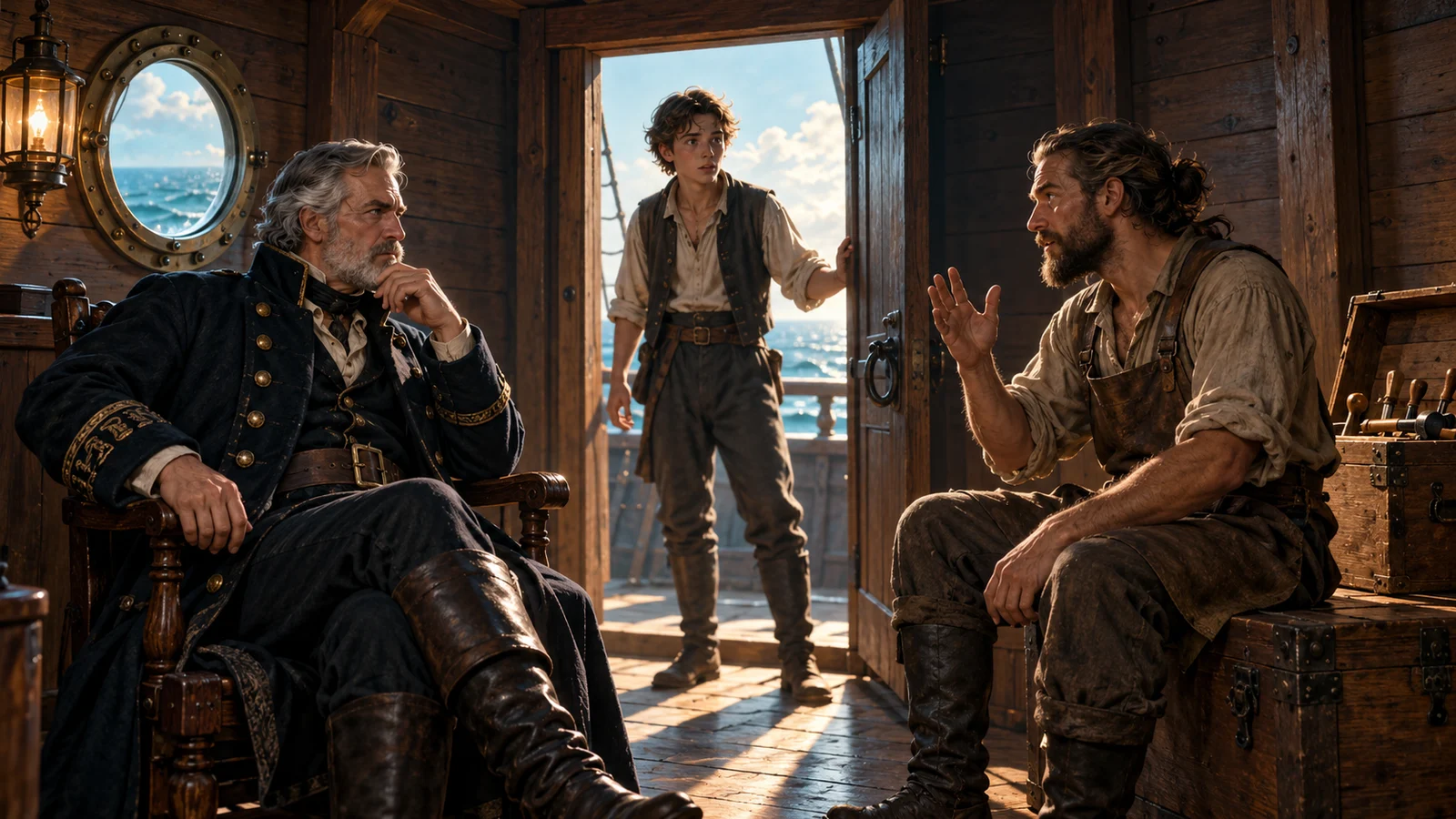
After an interruption in a conversation involving several characters, identify the speaker again in the first line that resumes the exchange. A direct construction is “The carpenter raised a hand and continued, ‘…’”: it explicitly connects the person acting with the person speaking. Only consider dropping the name afterward if that character continues speaking and no new competing speaker appears. When editing, check what evidence the text provides for attribution. Your knowledge of who is supposed to say a line is not enough.
Find the line where the alternating-speaker assumption breaks down
When two characters trade questions and answers, writers often omit tags such as “the captain said” and “the carpenter replied.” Once a third character interrupts, the original sequence no longer automatically applies. Even a one-line interruption leaves the next line open to several possibilities: the interrupter, the person who was interrupted, or someone else responding.
The following is an original fictional teaching example. Its characters, setting, and revisions illustrate an editing method. It is not a real user case or a tested result, and it does not represent DramaFork product features.
The captain asked, “Can you patch it before dawn?”
The carpenter replied, “I need a dry plank.”
The apprentice called from outside the door, “There’s one in the storeroom!”
The captain pushed the lamp to the edge of the table.
“Don’t bring it yet. That one’s cracked.”
“Then what do we do?”
“Take the boards from my bunk.”
The author intends the last three lines to belong to the carpenter, the captain, and the carpenter, in that order, but the draft does not establish this clearly enough. “Don’t bring it yet” could be the apprentice adding to a discovery, the captain giving an order, or the carpenter making an assessment. The carpenter’s knowledge of timber is a contextual clue, not a substitute for identifying the speaker.
Mark the attribution breakdown immediately before “Don’t bring it yet.” The apprentice’s preceding speech is explicitly attributed, and the captain’s action is explicit too. What is missing is a connection between the next spoken line and a character. Guessing the following two speakers from an alternating pattern only carries that uncertainty forward.
What action subjects, forms of address, and dialogue tags each establish
The character named in an action beat is not necessarily the speaker of the next line. “The captain pushed the lamp to the edge of the table” establishes only that the captain moved the lamp, not that he spoke. If the carpenter is meant to speak, add “The carpenter raised a hand to stop the apprentice and said, ‘…’” The action changes what is happening in the scene; “said” connects the dialogue to the character.
You can also simply write “the carpenter said.” There is no need to add a raised hand, a turn, or a nod every time. If an action serves no purpose in the scene—stopping someone, handing something over, observing something—and exists only to avoid repeating “said,” it can leave characters fussing with meaningless movements.
A form of address usually identifies the listener. “Captain, that one’s cracked” tells us the line is addressed to the captain, but it does not establish whether the carpenter or the apprentice is speaking. By contrast, “The carpenter said to the captain, ‘That one’s cracked’” identifies both ends of the exchange. These constructions are not interchangeable.
Likewise, “he continued” requires “he” to have only one possible referent. Where the captain, carpenter, and apprentice have all just been mentioned, omitting one name saves little space and may reopen the ambiguity. Use a consistent role label here; do not suddenly switch to “the man” or a personal name that has not been introduced.
Turn the revision into an annotated attribution draft
First decide who is intended to speak each line, then fill in the annotations. In the table below, “Current speaker” means the character actually speaking; action-only lines are not assigned a speaker. Whether a marker can be omitted is an editorial judgment. After deleting it, reread the passage in sequence to check.
| Line | Revised text | Current speaker | Intervening material | Attribution breakdown | Speaker reidentification | Marker that may be omitted |
|---|---|---|---|---|---|---|
| 1 | The captain asked, “Can you patch it before dawn?” | Captain | None | None | The captain asked | Retain the opening identification |
| 2 | The carpenter replied, “I need a dry plank.” | Carpenter | None | None | The carpenter replied | Retained in this draft |
| 3 | The apprentice called from outside the door, “There’s one in the storeroom!” | Apprentice | A third character interrupts | The original two-person sequence is interrupted | The apprentice called | Do not omit |
| 4 | The captain pushed the lamp to the edge of the table. | No new speech | The captain’s action | This does not establish that the captain speaks next | None | No dialogue tag |
| 5 | The carpenter raised a hand to stop the apprentice and said, “Don’t bring it yet. That one’s cracked.” | Carpenter | None | Repairs the attribution gap at this point in the original | The carpenter … said | Retain the carpenter’s identity and the connection to the speech |
| 6 | The captain asked, “Then what do we do?” | Captain | None | The apprentice is still present; a two-person alternation cannot be assumed | The captain asked | Do not omit |
| 7 | The carpenter said, “Take the boards from my bunk. I’ll sleep on the floor tonight.” | Carpenter | None | Reestablish identity when the speaker changes | The carpenter said | A repeated “the carpenter said” before the second sentence may be omitted |
Line 5 is the central change. The captain’s movement of the lamp can remain exactly as it was. Immediately afterward, the carpenter raises a hand and speaks, clearly returning the floor to the carpenter. Resolving the ambiguity does not require removing every action or giving the carpenter a signature catchphrase.
Line 7 demonstrates a limited omission. Both sentences fall within a single set of quotation marks for the carpenter, with no interruption by another character in the surrounding conversation, so the name need not be repeated. If you split them into separate paragraphs and insert the apprentice’s reaction between them, check again. The decision to omit the tag here cannot simply be transferred to that new arrangement.
Keep the outer speaker clear when quoting someone else
Now suppose the carpenter explains where the cracked plank came from:
The carpenter said, “Last night, the apprentice told me, ‘Keep this one to prop up the crates.’ I saw the crack right then.”
The apprentice lowered his head.
The carpenter continued, “It’s no good for patching the boat.”
The carpenter is speaking in the first paragraph. The apprentice is identified as the source of the inner quotation, but that does not give the apprentice the floor in the present scene. “I saw” returns to the outer level and refers to the carpenter. The annotation could read: “Current speaker: carpenter; intervening material: quotation of the apprentice’s words.”
If the text instead reads “The apprentice said to keep that one to prop up the crates. I saw the crack right then,” with no outer dialogue tag, readers may need to backtrack to establish who “I” refers to. In revision, first make clear that the carpenter is recounting the exchange, then use paired quotation marks to distinguish the outer speech from the inner quotation.
Although the apprentice does not actually interrupt when lowering his head, the scene’s focus has shifted to him. Adding “The carpenter continued” in the next paragraph helps prevent the assessment from being assigned to the apprentice. With a longer quotation or more characters, indirect speech is another option: “The carpenter said that the apprentice had mentioned the night before that the plank should be kept for use as a support.” This gives up the exact wording in exchange for clearer layers of speech.
Review for the minimum necessary markers, and state the limits
The editing can be done in three passes. First, read only the dialogue and write the intended speaker beside each line. Second, restore the actions and interruptions, and circle the evidence in the text that attributes each line. Third, try removing repeated names one at a time. If a deletion leaves two plausible speakers, restore the marker or rewrite the connecting phrase.
Do not fill gaps with “the reader should know,” and do not treat editorial notes as evidence in the prose. If the annotation says “carpenter” but the published text still contains only an unattributed line of dialogue, the problem remains. Keep both the revised text and the attribution rationale when handing over the draft so the next editor can check them.
This method suits text-only passages whose speakers have already been determined. If the work deliberately conceals an identity, you can temporarily retain “the person outside the door,” but that is an intentionally designed unknown and should not also confuse the identities of known characters. At branch merges or chapter reentry points, check from the actual reading entry point: a name that appeared on the previous path may not appear on the current one. The annotations can show whether attribution has sufficient textual support. They cannot prove that every reader will interpret it the same way.