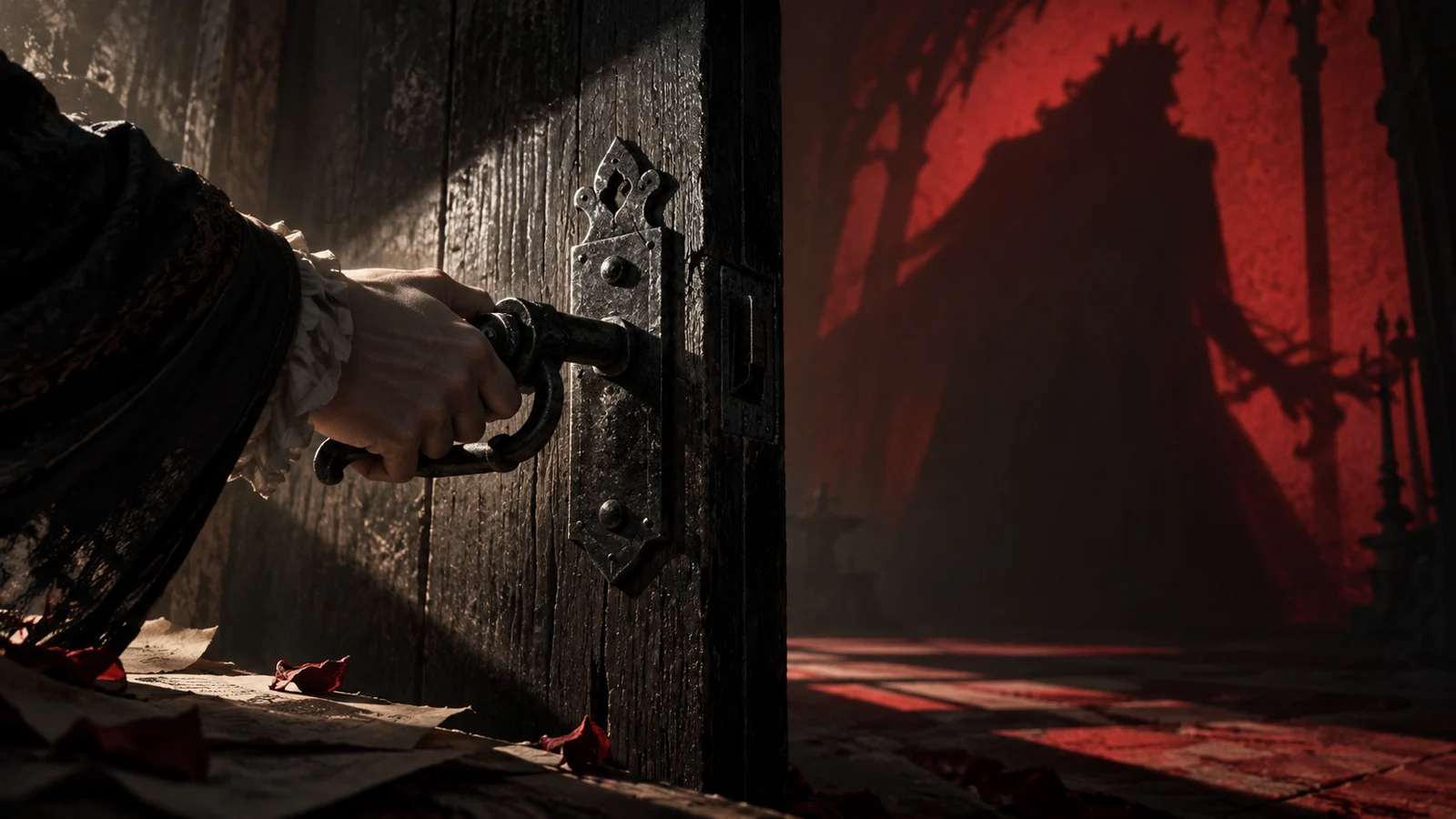
A Corridor Like an Open Mouth: Keeping Metaphor from Becoming a False Action Cue in Interactive Fiction
You can keep the horror of a corridor that resembles an open mouth. The key is to check whether the metaphor also implies teeth to pull, breathing to time, or a grip to escape. A metaphor–action boundary table grounds figurative language in actual objects; if the space really is changing, give players separate observable evidence.

Introduction
You can describe a corridor as an “open mouth,” but players need to know whether they can touch a doorframe or whether a mouth has actually grown there within the fictional world. When revising, check each sentence for objects the metaphor introduces and actions it suggests, then establish the boundaries through concrete sensory details. Purely figurative language needs to lead back to actual objects; a real transformation needs observable changes that stand independently of the metaphor.
First, find the objects and actions the metaphor quietly adds
“The corridor is like a mouth” mainly suggests a shape. “Teeth guard the entrance” introduces things players might strike or pull out. “The walls breathe and seize you” suggests cyclical movement, contact, and resistance. When reviewing the prose, ask more than whether a sentence sounds good: if players take it literally, what will they try?
Start by marking three kinds of wording: concrete nouns, such as teeth, tongues, and fingers; verbs that imply a change of state, such as biting shut, swallowing, and grabbing; and expressions of timing or conditions, such as “with every inward breath.” Pay particular attention to that last group, because it may suggest that players can wait for an opportunity to pass.
Adding “as if” does not automatically remove these implications. “The walls seem to breathe, blocking the gap in the doorway each time they swell” still states that something changes position. What matters is whether the second half describes a fact about the scene, not merely whether the first half signals a metaphor.
Revise the same corridor using a five-column table
The following is an entirely fictional teaching example. It is not a real user case, a measurement, or a hands-on test, and it does not represent DramaFork product features. Suppose an author is writing a passage about entering an old building. For now, the intended actions are simply to examine the entrance, touch the doorframe, and decide whether to enter.
The draft reads: “The corridor opens its mouth, revealing two rows of teeth. The walls breathe slowly. The darkness reaches out its fingers and grips your wrist.” The author wants a sense of oppression but has not decided whether the teeth, moving walls, and grip actually exist.
First, establish the facts for a purely figurative version: the entrance is built from ordinary stone, the doorframe is fixed in place, the walls do not move, and no external force acts on the wrist. The table below is a working document for revision; it does not need to appear in full in the story.
| Original sentence | Possible literal reading | Actual object | Clarifying sentence | Retained figurative language |
|---|---|---|---|---|
| The corridor opens its mouth. | The entrance can close. | A fixed archway | The stone edges of the archway remain in place. | The archway’s shadow looks like a mouth. |
| It reveals two rows of teeth. | There are pointed teeth that can be pulled out. | Stone ridges on both sides of the doorframe | Your fingertips meet the rough, hard stone ridges of the doorframe. | The stone ridges cast tooth-shaped shadows. |
| The walls breathe slowly. | The walls swell at intervals. | A stationary wall surface | The cracks in the wall have not moved. | You hold your breath and find yourself feeling that the corridor is breathing. |
| The darkness grips your wrist. | Something is holding the character. | A shadow beside the wrist | You withdraw your hand; your wrist moves normally. | That patch of darkness makes you reluctant to reach out again. |
Fill in the literal reading first, decide on the actual object next, and add the clarifying sentence last. Otherwise, it is easy to polish an elegant explanation without deciding what is actually happening in the scene. “No corresponding physical entity” is also a valid entry under “Actual object.” You do not need to invent a mechanism just to preserve every image.
The purely figurative version: work the clarification into the character’s actions
Using the table, the draft could become: “The archway’s shadow looks like an open mouth, the stone ridges on either side taking on the shape of teeth in the dark. You reach out to steady yourself against the doorframe, your fingertips brushing its rough, hard stone. As you withdraw your hand, your wrist moves normally. The cracks in the wall remain in place; still, you hold your breath, feeling that the whole corridor is waiting for you to enter.”
This keeps the mouth, the toothlike shapes, and the sense that something is waiting for you, while establishing the doorframe as the object being touched. The freely moving wrist and stationary cracks address the draft’s suggestions of gripping and breathing respectively. Subsequent actions can use “Examine the doorframe” and “Enter the corridor,” retaining the names of objects already established.
Players can infer that the doorframe physically exists and can be touched. They cannot infer that there are teeth to pull out, much less that the entrance closes in time with a breathing rhythm. If the work accepts free-text input, a response to an attempt to “pull a tooth” should likewise point back to the stone ridges, rather than suddenly producing a tooth to accommodate the input.
Clarification does not have to become an itemized series of denials. Once the boundaries that matter most for action have been established, later prose can keep calling it “that black mouth.” But writing “the mouth is closing” introduces movement again, requiring another decision about whether this is an impression or a fact.
The real-transformation version: give the change a fixed reference point
Now change just one premise: the walls really do swell and recede, while the entrance remains a stone doorframe with no teeth. Revision requires more than removing “as if”; it needs changes that players can use as evidence.
The passage could read: “The archway’s shadow looks like an open mouth. You brace a hand against the doorframe; the stone edge is cold and hard. The middle of the right-hand wall bulges outward, hiding a notch on the inner side of the doorframe, then draws back, revealing the notch again. You stop at the entrance and watch the same section of wall complete another swell and retreat.”
The notch is a reference point added to this fictional scene to establish that the wall changes position. Repeated observation supports the conclusion that swelling and receding occur here. It does not establish that the wall is alive or that the next movement will follow at a fixed interval. “The wall moves” and “you can pass through in time with its movements” are two different promises.
This version therefore initially supports the inference that players can continue observing changes in the wall. It does not directly establish that touching it is safe or that waiting for it to contract will allow passage. If the author wants these movements to inform a decision about passing through, they must also describe how the available space changes and provide appropriate feedback for an attempt to pass. The word “breathing” cannot substitute for those facts.
The five-column table must change accordingly. For “The walls breathe slowly,” the actual object becomes a wall that swells and recedes, and the clarifying sentence describes the notch being hidden and revealed. The retained figurative language can still refer to breathing, but it now supplies atmosphere without carrying the explanation of the rules on its own.
Finally, scale the clarification to the cost of acting
When reviewing, first read only the description and list the actions you would try. Then compare them with the actions the author is prepared to support. If the prose prompts “pull a tooth,” “break free,” or “wait until it finishes breathing in,” but neither the narrative nor the feedback provides a corresponding object, return to that sentence in the table. Do not expect players to guess the author’s poetic intent.
Nor should “it is ordinary stone” become a universal clarification. Ordinary stone can still be loose, rotate, or form part of a mechanism; establishing material settles only the question of material. If what matters to the current task is whether something is fixed in place, describe its position or the feedback from touching it. There is no need to declare that every other use is impossible.
To preserve uncertainty, let the character remain unsure why a change occurs while making clear what they currently see. Why the wall swells can remain unknown; whether it blocks the entrance should be established before players need that information to choose. If the author deliberately uses unreliable perception, they should provide opportunities to check it, so that unmarked ambiguity does not directly determine an irreversible loss.
This table is useful for sentence-by-sentence revision of descriptions of spaces and objects. It cannot, by itself, establish that an entire puzzle is fair. In practice, clarify only the boundaries that would change how players judge their actions in this passage, leaving the remaining resonance to the prose: players can fear that mouth while knowing exactly what their hand is resting on.