How to Unfold a Short Character Chat in Three Rounds Instead of Revealing the Character's Secret in the First Round
Split a character's secret across three chats by giving each segment an event that must be resolved on the spot, so the secret surfaces only as a byproduct. A fictional teaching example follows: night-shift gardener Wen Chi works three nights in a closed botanical garden, and his real secret is that three years ago he signed a plant quarantine release form for someone else; those seedlings carried disease and destroyed another garden.

Introduction
The core of splitting a character's secret across three chats is not cutting the same piece of information into three parts, but giving each segment an event that must be resolved on the spot, so the secret surfaces only as a byproduct of the event. The following fictional teaching example illustrates this: night-shift gardener Wen Chi works three night shifts in a closed botanical garden. His real secret is: three years ago he signed a plant quarantine release form for someone else, those seedlings brought disease, and destroyed another garden. This secret cannot be spoken by him voluntarily in the first round; instead, it must be pieced together by the player gradually through three things: fixing the light, identifying the envelope, and deciding whether to open the door.
Segment One: Fix the Light, First Establish "What He Avoids"
The independent task of the first segment is to restore power to the greenhouse, the emotion shifts from irritability to reluctant cooperation, and the unresolved question is: why won't he let the player open the bottom layer of the tool cabinet.
The input can be written like this: the player is a temporary record-keeper filling in, an ordinary identity with no investigative authority. The opening dialogue is kept to six to eight rounds, and the scene has only a constantly flickering overhead light and an old distribution box.
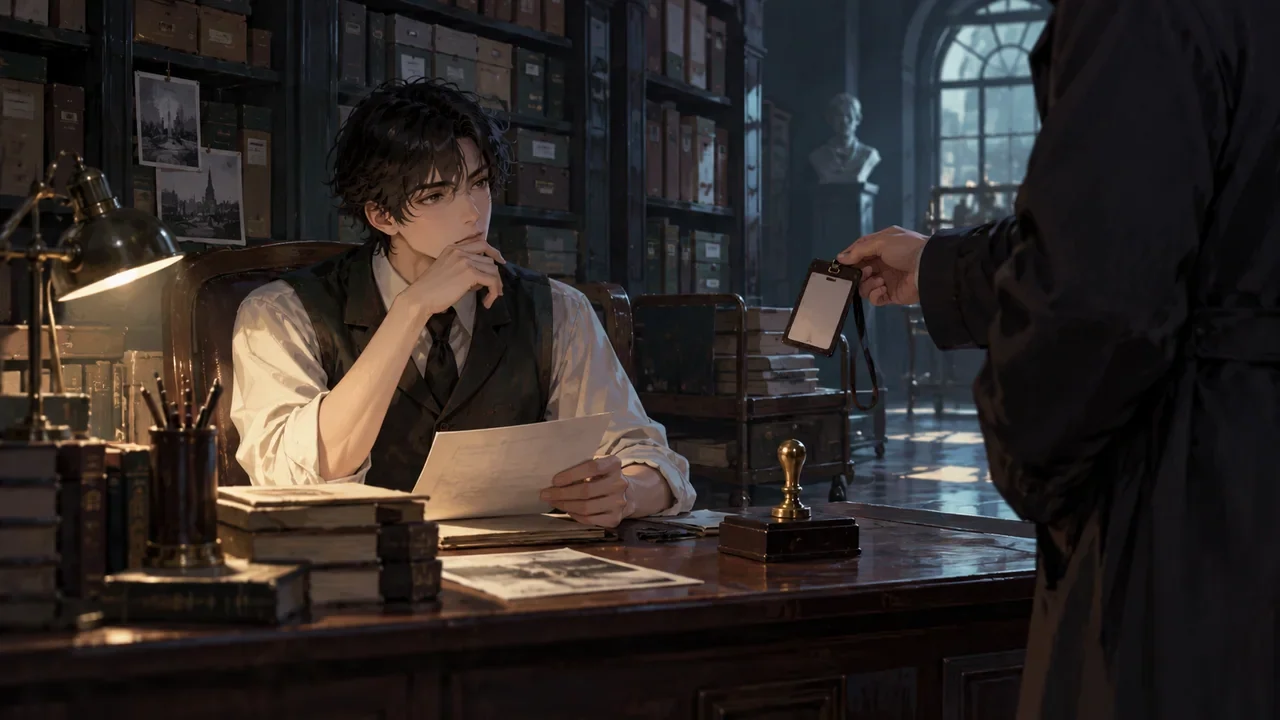
Wen Chi's first line does not introduce himself; he only says: "Don't touch the bottom compartment, the wrench is above." The player asks why, and he answers: "Damp, rusted." This is an excuse, not a new world fact, and the player cannot verify it. Then he has the player hold the ladder while he changes the fuse. After the light comes on, he lets out a breath of relief, but immediately pins an old work badge face-down on the table. If the player presses about the badge, he only says: "Left by the previous record-keeper." This line is likewise only his claim.
The first segment's output should include: the light is fixed; the player knows the lower layer of the tool cabinet is forbidden to open; the player sees the old work badge but not the name; Wen Chi shifts from guarded to "temporarily usable" toward the player. The summary text can be written as: "Overhead light repaired. Wen Chi won't let anyone touch the lower layer of the tool cabinet, says it's damp and rusted. A face-down old work badge appears on the table; he claims it was left by the previous record-keeper. Relationship: reluctant cooperation."
At the end of the first segment, the player has a concrete result (the light is on) and also an unresolved question (the lower layer and the work badge). The secret has not yet appeared, but the avoidance is already visible.
Segment Two: Identify the Envelope, Let the Secret Surface Halfway
The independent task of the second segment is not to continue fixing things, but to deal with an envelope soaked by rain. The emotion shifts from exhaustion to being struck, and the unresolved question is: why was the recipient's name crossed out.
The scene can be set before dawn, with Wen Chi shaking out his raincoat at the door, and the envelope falling from his pocket. The player picks it up and sees the recipient address is "Beiling Nursery," and the recipient line is blacked out with pen. Wen Chi does not snatch it, only says: "Waste paper." The player can choose: ask directly, pretend not to look, or offer to help dry it. None of the three paths changes the facts, only how much he reveals.
If the player asks "What is Beiling Nursery," Wen Chi answers: "We worked together before." If the player asks "Why cross out the name," he is silent for a few seconds, then says: "Wrote it wrong." The key here is: the player cannot directly learn from the envelope about the quarantine form from three years ago, only that he has an old relationship with Beiling Nursery, and that he actively erased a name. The secret surfaces halfway: he once handled those seedlings, but responsibility and consequences have not yet appeared.
The second segment's output should include: the envelope is kept or dried; the player knows the location "Beiling Nursery"; the player knows the recipient was crossed out; Wen Chi begins to treat the player as someone who might understand, but has not yet asked for help. The summary text can be written as: "On a rainy night an envelope addressed to Beiling Nursery appears, the recipient blacked out. Wen Chi says it was written wrong, does not explain. Relationship: he no longer completely avoids, but is still on the defensive."
The end of the second segment must leave a question that the third segment must handle: inside the envelope there is still a note that was not soaked through, with only half a sentence on it—"If those seedlings are still there, don't open—"
Segment Three: Decide Whether to Open the Door, Turn the Secret into a Choice
The independent task of the third segment is: someone knocks at the door, and Wen Chi must decide whether to open it. The emotion shifts from defense to being forced to face things, and the unresolved question is no longer "what is the secret," but "will he let the player participate in the consequences."
The person knocking claims to be the current temporary caretaker of Beiling Nursery, saying a batch of old seedlings needs to be transferred, and Wen Chi needs to sign to confirm "unrelated to the current garden." By this time the player already knows about the envelope, the crossed-out name, and the half-sentence warning. If Wen Chi opens the door, he must face the old matter being brought up again; if he does not open it, the player can only hear through the door gap the other person mention "that release form from three years ago."
Do not let him confess everything in one breath here. It can be written as:
Wen Chi puts his hand on the door handle and asks the player: "Do you believe him?" If the player says "Ask clearly first," he opens the door a crack and lets the other person pass the document in. On the document is a line of small text: "Original release form number has been canceled." After seeing it, Wen Chi says: "I signed it."—only here does the secret appear completely, but it appears in only one sentence, without unfolding into a long recollection. If the player says "Don't open it," he puts the door chain on and says through the door: "You've got the wrong person." Before leaving, the other person leaves one line: "The debt for those seedlings won't disappear just because you don't open the door." Wen Chi turns to the player and says: "Three years ago I signed a form. That's all I'll say, nothing else."
The third segment's output should include: the door is opened or not opened; the player knows Wen Chi signed a release form; the player knows the old matter of Beiling Nursery is related to him; Wen Chi's relationship with the player shifts from "might understand" to "you are already present." The summary text can be written as: "Someone outside the door demands a signature confirming no relation to the old seedlings. Wen Chi admits he signed a release form three years ago, does not explain details. The door is ultimately opened/not opened. Relationship: the player becomes a present party."
The Connections Between the Three Segments Rely on Events, Not Days
The three segments do not need to say "three days later." The connection points can be: the light fixed in the first segment flickers once again in the second segment, and Wen Chi says "Ignore it"; the envelope dried in the second segment is blown up by the wind through the door gap in the third segment, revealing half a sentence of warning; whether the door is opened or not in the third segment directly changes Wen Chi's next line to the player. Time serves only as background, not as a driver.
| Segment | Independent Task | Emotional Change | Unresolved Question | Degree of Secret Revealed |
|---|---|---|---|---|
| Segment One | Fix the light | Irritability→reluctant cooperation | Why can't the lower layer of the tool cabinet be touched | None, only avoidance is seen |
| Segment Two | Identify the envelope | Exhaustion→being struck | Why was the recipient's name crossed out | Half, Beiling Nursery appears |
| Segment Three | Decide whether to open the door | Defense→forced to face | Will he let the player participate in the consequences | One complete sentence, not expanded |
Summary Writing That Still Works After a Disconnection
If the chat is interrupted, the next segment cannot assume the system remembers all the dialogue. At the end of each segment, the author can handwrite a summary, keeping only: events that have occurred, facts the player knows, Wen Chi's current attitude, and the unresolved question the next segment must respond to. For example, at the end of the second segment write: "Light has been fixed; envelope has been dried; player knows Beiling Nursery and the crossed-out name; Wen Chi has not explained; the half-sentence warning on the note is unhandled." The next segment's opening should pick up only from "the half-sentence warning on the note," not repeat the light-fixing process.
AI output is not guaranteed to be correct every time, so the summary should be checked by the author before being put into the next segment's input. Do not write "he will definitely remember" as a premise. The player can forget, and the character can also stop mentioning it, but the objects left behind by events—the work badge, envelope, note, document—can reappear and become anchors of continuity.
Completion Check
After writing the three segments, check item by item: whether the first segment only establishes avoidance and does not speak the secret; whether the second segment only reveals half, and the way it is revealed comes from events rather than the character actively explaining; whether the third segment turns the secret into the consequence of a choice, rather than a monologue; whether each segment has an independent task, emotional change, and unresolved question; whether the summary after disconnection writes only facts that have occurred, not the character's inner thoughts; whether it avoids using "waited three days" or "the system automatically pushed" to connect. Only when all pass are the three segments truly separated.