Where to Break the Page in a Visual Novel: Timing Answers, Expressions, and Pauses
Let the question fully take shape, then place the key answer at the start of the next page. Hold back any expression that would give it away, too. Use an exchange about restoring an old instrument to build a reusable page-turn reveal beat sheet and check exactly what each turn reveals.

Introduction
When a page turn is meant to reveal a key answer, place that answer at the start of the next page and hold back any expression that hints at it until after the answer appears. The preceding page must deliver a complete question worth waiting to have answered, or a clearly stated condition. The pause belongs between two layers of information; it should not be manufactured by cutting a conditional sentence in half.
The fictional teaching example below follows an apprentice asking whether an old instrument can be restored. We will use it to complete a “page-turn reveal beat sheet.” The dialogue, characters, and staging are original fictional material, not a real user case, measured results, or DramaFork product features. They are not instrument-restoration advice. This example compares the order in which information appears; it does not claim that any page arrangement has been proven more effective.
First, decide exactly what this page turn answers
Before adding page breaks, read the whole exchange:
Apprentice: “Master, can this old instrument still be restored? I want it to sound the way it used to.”
Master: “If you can accept that it will sound different after the repairs, I’ll take the job.”
Apprentice: “I can. Which part needs replacing?”
Master: “What you need to let go of is the idea that it will sound exactly as it once did. We can keep the old instrument, but I can’t promise you its old sound.”
Apprentice: “Then let’s keep it. We’ll get to know its sound all over again.”
This exchange contains two different answers: whether the master will accept the repair, and what the apprentice actually needs to let go of. A complete conditional sentence answers the first. The second is the key line this passage will reserve for a page turn.
There is no need, then, to keep “Can it still be restored?” hanging until the end. The condition page first establishes that the master will take the job and on what terms. The apprentice then shifts the question to “Which part needs replacing?” The next page changes what must be let go of: from a component of the instrument to the expectation of hearing its old sound. If even the author cannot say which question each page turn advances, pagination can easily amount to little more than shorter sentences.
Finish the condition before choosing where the answer lands
The same dialogue can be arranged in three ways. What differs is how much the reader knows before turning the page.
| Arrangement | Visible before the page turn | What the page turn does |
|---|---|---|
| Question and answer on the same page | “Which part needs replacing?” and the full answer beginning “What you need to let go of…” | The answer has already been delivered; the next page carries the reaction |
| Question and answer on separate pages | The page ends with “Which part needs replacing?” | The next page reveals for the first time what must be let go of |
| Condition split across pages | The page ends with “If you can accept…” | The next page completes a thought that has not yet been fully stated |
This example uses the second arrangement. The first is not wrong: if the focus is on what the apprentice decides after hearing the answer, the answer can sit at the end of the current page, with the reaction saved for the next. But a question and answer on the same page can no longer serve the goal of “learning the answer only after turning the page.”
The third arrangement needs revision. “If you can accept that it will sound different after the repairs” gives only the condition, not the master’s commitment. Keep it on the same page as “I’ll take the job.” If the page is too crowded, first cut unnecessary words or recast the line as two complete sentences, such as: “After the repairs, it will sound different. If you can accept that, I’ll take the job.” Do not make readers turn the page only to discover that the previous page had not finished expressing its thought.
Also avoid splitting the answer into “What you need to let go of is” on one page and “that idea” on the next. The extra click would merely fill a grammatical gap, without introducing another layer of information.
Turn the five pages into a reveal beat sheet you can hand off
In the table below, “Known by the end of this page” means the information available once the page has been read. “Still withheld” means material that should not yet appear in either text or visuals. The page-turn actions describe a proposed handoff of information; they do not assume that any particular software supports these controls.
| Page | Known by the end of this page | Still withheld | Page-turn action | Expression change | Opening line of the next page |
|---|---|---|---|---|---|
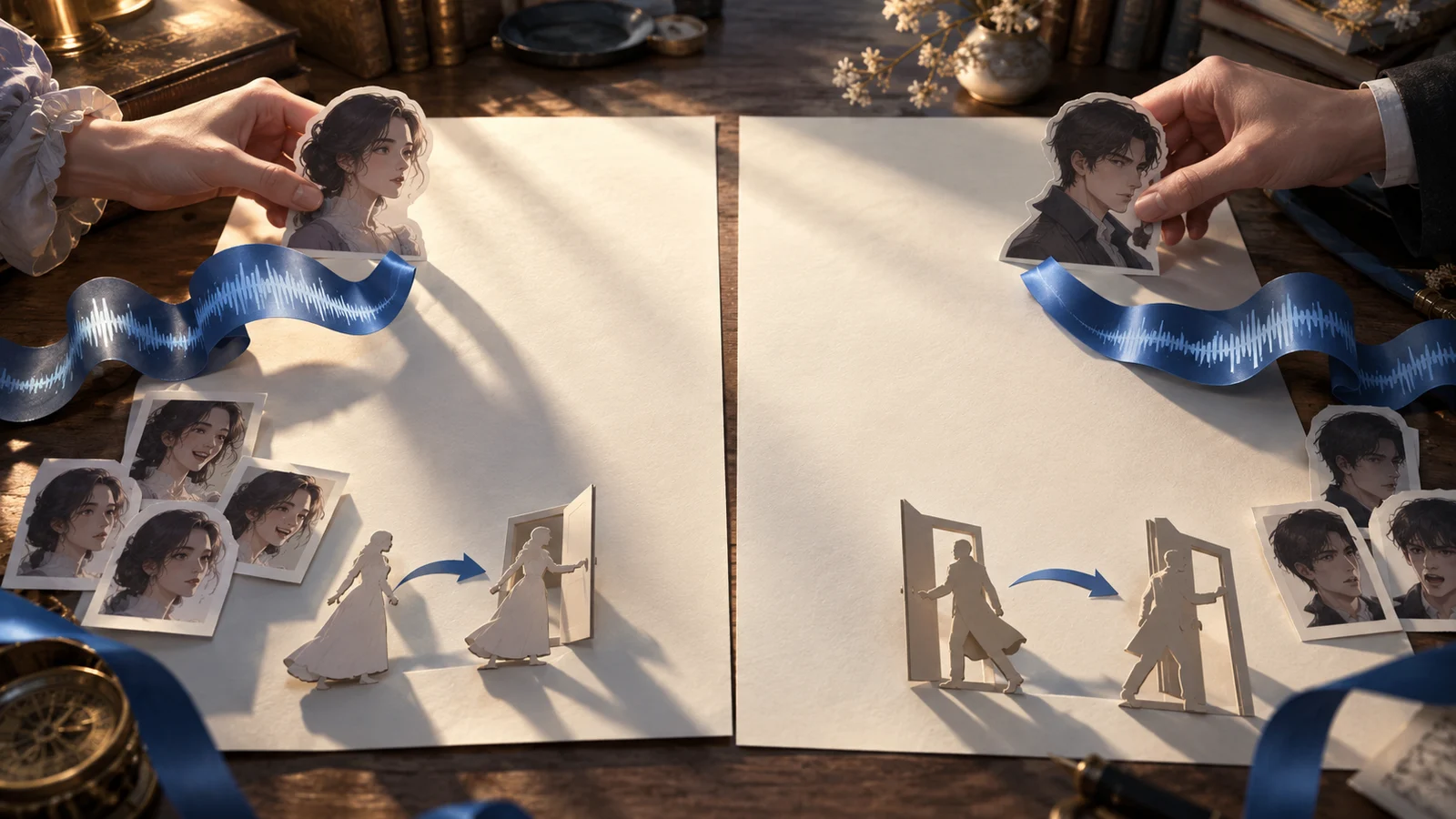
| 1: Make the request | The apprentice wants the instrument repaired and its old sound restored | The repair condition; what must be let go of | On advance, move to the page containing the complete condition | The apprentice looks hopeful; the master remains calm | “If you can accept that it will sound different after the repairs, I’ll take the job.” |
| 2: State the condition | The master will take the job, but the sound will change | Whether the apprentice accepts; how they understand the cost | On advance, show the apprentice’s response and follow-up question | The master remains calm; the apprentice stays attentive | “I can. Which part needs replacing?” |
| 3: Establish the misunderstanding | The apprentice accepts the condition but still understands it as replacing a component | What must really be let go of is the expectation of the old sound | On advance, deliver the complete answer first | No early expression change on this page; the master looks hesitant only after the answer is visible | “What you need to let go of is the idea that it will sound exactly as it once did.” |
| 4: Reveal the cost | What must be let go of is now clear; the following sentence explains that the old sound cannot be promised | The apprentice’s final decision | On advance, move to the acceptance page | The master remains hesitant; the apprentice does not yet look relieved | “Then let’s keep it. We’ll get to know its sound all over again.” |
| 5: Give the decision | The apprentice decides to keep the instrument and accept the change | No answer in this passage needs to remain suspended | End this passage; plan what follows separately | The apprentice’s brow relaxes after the line is delivered | None; do not add a summary that says the same thing again |
Page four contains both of the master’s complete sentences; the table lists only its opening line. Do not accidentally cut the continuation, “We can keep the old instrument, but I can’t promise you its old sound.” It sets the limits of the promise and gives the apprentice a clear basis for the final decision.
To reuse the sheet, fill in these five information fields for each page. If the “Opening line of the next page” merely repeats the current page’s conclusion, consider combining the pages. If the “Still withheld” information is already present in the current page’s expression notes, move the expression change.
Expressions are answers, too: check more than the dialogue
If the master looks visibly regretful on page three, the visuals already point toward a negative outcome, even without explicitly saying, “Its old sound won’t come back.” If the editor wants to withhold the precise nature of the cost, keep the master’s expression calm and let the apprentice finish asking the question.
Here, the hesitation comes after the answer is visible on page four. It conveys the master’s reservations about saying these words; it is not there to foreshadow the answer. The apprentice’s relief is held until after the decision is delivered on page five, so the visuals do not accept the condition on the apprentice’s behalf before a reply is given.
Define “after the answer is visible” in the staging script: here, it means the complete answer is on screen, not that the system can confirm the reader has finished reading it. If the text and expressions can only change together for the entire page, keep the master calm on the answer page and move the hesitation to a separate reaction page afterward. That costs an extra page turn, so decide whether the hesitation deserves a page of its own. If it does not, simply keep the calm expression.
Nor does the pause need a fixed duration in seconds. With manual page advancement, the reader decides how long to wait on page three. The editor can determine what information is visible during that wait, but cannot guarantee that everyone stays for the same length of time.
Hide the following pages to check for early reveals and empty beats
Before handing off the script, try showing only the current page and covering the pages that follow. Write down separately “What is already certain?” and “What am I still waiting to learn?” Page three should leave the question “What exactly needs replacing?” open. If the dialogue or expression already makes clear what must be let go of, move the revealing detail later. This is a checking method, not a claim that this example has been validated with readers.
Next, remove the expressions and read only the text to check that each page conveys a complete thought. Restore the expressions and check whether the visuals say more than the text has yet revealed. Finally, review each page turn: it should bring a condition, a follow-up question, an answer, or a decision. A page consisting only of an ellipsis and an expression change needs a reason to stand on its own.
This sheet suits short exchanges in which the editor can control page boundaries and the reader advances manually. With autoplay, voice acting that continues across page boundaries, or gradually appearing text, the delivery of sound and text needs a separate timing plan; this table alone cannot guarantee synchronization. If the story deliberately lets the reader understand the master’s reservations early, an earlier expression change is also an option. In that case, however, the page turn confirms a suspicion, so revise the page’s withheld information accordingly.