How to Organize an Interactive Film Classroom Discussion: Record Reasons Before Discussing Outcomes
Keep pre-choice reasons separate from explanations after the outcome, so the class can discuss what informed the original judgment. An original fictional scene supplies two worksheets, neutral questions and completed examples.
Preserve the original reasons before revealing what follows
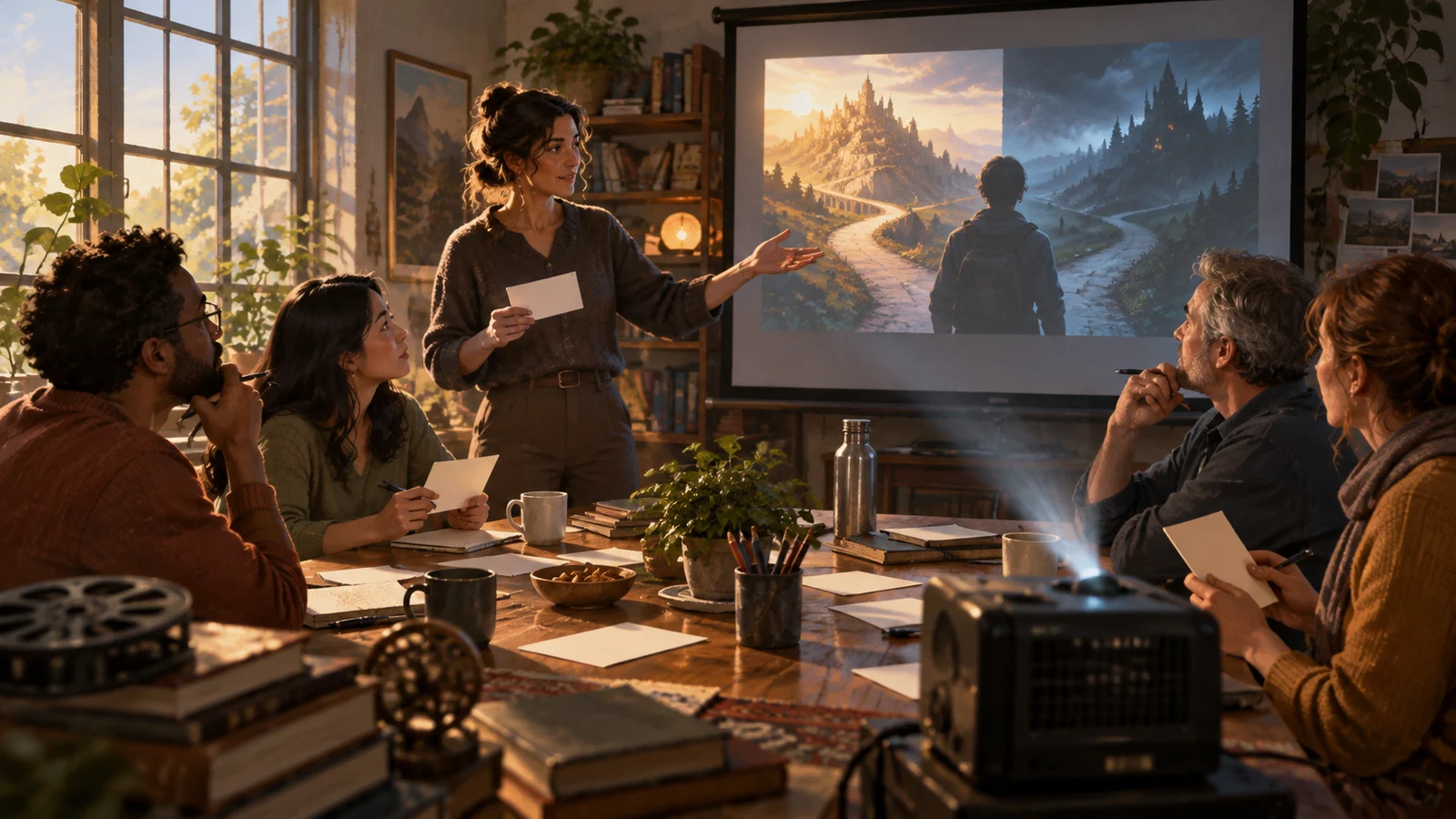
Arrange the class in this order: play to the choice, have students independently fill in a reasons sheet, collect or fold away the original records, show one continuation, then fill in a reflection sheet. Discuss what the material available then could support and how new information should change the judgment. Choosing a successful ending does not itself prove that the reasons were sufficient.
The scene, characters, student answers and continuations here are original fictional teaching examples, not real user cases, tested teaching outcomes or DramaFork features. Teachers can present them with a homemade short film, storyboard or read-aloud script, without depending on particular software.
The deliverable is two worksheets that can be checked against one another. The first preserves the information boundary at the choice; the second marks judgments changed by new information. Do not let students erase their original answers, or the class loses its most useful comparison: how people thought before knowing the result.
Define the evidence boundary with a dilemma
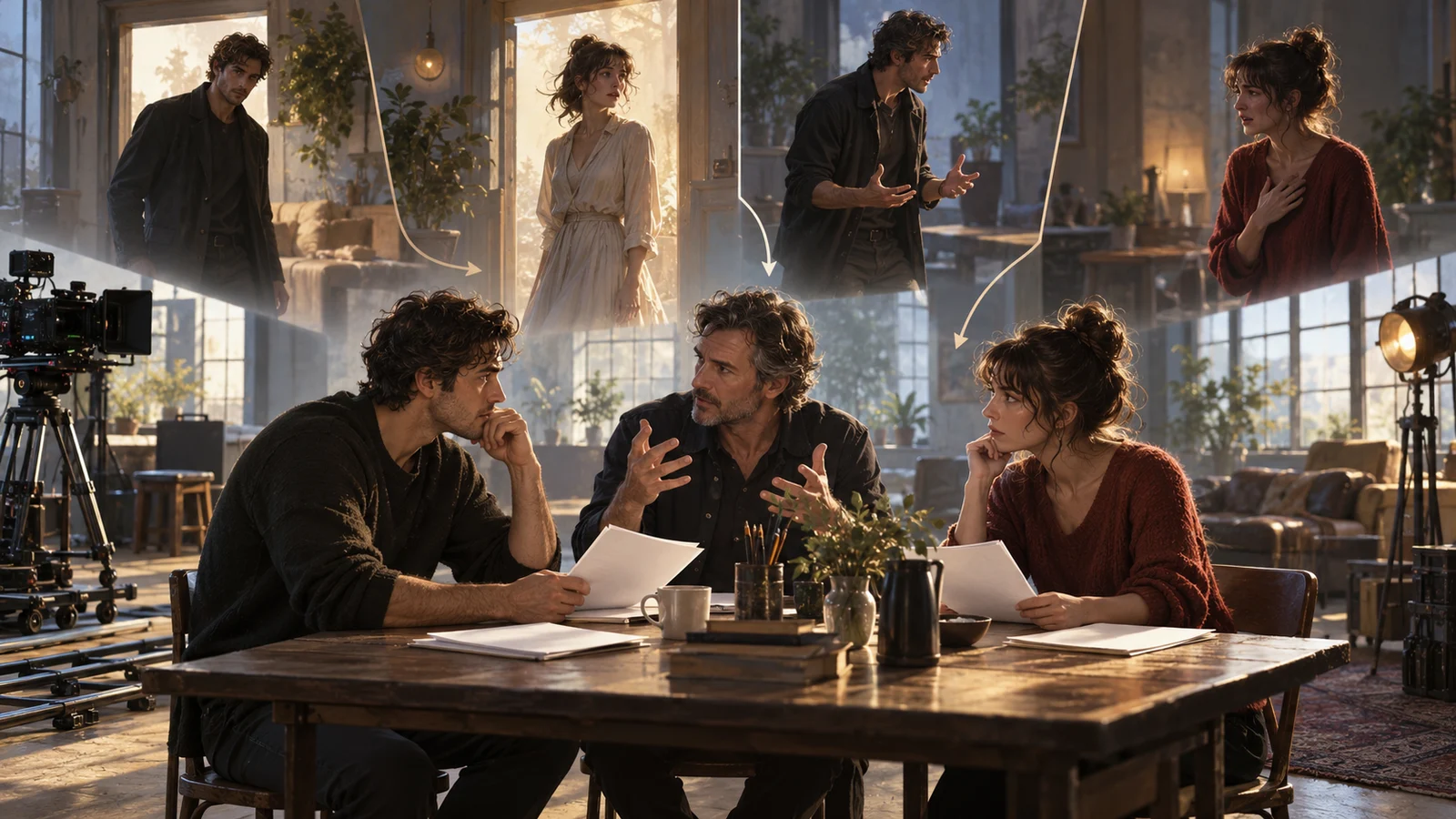
The fictional scene At the Rehearsal-Room Door takes place during preparations for a campus short-film showcase. Lin He, responsible for the opening introduction, notices that Zhou Yao is missing from the display board’s author list. The opening is imminent, and she can take only one initial action: A, introduce using the existing list; or B, delay the introduction and check the list. This round has no “correct option.”
Before pausing, provide only three items: a shot shows the printed list without Zhou Yao; in a group chat, Zhou Yao says, “I’ve finished revising the end credits”; a companion says, “The list was probably finalized yesterday.” Label them one, two and three, retaining the wording. The shot establishes the printed contents, the chat establishes what Zhou Yao said, and the companion’s statement remains uncertain.
These items do not establish Zhou Yao’s formal credit agreement or prove who caused the omission. Students can suspect an incomplete list but cannot turn that suspicion directly into “someone deliberately excluded Zhou Yao.” Choosing A or B requires stating whether the priority is starting on time, accurate attribution or another concrete goal.
Prepare a separate continuation card and reveal it only after this round’s choice. In the fictional setup, a line was omitted during printing. On B, checking finds it but delays the introduction. On A, the opening starts on time and Zhou Yao later requests an additional credit. Both continuations contain gains and costs; do not stage one as a reward and the other as humiliation.
Pre-choice reasons sheet: separate observation, inference and trade-offs
Copy the reasons sheet directly. “Unknown” is allowed, but explain which judgment the unknown affects.
| Field | Student entry |
|---|---|
| My choice | A or B; explain if unable to decide yet |
| Material seen | Item IDs and original wording or visible details |
| My inference | What I think may have happened on this basis |
| What is still missing | Information that has not appeared |
| Priority goal | What I most want to preserve this time |
| Condition for changing my choice | Material that would make me change |
For example, fictional student Xu Ning chooses B, cites items one and two and infers that the list may have an omission. He acknowledges, “Editing credits does not establish author status.” He prioritizes accurate attribution in the introduction. His change condition is, “If a verification record confirms that Zhou Yao is specifically not meant to be included in this author list, I will use the existing list.” This is a checkable condition, unlike “I’ll change if someone persuades me.”
Another fictional student, Tang Yue, chooses A. He thinks the current information cannot confirm an error, prioritizes the opening schedule and proposes checking immediately afterward. Ask whether that later check is an action the option already permits or a plan he added himself. If the original scene permits only one initial action, list the plan separately; it cannot count as something that has already happened.
The source of the disagreement is now clearer: their estimates of an omission’s likelihood may differ, or their goals may differ. The teacher need not resolve it immediately. First ask each to accurately restate one of the other’s grounds, then identify which step they disagree with.
Ask neutral questions in order, then complete the reflection sheet
Before revealing the continuation, ask in sequence: “What did you see or hear?” “Which part is your inference?” “Which missing information is most likely to change your choice?” “What are you prioritizing, and what cost do you accept?” Let students write first, then invite people with different choices to speak, so the first speaker does not set the explanation for everyone.
Do not ask, “Zhou Yao worked so hard; why would you still ignore her?” That has already decided the relationship between contribution and attribution. Ask instead, “What attribution judgment does the revised-credits item support? What is still missing?” Do not begin the outcome discussion with “Who chose correctly?” either.
After playing route B, use the second sheet:
| Field | Xu Ning’s fictional entry |
|---|---|
| New information | Printing omitted a line; checking delayed the introduction |
| Change in original inference | Suspicion of an omission is supported in this continuation |
| Gap in original reasons | I did not specify how much delay I would accept |
| What still cannot be concluded | B is necessarily better in other situations |
| What to retain or change next time | Keep the checking goal; add conditions for judging the time cost |
Then ask, “If no line had been omitted, which original reasons would still hold?” Xu Ning could answer that the mismatch between materials still deserves attention, but checking would have a different benefit. This separates grounded reasons from a hoped-for outcome.
If route A is later revealed, first identify it as another fictional continuation supplied by the author. Students can compare how the stories assign costs, but cannot claim that delaying an introduction is inevitably better in reality. The author’s outcomes are themselves design choices the class can discuss.
Close with an exit slip and identify where the activity fails
Have each student submit three sentences: “What I originally relied on,” “What was added later,” and “What I changed or retained, and why.” Check accurate citations, whether inferences exceed the evidence and whether revisions answer the new information. Holding a minority view or ultimately keeping the same choice must not, by itself, lower a grade.
With limited time, reveal only one continuation and complete both sheets; traversing every branch is unnecessary. Without video, distribute text cards in two stages, still recording before revealing. If the goal changes to comparing narrative writing, groups can each write a continuation, but separate authoring from character judgment as two tasks.
Common failures include revealing the outcome early, a teacher’s expression signalling the answer and students rewriting reasons afterward. Address these with a new scene whose continuation has not been seen, the same follow-up wording for both sides and retained originals with added revisions. If most choose the same option, do not manufacture opposition. Comparing cited material and change conditions can still reveal differences in judgment.
This design leaves discussable records of judgment. One classroom round alone cannot establish improved reasoning ability. If the scene lacks material that distinguishes observation from inference, revise it first; repeated teacher questions cannot supply evidence the story never provided.