How to Rehearse Unfilmed Interactive Film Routes with Actors: Establish Cause Before Sharing Footage
A shared scene depends on whether characters have reason to say the same line after each route. Connect entry facts, actor objectives, partner responses and merge conditions in a rehearsal sheet before deciding which performances to share.
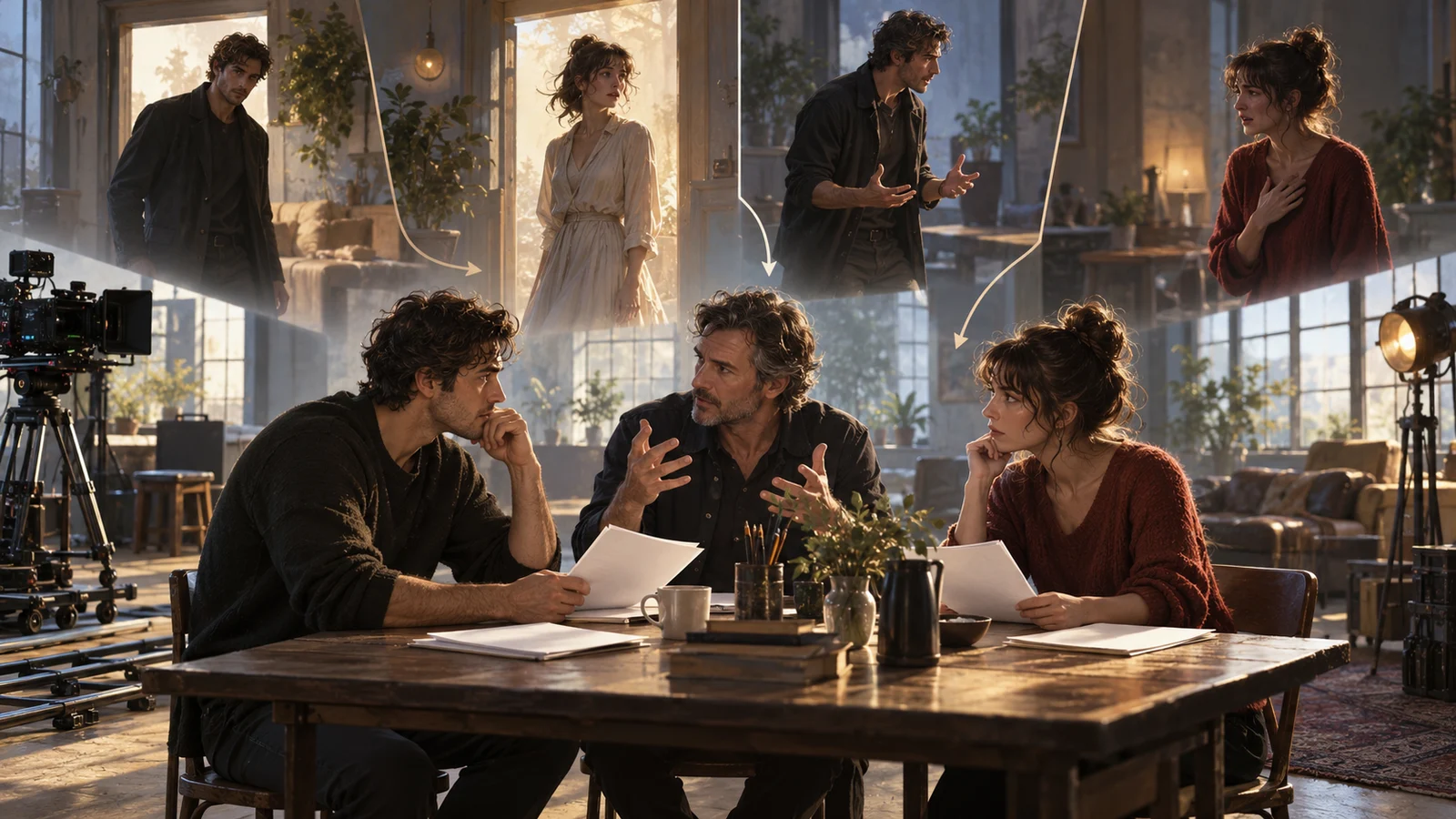
Check why characters stay before discussing shared shots
Reduce each unfilmed route to an entry-premise card. Have actors start from the previous choice’s consequence and perform continuously through the shared scene’s first joint decision. Ask why, despite different experiences, the characters still arrive here, say this line and accept the other’s action. If only the director’s explanation supplies the answer, the shared segment still lacks a causal link.
The Last Ferry below is a fictional teaching example, not a real user case, tested outcome or product feature. Lin Lan and Zhou Heng reach the dispatch room to look for a missing crew member. Both routes are planned to enter the same line: “Give me tonight’s duty roster.”
On the confession route, Lin Lan has given Zhou Heng the anonymous note and they have agreed to investigate together. On the concealment route, she hides it, but he sees her putting it in her pocket. Reaching the same room does not restore the same relationship. Limit this rehearsal to the final confrontation outside the door, entering, requesting the roster and Zhou Heng’s first response, rather than the whole story.
Write entry premises as facts known separately to each character
Premise cards should separate fact, knowledge and intention. “They don’t trust each other” is too broad to tell actors what to prevent. Be specific: the note is in Lin Lan’s pocket; Zhou Heng saw the hiding action but has not read it; Lin Lan does not know she was discovered.
The director may know everything, but each actor’s character card contains only what that character knows now. Otherwise, Zhou Heng might ask about the boat name on the note before learning it. Lin Lan might play defensiveness without a character reason because the actor read the other card.
Give each actor an objective that acts on their partner. On confession, Lin Lan wants “Zhou Heng to ask the administrator for me”; on concealment, “Zhou Heng to look at the roster first and not ask about my pocket yet.” Zhou Heng’s corresponding objectives are “help investigate” and “get Lin Lan to explain what she is hiding.” “More anxious” or “colder” can assist performance but cannot replace action objectives.
Add entry actions: who pushes the door first, gives way or holds the handle. These are not fixed blocking but a way to check intention. If Zhou Heng wants to stop Lin Lan yet opens the door for her unconditionally, supply a reason or change the action.
Use a record sheet to perform the route through a concrete response
Copy the sheet for “one entry and one principal character pair.” The observation column records actual performed actions and exact words, not judgments such as “good state.” All example entries are hypothetical and illustrate the method.
| Field | What to enter | Concealment example |
|---|---|---|
| Entry premise | Facts caused by the previous choice | Lin Lan hides the note; Zhou Heng sees the action |
| Knowledge gap | Who knows what and who does not | Zhou Heng does not know the contents; Lin Lan does not know he saw |
| Actor objective | What the partner should do now | Lin Lan wants him to check the roster first; he wants an explanation |
| Starting action | Performable action to begin with | Lin Lan pushes the door; Zhou Heng holds its edge |
| Shared-segment candidate | First line or action proposed for reuse | “Give me tonight’s duty roster” |
| Merge response | Why the partner can respond to that line | Zhou Heng first asks her to leave the note |
| Observation and break | Exact words and where cause is lost | Hypothetical record: gets the roster for her without an explanation |
| Change and rerun | What changes and where to restart | Add terms for postponing the argument; rerun from outside the door |
| Handoff decision | Share, entry variant or stay separate | Provisional entry variant; move sharing later |
Read confession first, then concealment, keeping the proposed shared segment unchanged. The continuity supervisor records what Zhou Heng does after each roster request. Then reverse the order, so closeness formed on the preceding route is not carried into the next.
A read-through host can briefly explain unfilmed upstream events, but actors should perform the final relationship-changing action. Do not merely read “Lin Lan concealed a clue.” Have her put away the note and Zhou Heng decide whether to question her immediately. This reveals whether a step is missing between seeing concealment and agreeing to cooperate.
Make the merge a visible exchange rather than resetting emotion
Suppose concealment stalls at the door because Zhou Heng has no reason to help immediately. The first fix adds an entry exchange. Lin Lan says, “I’ll put the note on the table. Check the roster first, and I’ll explain afterward.” He takes it and says, “I’m waiting for your explanation.” Only then do they turn to the administrator.
This does not remove suspicion; it establishes terms for temporary cooperation. The shared task can match while the relationship differs. Check later shared lines too: “I’ve always trusted you” still lacks support from this exchange. Merge conditions must cover behaviour throughout the proposed shared passage, not just connect its opening line.
The second fix retains different opening reactions and moves sharing until after the administrator unfolds the roster. On confession, Zhou Heng voluntarily makes room. On concealment, he holds the note down beside his hand. After both reactions, attention can move to the absent person’s name on the roster, but later sharing still requires line-by-line checks.
The third fix keeps the routes separate. If Lin Lan refuses to hand over the note and Zhou Heng insists on an explanation first, forcing them to check the roster together erases the choice’s consequence. Change the route’s destination or retain a separate passage. Saving an asset segment must not be the sole reason for sudden cooperation.
Cover rehearsal by causal premises and hand off doubts before shooting
With many routes, group them by premises affecting this scene’s action. Different upstream routes can initially use a representative entry if knowledge, current objectives and prop possession match, then check whether the others truly are equivalent. “They all end in the dispatch room” alone is not a grouping criterion.
Also read the entry least likely to merge: greatest tension, widest knowledge gap or a key prop held by the wrong character for the plan. A representative route working does not establish that other entries work. Leave unexplained differences on the sheet.
Three common failures are actors adding motivational lines never incorporated into the shooting script, a director hiding missing terms in “just cooperate first,” and actors expressing suspicion silently while later dialogue assumes complete reconciliation. Return to the break, rewrite or split the segment, and rerun from the previous choice.
After the table read, hand off the updated sheets and marked-up dialogue pages, identifying the shared starting point, required entry reactions and unresolved issues. They inform shooting design but cannot replace camera position, eyeline, prop continuity or edit-join checks. Rehearsal helps locate causal gaps; whether images connect still needs later previs and asset review.