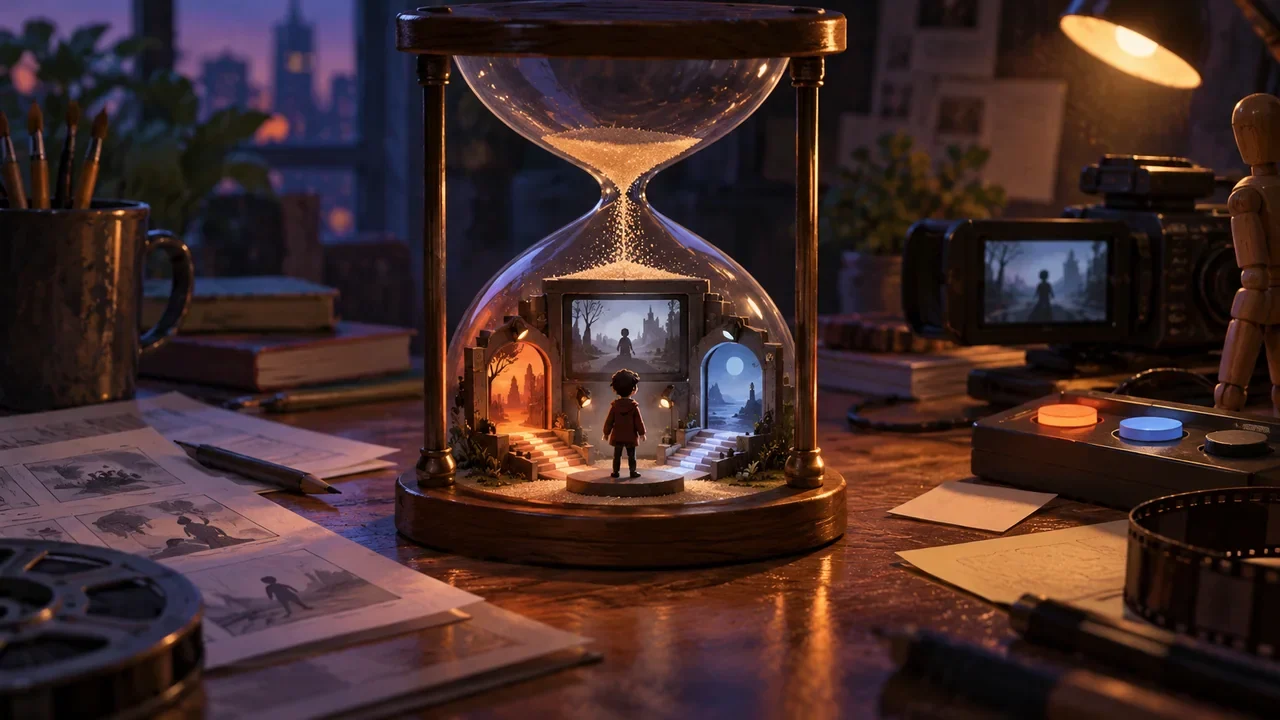
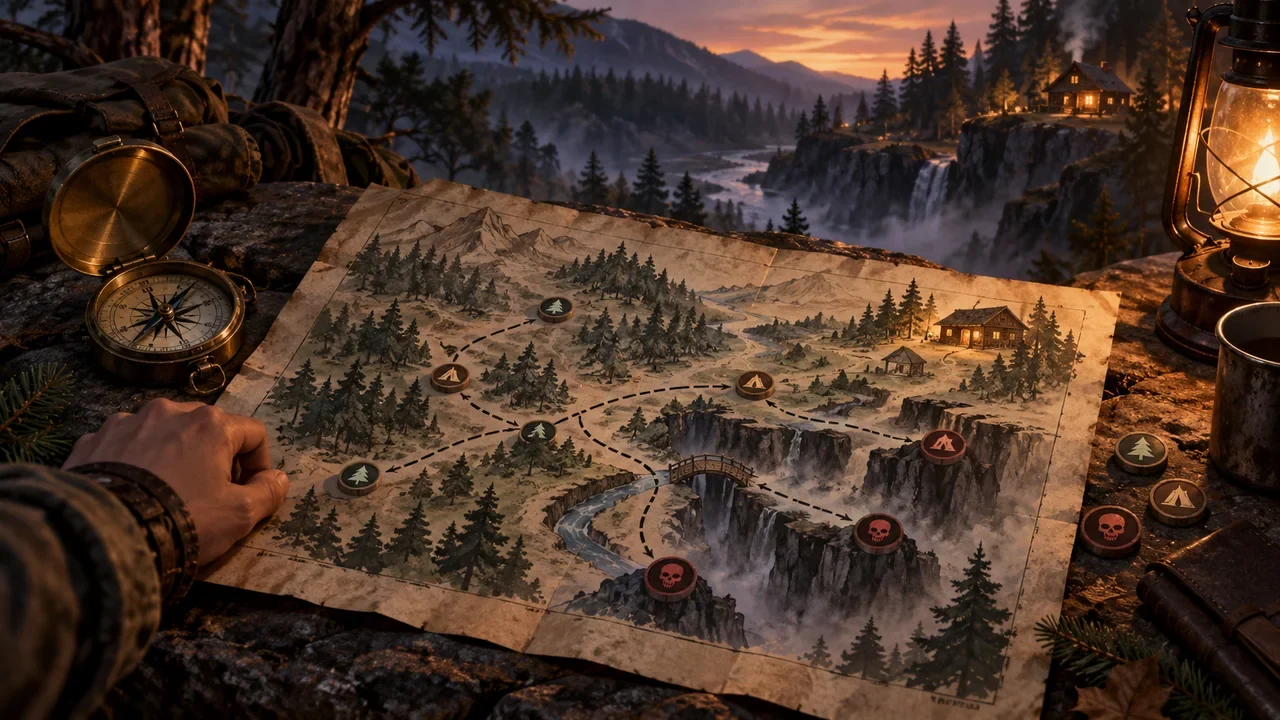
Interactive Movies: When the Audience Holds the Controls
Picture this: you're watching a thriller on screen. The lead is about to push open a door when two options pop up at the bottom — "Push the door open" or "Quietly back away." You hesitate, make your choice, and the story forks. A character survives; another disappears. This isn't a choose-your-own-adventure novel, and it isn't a typical puzzle game. It's the **interactive movie** — also called the **FMV (Full-Motion Video) game** or **interactive film** — a genre that has been quietly heating up on Steam, consoles and mobile over the past few years.

Introduction
1. What Is an Interactive Movie?
An interactive movie — also known as an interactive film, live-action interactive game, or FMV game — uses pre-recorded footage (live-action shooting or high-fidelity CG animation) as its narrative engine. New-media scholar Glorianna Davenport once defined it as a film genre that integrates cinematic language and aesthetics with a feedback-and-control communication system.
Three traits define the form:
Pre-rendered footage carries the story, rather than real-time generated graphics.
Player intervention — through narrative choices or QTEs (Quick Time Events) — triggers different video clips.
Choices have real consequences, reshaping relationships, fates and endings across a vast branching narrative tree.
Compared with traditional RPGs or action games, interactive movies demand almost no mechanical skill. Most of the time you're "watching," stepping in only at the crossroads. This low-skill, high-decision structure makes the genre a natural meeting point for filmmakers, visual-novel authors and game designers.
2. A 40-Year History
Interactive movies are not new — their history is nearly as old as video games themselves.
The germination (1960s–1980s). In 1967, Czech director Radúz Činčera unveiled Kinoautomat: One Man and His House at Expo 67 in Montreal; the audience voted on the protagonist's actions, making it the world's first interactive film. The genre reached mass audiences through the 1983 arcade game Dragon's Lair. Storing fully animated footage on a LaserDisc, it asked players to input the correct direction or reaction at each danger point to keep Dirk the Dargon alive — the prototype of the modern QTE. Long coin lines proved FMV could be a blockbuster.
The controversial 1990s. The 1992 game Night Trap used live-action footage and a surveillance-camera perspective, shocking the industry — and triggering a U.S. congressional hearing over its depiction of simulated violence against women, indirectly spurring today's game rating system. As CD-ROM drives spread, FMV games flooded the market, but most were shallow and quickly faded once real-time 3D graphics matured.
The artistic turn (2000s–2010s). French studio Quantic Dream — with Fahrenheit, Heavy Rain, Beyond: Two Souls and Detroit: Become Human — lifted interactive movies from gimmick to art form: Hollywood-grade cinematography, scores and motion-capture performances, branching logic polished into a "butterfly effect" system where a trivial choice hours later can decide a character's life. Supermassive Games' Until Dawn transplanted the same mechanism into a teen-horror setting, promising: "Butterfly effect. No redo."
The Chinese boom (2019–present). In 2019, The Invisible Guardian — adapted from the text hit 潜伏之赤途 on the Orange Light (橙光) platform — brought live-action spy storytelling to Steam, earning nearly 100,000 reviews in China and widely seen as the opening shot of Chinese interactive cinema. In 2023, Damn! I'm Surrounded by Beautiful Women sold over a million copies in days, becoming a cultural event; that same year, Breakout 13 aimed its camera at the uniquely Chinese memory of "internet addiction rehabilitation camps," triggering strong social resonance. By 2025, Prosperous World: The Queen's Game returned to the top of Steam, selling over a million copies in half a month — proof that the genre has matured from occasional viral hit into a steady content pipeline.
3. Why Players Can't Stop
Emotional weight. In a film, a character's fate is fixed; in an interactive movie, their death is your choice. Guilt and relief are amplified.
Replay value. A two-hour film is watched once; an interactive movie often hides over a dozen endings and dozens of branching routes. Players replay to save a beloved character, then share "perfect ending" walkthroughs on Bilibili and Steam.
Social currency. Titles like Damn! and The Queen's Game wrap endings in shareable "personality reports," tailor-made for short-video clipping.
Low barrier. Players who struggle with action games, film audiences and tabletop LARP players can all step right in.
4. Eight Must-Play Classics
The following eight titles span four decades, balancing international and Chinese works, and trace the spine of the genre.
① Dragon's Lair (1983) — The FMV Origin Cover of the arcade original; animation by former Disney artist Don Bluth. Knight Dirk ventures into a dark castle to rescue a princess, and the player must input the correct command at every lethal moment. Its hand-drawn animation felt like a visual miracle in 1983 — proof that video games could look like cartoons.
② Until Dawn (2015) — Butterfly-Effect Horror The iconic skull-and-hourglass cover, suggesting irreversible time and life. Eight friends are trapped in a mountain lodge, hunted through one long night. The "butterfly effect" system means a line of dialogue or a small gesture early on may decide who sees dawn. Supermassive used it to establish the horror-anthology subgenre.
③ Late Shift (2016) — A Film Actually Shot for Interaction Poster for the first interactive film ever screened in cinemas. Math student Matt is pulled into a London heist overnight. Shot as a live-action feature, roughly 180 decision points weave seven distinct endings. It even played in theaters, where the audience voted with remote controls — one of the most aggressive experiments in dissolving the line between film and game.
④ Detroit: Become Human (2018) — The Genre's Summit PS4 box art featuring the three android protagonists: Kara, Markus, Connor. In near-future Detroit, three androids — Connor, a hunter of deviants; Markus, a leader of android liberation; and Kara, a caretaker fleeing north with a little girl — follow branching fates. Nearly 200 motion-capture actors, an enormous branching web, and serious themes (AI rights, racial revolution) still set the industrial benchmark for interactive cinema.
⑤ The Dark Pictures Anthology: House of Ashes (2021) — The Anthology's High Point Art cover evoking ancient Mesopotamian temples and skulls. The Dark Pictures is Supermassive's horror anthology modeled on The Twilight Zone. House of Ashes is set at the end of the Iraq War, where five American and Iraqi soldiers stumble into an underground temple. The pressure of war trauma collides with a millenia-old creature — widely regarded as the strongest script in the five-part series.
⑥ The Invisible Guardian (2019) — China's Breakthrough Horizontal poster with its signature spy-thriller atmosphere. Adapted from the Orange Light visual novel 潜伏之赤途, players take on the role of underground Party agent "Xiao Tu," embedded between the Wang Jingwei regime and the military police, walking a tightrope of trust and betrayal. Its live-action cinematography and rooted Chinese history proved, for the first time, that Chinese audiences would pay for "their own stories."
⑦ Damn! I'm Surrounded by Beautiful Women (2023) — The Phenomenon Group poster of the six female leads. A down-on-his-luck man shares a roof with six sharply different women; players route their romance by choices. It fused reverse-otome structure, live-action short-drama production values and clip-driven streaming, topping the Steam China best-seller list and even reshaping the micro-drama industry.
⑧ Breakout 13 (2023) — A Sharp Social Provocation Ensemble poster; the electroshock chair and "Professor Yang" became a generation's collective memory. Loosely based on real events: a rebellious teenager is sent by his parents into a "behavior correction center" named in the language of "gratitude," and must find a way out through electroshock, surveillance and psychological control. Rather than sweet wish-fulfillment, it uses interactivity to force players to confront family trauma and educational violence — showing the genre's potential as realistic, pointed storytelling.
5. A Future of Blurred Boundaries
Today, interactive movies are growing along three paths: (1) moving closer to film production, with higher-budget "prestige TV" live-action works; (2) merging with micro-dramas, LARP and platforms like Orange Light to incubate more locally rooted stories; (3) using AI and real-time rendering to move from "pre-scripted video" toward truly dynamically generated narratives.
When Netflix pushed Black Mirror: Bandersnatch to hundreds of millions of subscribers, and when Chinese players spent all night playing through "Professor Yang" and "Wu Yuanzhao," we were witnessing something: the fourth wall between audience and story is being quietly torn down, one click at a time. Next time you press play on a film, expect it to stop — and ask you: what would you have him do next?