Change regression in an interactive film workflow: An impact card for minimum retesting
After replacing a shot, trace its users and dependent judgments before creating checks with entry conditions and expected results. A change-impact card defines the handoff scope, evidence and return conditions.
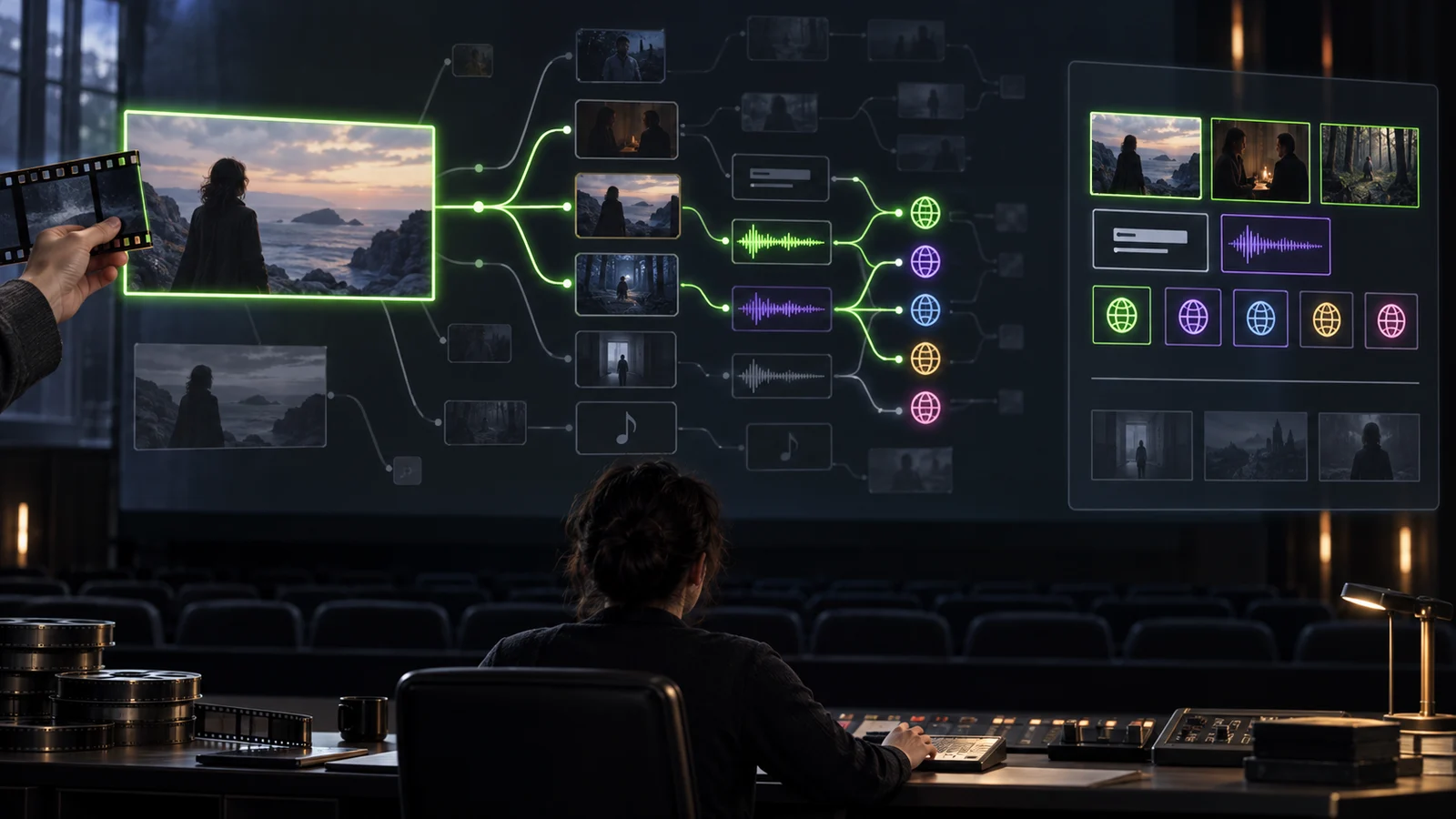
Hand over impact evidence before the retest list
After a change, trace the altered asset to routes, languages and later conditions using it, then check each dependency. In this interactive film workflow handoff, the input is an explicit old-versus-new difference, the output is a retest set with coverage reasons, and acceptance evidence is observation of the specified version. “Editing changed only one second” does not justify reducing scope.
“Minimum” means removing duplicate checks within known dependencies. It does not guarantee a mathematical minimum or replace a complete test template. Explain why every excluded area is unaffected; if you cannot, keep it.
The official ink guide describes conditional flow and content paths as background for dependency tracing. Official guide. This retest method is an original teaching design, not a testing standard specified by that guide or a DramaFork feature.
Expand a one-second edit into specific dependencies
In the fictional mystery short Rainy-Night Lost Property Room, Xu Lan seeks a missing courier. Viewers choose whether she checks a cupboard alone or with a companion. Both enter the shared “Discover ticket stub” segment; “Leave the station directly” bypasses it. Assets, arrangements and checks below are demonstrations, not real user cases, measured results or product features.
The old segment shows the date on the stub’s back before “Confront the courier” and “Do not expose it yet” appear. No input takes the silent exit. The new cut removes a one-second pause for pacing and moves the date close-up later. Dialogue is unchanged, but viewers may now submit before seeing the date.
On the solo entry, the companion does not know the date; on the joint entry, the companion does. Dialogue after confrontation depends on these respective states. The project has separate Chinese and Japanese subtitles sharing video and choice configuration. Trace not just subtitle timing but date visibility, retained entry state and later dialogue validity.
Direct departure can be provisionally excluded only if the route-reference table establishes that it loads neither the segment nor changed configuration. Replacing whole-film shared configuration during handoff invalidates that exclusion.
Hand off scope and doubts with a change-impact card
The submitter fills the card; the review lead plans retests from it. “Improved pacing” is insufficient. Without the old-version location and specific difference, recipients cannot judge missing checks.
| Field | Example entry |
|---|---|
| Change and baseline | Discover stub: Cut 3 to Cut 4; old check records refer to Cut 3 |
| Actual difference | Pause removed, date close-up later; dialogue unchanged |
| Direct references | Solo and joint entries; Chinese and Japanese subtitles; shared choices |
| Indirect dependencies | Date supports confrontation; entry knowledge affects dialogue afterward |
| Assets to check | New video, two subtitle files, option display/close markers, three exit connections |
| Provisional exclusion and reason | Direct departure has no listed dependency; reviewer must confirm |
| Unknowns | Old subtitle timing retained? Interaction markers moved with the cut? |
| Handoff responsibility | Editor lists changes; language lead checks subtitles; interaction lead checks connections; reviewer signs scope |
Add accessible locations for versions, configuration and reference tables. If the old version cannot be found, return for completion, not a memory-based “unchanged.” Unknowns are not presumed harmless: include the checks first, then remove them only with evidence.
The card can be maintained manually. It supplies facts for scoping, does not require particular software and gives submitters no publication-approval authority.
Derive four retest groups from coverage requirements
Write what must be established before choosing routes. Four requirements apply: both entries bring the right state; both subtitles fit the new segment; date information arrives before decisions are allowed; both active exits and the silent exit keep correct connections.
Two entries combined with two languages make four groups. Each starts in a preceding segment establishing entry state, watches the new stub segment and follows each of the three exits. That is four groups and twelve exit checks, not merely four video plays.
| Group | Entry and language | Observations in each group |
|---|---|---|
| A | Solo / Chinese | Companion unaware of date; aligned subtitles; all three exits match choice |
| B | Joint / Chinese | Companion knows date; aligned subtitles; all three exits match choice |
| C | Solo / Japanese | Solo state retained; Japanese alignment; all three exits match choice |
| D | Joint / Japanese | Joint state retained; Japanese alignment; all three exits match choice |
On confrontation, continue to the first line using knowledge state. On non-exposure and silence, reach the first confirmation of each consequence too. Entering the new segment is insufficient: correct connection is not correct consequence.
Remove duplicate work. One file-identity record can cover shared video; unaffected distant endings need not replay each time; verified-state checkpoints can start the three exits separately. If a checkpoint cannot restore language, knowledge and timing, replay the preceding segment. Manual jumping cannot pretend to cover the entry.
Group A cannot replace B’s story check, and Chinese records cannot replace Japanese display records. More aggressive sampling requires proof that combinations are equivalent; this example has none. Without reliable checkpoints, replaying all four full preceding sequences is safer, at the cost of more repeated viewing.
Accept through records and expand along the detected problem
Use one record format: “build version; entry state; language and asset ID; choice performed; expected consequence; actual observation and location; conclusion and owner.” Screenshots support subtitle placement but do not alone establish timing or exit connections. Keep continuous-viewing records or reproducible steps too.
Suppose C’s Japanese subtitles disappear on old timing. Return to the subtitle owner to retime, then check that file at both entries. If the date appears after the earliest submission moment, return jointly to editing and interaction. After choice configuration is fixed, reinclude the related exits across all four groups.
Expansion follows dependencies. Changed shared configuration calls for all referencing nodes; changed state writes call for downstream readers; wrong language fallback calls for language entries using the same loading rule. Missing reference tables, mixed versions or repeated out-of-scope failures mean abandoning this minimum set, rebuilding scope and, if needed, running full regression.
Finish when every coverage requirement has current-version evidence, exclusions still hold and unresolved items have owners and destinations. Timing relationships can be checked; viewers’ understanding still needs separate observation. A local pass cannot be recorded as the whole film passing.