Record Interactive Film Review Disagreements: Separate Aesthetic Preferences from Route Errors
When reviewers want the same transition shorter and longer, first align their routes. Split comments into observable facts, route impact, aesthetic preference and questions to verify, then decide what to fix first and what requires the creative lead’s judgment.
Introduction
When two reviewers give opposite suggestions for an interactive film transition, do not start by compromising on duration. Align their viewed versions, entry routes and preceding choices, then record four columns: observable facts, route impact, aesthetic preference and questions to verify. Fix identifiable violations of established route requirements first; retain rhythm decisions as creative choices; turn insufficient evidence into an executable next review task.
First check whether they are reviewing the same problem
The Last Ferry is a fictional teaching example. Characters, clips, comments and proposed responses are author-created, not real user cases, tested effects or product features.
Shen Yao can choose “Take the key” or “Leave the key,” with both routes proceeding to the dock. Take requires a close-up of her holding the key; Leave must not show it in her possession. Both use a ship’s horn to enter the dock wide shot. These are this example’s predetermined editing requirements.
Reviewer A says, “The black screen drags; cut directly.” Reviewer B says, “The transition is too rushed; leave more time.” Recording only these lines makes it easy to treat the dispute as merely the length of black.
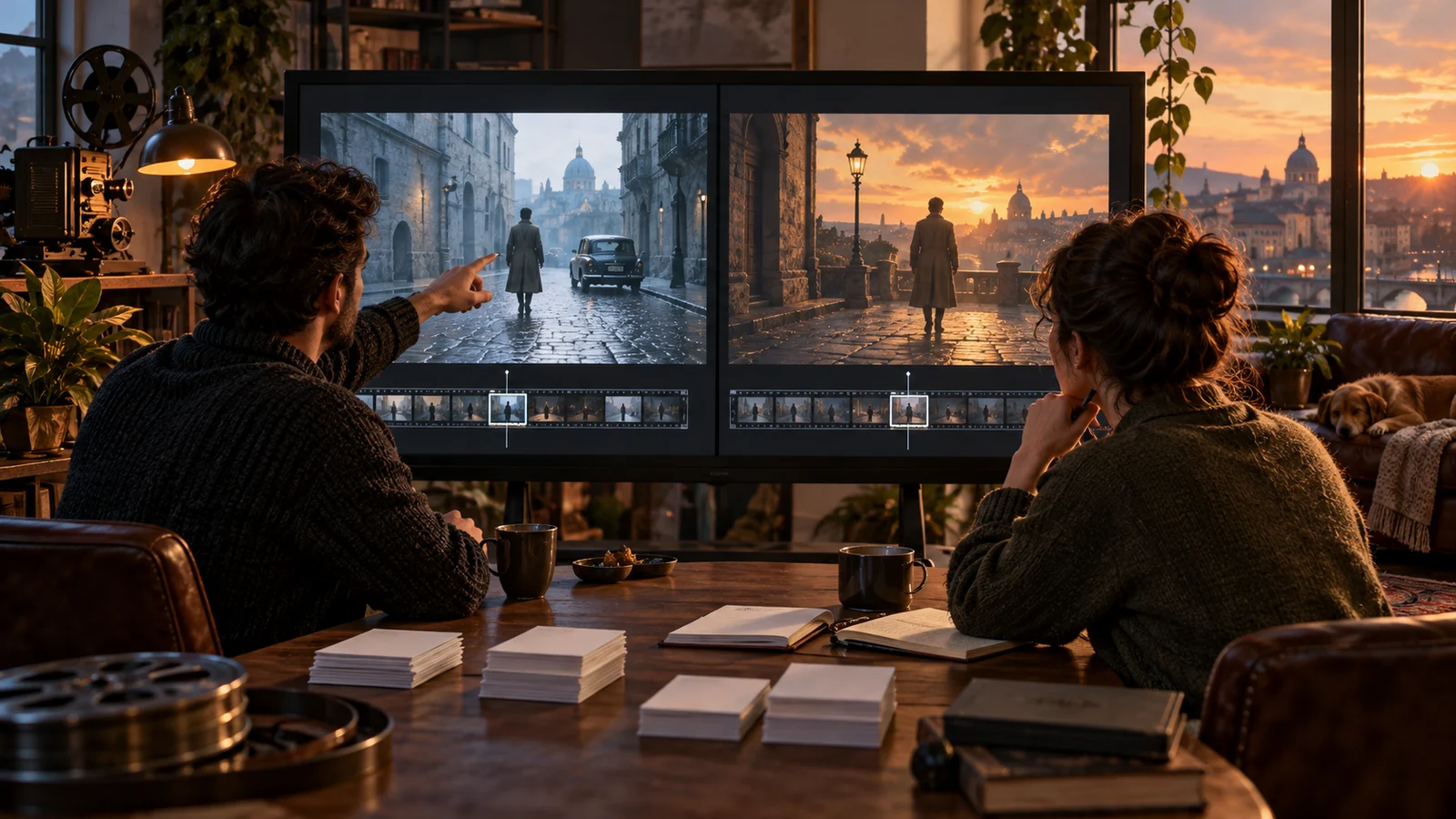
But A watches Take and B watches Leave here. The dock wide shot is identical, while preceding information differs. Start the record with review version, entry route, preceding choice, disputed segment’s in/out points and verbatim comments. Timecodes belong to a version; after revision, shot descriptions must help relocate the issue.
If these details are missing, mark “Viewing conditions not aligned.” Do not merge the comments into one joint opinion or assume B failed to understand. Feeling rushed is B’s stated opinion; its cause still needs examination.
Four-column record: one comment may require several rows
The columns have different jobs. Observable facts identify images, sounds and sequence relations in the clip. Route impact links them to established requirements. Aesthetic preference retains the feeling a reviewer wants. Questions to verify state what remains unknown and how to check it.
Use the template below. Put location details above each table, address one problem per row, and record decisions, responsible person and recheck version afterward.
| Observable facts | Route impact | Aesthetic preference | Questions to verify |
|---|---|---|---|
| Locatable shot or sound, not psychological inference | Applicable route, requirement and conflict; mark undetermined without a basis | Who prefers which effect; retain the comment’s meaning | Object of review, operation and observable criterion |
| Take: key-holding close-up, then black, then dock | Close-up supports possession; no basis yet for a route conflict | A wants more continuous action and favors removing black | Keep close-up and remove only black; compare whether the cut still needs a pause |
| Leave: key put down, then key-holding close-up | Conflicts with not possessing the key after leaving it | B wants more room for the departure action to unfold and suggests a longer transition | Remove wrong close-up first, then ask B to identify what still feels rushed |
These observations are also fictional clip assumptions, not results from actual playback. Replace them with locatable project content when reusing the table.
“She looks regretful” cannot go directly into facts. Write “She looks back before closing the door,” and move “Is looking back read as regret?” into verification. “The transition has a problem” cannot occupy route impact alone; name the affected route and requirement.
Work through a case: fix contradiction before debating speed
A’s record identifies no route error. Make a candidate retaining the key close-up but removing only black, then compare with the original. If A also wants the close-up removed, open another row: that change affects the agreed display of possession and cannot use the same “just shorten the transition” justification.
For B, lengthening black cannot remove the incorrect key-holding image. First replace or remove that close-up so Leave meets its requirements. Mark “Repair proposed; recheck pending,” not already resolved.
Only then discuss B’s rushed feeling. Let B watch the full repaired connection and specify whether the part needing time is putting down the key, leaving the room or entering the dock. The next change has a defined target rather than lengthening every pause.
Suppose feedback still says “The departure is too rushed.” Add a row: departure action unfinished before dock cut; no new state conflict found; B prefers complete action; compare a candidate retaining the action tail. This is hypothetical completion of the form, not a claim of improved viewing.
Submit “Fix Leave’s possession contradiction first; compare each route’s rhythm separately” to the creative lead. Do not write “A is right, B is wrong.” B’s proposed edit failing to repair a route error does not invalidate the expressed rushed feeling.
Where each of three approaches applies
If routes carry the same information task, share a transition and compare candidates against one creative goal. This is easier to maintain, but identical wide shots do not prove preceding footage can be shared.
If action and information demands differ, retain separate rhythms. Take might emphasize decisiveness while Leave permits a hesitant pause. These are available design directions, not conclusions proven by two comments. Shared-asset changes then require checking both places.
If reviewers pursue different goals, such as briskness versus lingering attachment, the creative lead must prioritize the scene’s expression. Four columns support that decision but cannot make it. Averaging the two durations is unnecessary: an average explains neither narrative goal.
Aesthetic opinions do not automatically become route errors through votes. Conversely, a clear state contradiction remains even if most people like the rhythm. If changing route requirements is chosen, record that change first, then check affected clips.
Close issues and know when they must remain open
At every recheck, follow the originally affected route first, then the other route using the same material. Compare preceding choices, images and transition connections. Do not play only the replaced shot; conflict may arise at adjoining cuts.
Use three statuses after the table: route issue checked, aesthetic choice decided, question still awaiting verification. Attach the applicable version and one reason to each. Closure need not mean everyone likes one edit, but must show who decided what and what remains unproven.
Two cases remain pending: the project has not specified whether the character holds the key, or the work intentionally uses memory or misleading images. First add a creative requirement in the former; in the latter explain the shot’s time position and permitted expression. Seeing a key alone does not establish a continuity error.
The table cannot guarantee viewers understand the transition. It delivers a traceable review decision: which comment started it, what locatable content was found, which route the change addresses and who decides the remaining aesthetic disagreement.