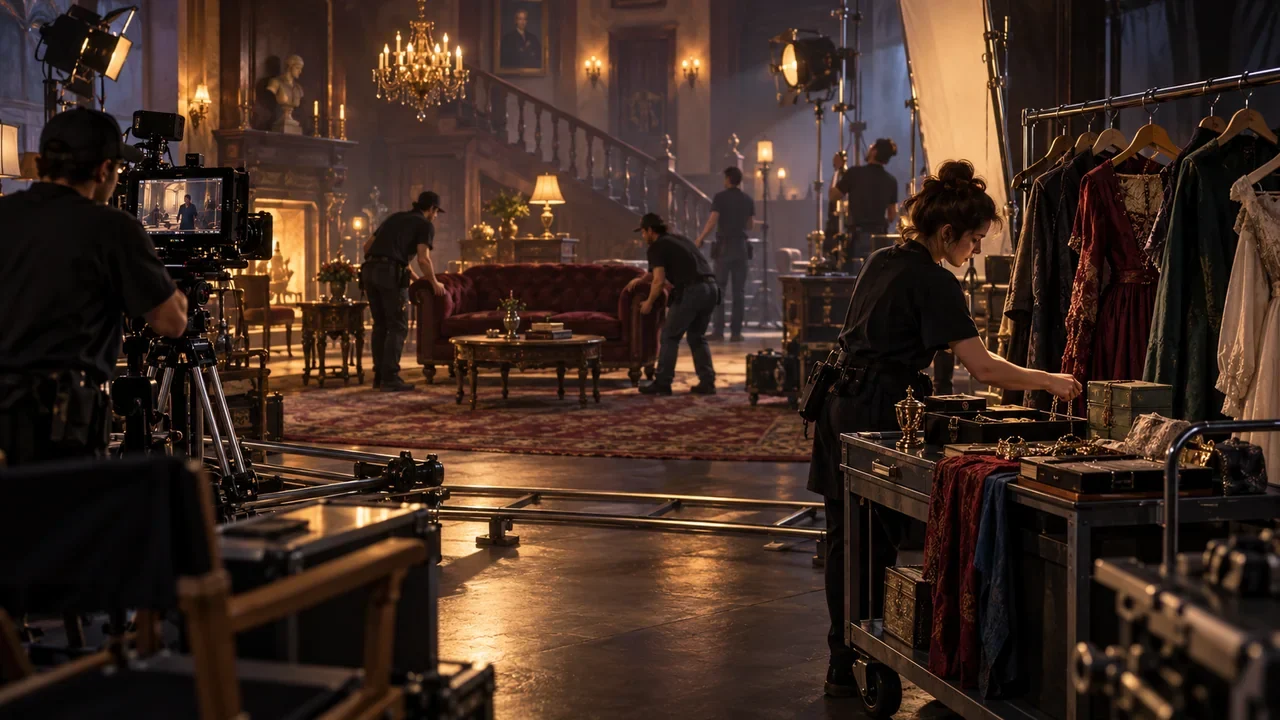
Schedule an Interactive Film by Set: Separate Story Routes from Shooting Order
You do not need to move the crew between two rooms in story order. Connect route and shooting lists with stable IDs, sort by set, prop state and actor grouping, then check each required asset before striking the set.
Lock the routes first, then schedule by set
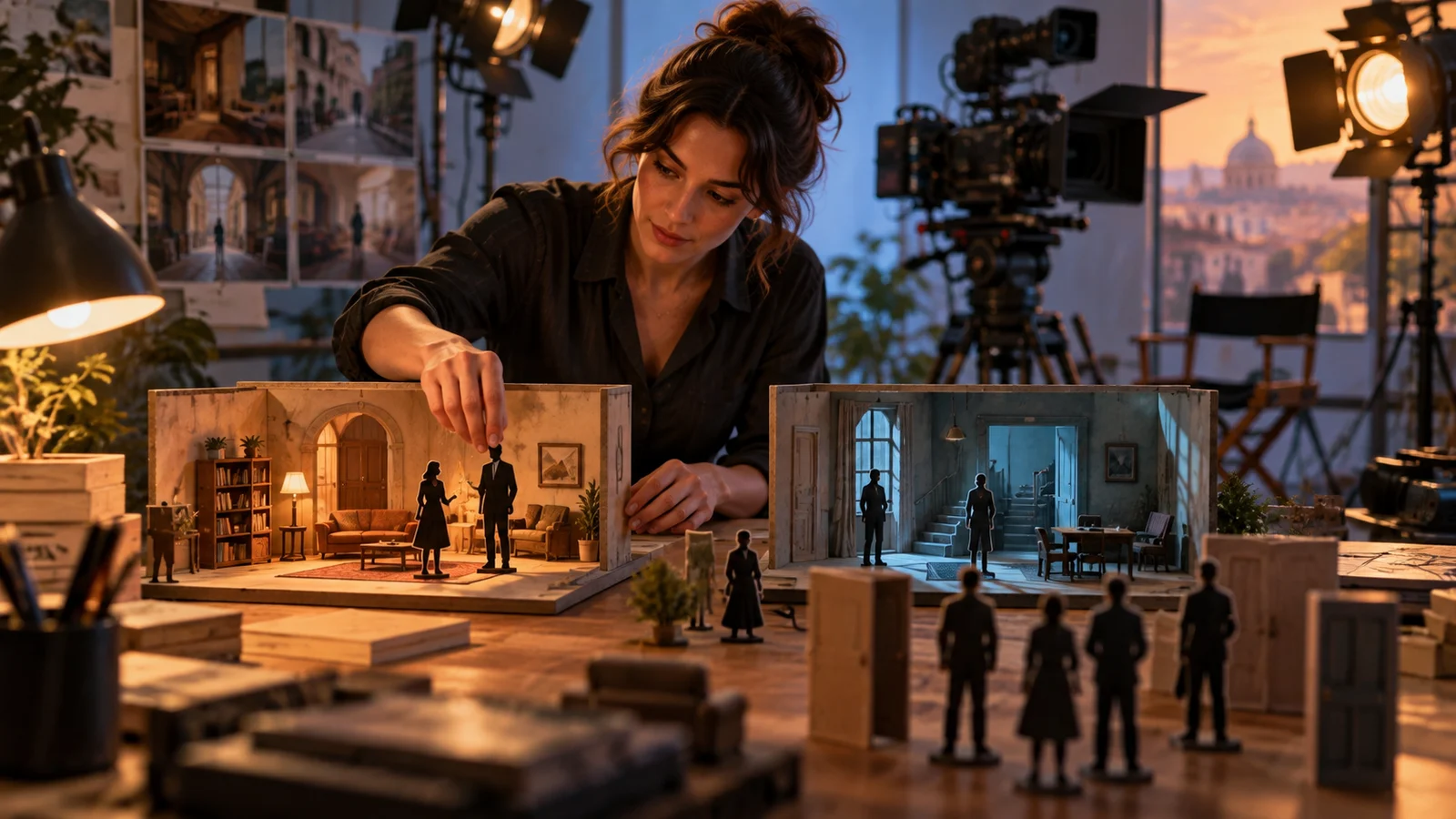
To shoot multiple interactive film routes across two rooms in one day, first divide the story into identifiable material units, then schedule by set, prop state and actor grouping. The story table answers “What does the viewer see next?” The shooting list answers “What do we film next on set?” Fixed material IDs connect the two. Changing shooting order does not change story connections.
“Complete in one go” here means concentrating each room’s required footage into a filming block, not performing every route from beginning to end. Before sorting, list actor availability, set availability and prop changes that cannot simply be reversed. Hard constraints determine which shots must come first; only the remaining shots can be rearranged.
The following The Unopened Letter is a specially written fictional teaching example, not a real user case, tested achievement or product feature description. All tables demonstrate manual scheduling. They do not establish that the plan has been verified on set or offer a cost-saving conclusion.
Divide two routes into seven material units
The story uses only a study and a reception room. Lin finds a letter in the study and may open it or keep it sealed, then takes it to meet Zhou in the reception room and finally returns alone to the study. The open-letter route ends with the letter sheet left on the desk; the sealed-letter route ends with the intact envelope put into a drawer.
First establish the two playback routes. The open-letter route is “Common 1 → Open 1 → Open 2 → Open 3”; the sealed-letter route is “Common 1 → Keep 1 → Keep 2 → Keep 3.” Common 1 only discovers the envelope and stops before the choice. Open 1 and Keep 1 show the respective actions after choosing; do not film the result into the shared segment early.
| Material ID | Story content | Room | Actors | Prop entry → exit |
|---|---|---|---|---|
| Common 1 | Discover the letter | Study | Lin | Sealed on desk → sealed in hand |
| Keep 1 | Decide not to open it yet | Study | Lin | Sealed in hand → carried out of room |
| Open 1 | Open and take the letter | Study | Lin | Sealed in hand → open, sheet returned inside |
| Keep 2 | Refuse to open it in front of Zhou | Reception room | Lin, Zhou | Sealed → sealed |
| Open 2 | Admit having read the letter | Reception room | Lin, Zhou | Open, sheet inside → unchanged |
| Keep 3 | Return and store the letter | Study | Lin | Sealed in hand → into drawer |
| Open 3 | Return and remove the sheet | Study | Lin | Open, sheet inside → sheet left on desk |
This table specifies material requirements only. If a unit needs a wide shot, a hand close-up and a reaction shot, break it down into individual shot rows while retaining the parent ID. Having filmed Open 1’s wide shot does not mean its missing opening-the-envelope close-up can also be marked complete.
Turn the requirements table into an on-set shooting list
Assume both rooms are available all day, Zhou can arrive before filming starts in the reception room, and lighting is the same throughout the study passages. Film the study in one block, then move to the reception room. Within the study, shoot sealed states before opening and open states; use the same sealed-before-open order in the reception room. Actor grouping can consolidate work further, but must not override required prop-state transitions.
| Shooting order | Material ID | Set and state | Actor grouping | Confirm before shooting |
|---|---|---|---|---|
| 1 | Common 1 | Study, sealed | Lin | Envelope at marked desk position |
| 2 | Keep 1 | Study, sealed | Lin | Hand position matches Common 1 |
| 3 | Keep 3 | Study, sealed | Lin | Drawer empty; performance reflects already having met Zhou |
| 4 | Open 1 | Study, sealed to open | Lin | Prepare matching replacement envelopes |
| 5 | Open 3 | Study, open | Lin | Sheet inside; emotion continues from Open 2 |
| 6 | Keep 2 | Reception room, sealed | Lin, Zhou | Switch back to an intact envelope |
| 7 | Open 2 | Reception room, open | Lin, Zhou | Use a prop matching Open 1’s exit state |
This order deliberately films both endings early. Before each unit, the director must explain what the character knows at that moment: in Keep 3, Lin has not read the letter but has already refused Zhou; in Open 3, Lin has already admitted reading it. “This is the next shot in the same room” is insufficient direction.
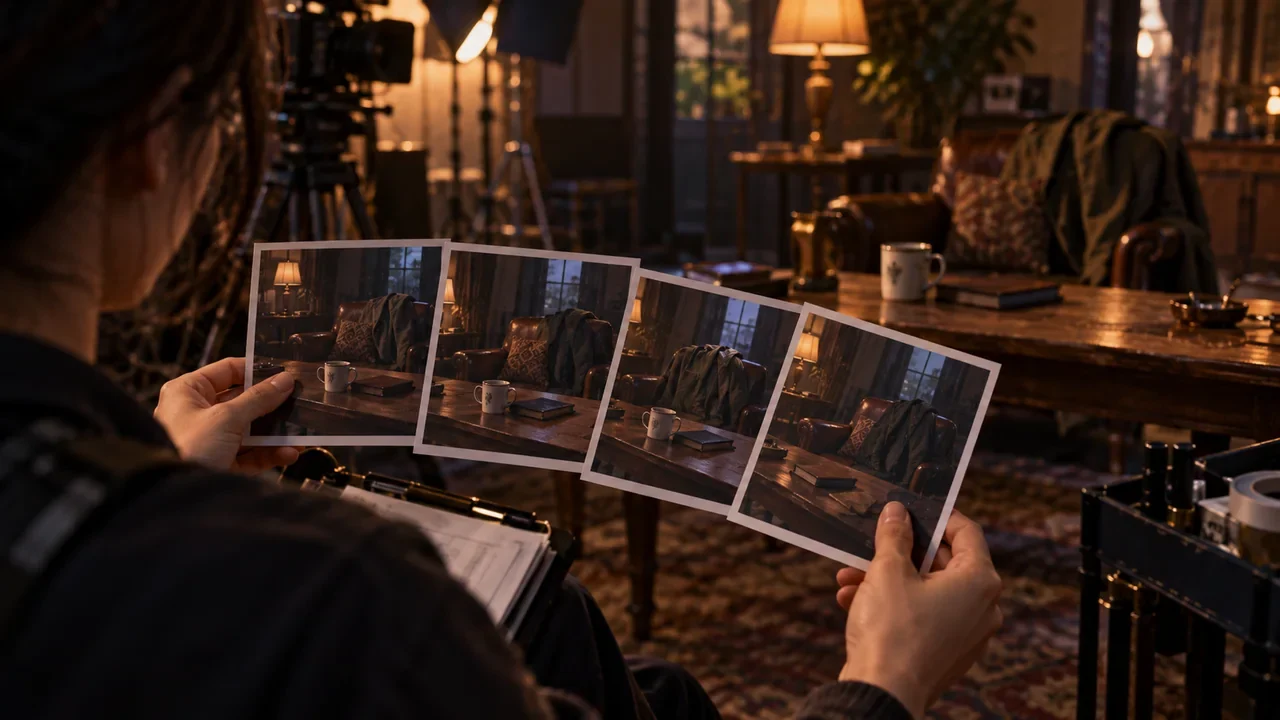
For reuse, add four on-set fields to every row: shot ID, entry reference, exit reference and usable take. Entry and exit references can record which hand holds the letter, envelope orientation, creases and gaze; usable takes point to actual material files. Material IDs never change; an unscheduled insert changes only shooting order.
Adjust order when props and performance conflict
Grouping by prop state does not mean allowing only one state change all day. This example returns to a sealed state after moving to the reception room, so reserve intact envelopes before opening the letter in the study. If opening is irreversible and no replacement exists, complete all sealed shots in both rooms before opening. This adds a location move but preserves footage still needing to be shot.
Do not mix replacement props merely because they “look roughly alike.” If Open 1 clearly shows the tear, the reception room’s open envelope must match that exit state. Retain the prop used in Open 1’s selected take and record the correspondence. If a reshoot changes the tear, check again whether later shots also need reshooting.
Actor availability can change the schedule. If Zhou is available only in the morning, film the reception room first and the study afterward, preparing both sealed and open states in advance. Work backward from the reception-room entry to the study exit. Do not discover that afternoon that Lin leaves the study holding the sheet while it is already inside the envelope in reception-room footage.
Another option is filming performance passages continuously. If Lin’s emotional progression is difficult to separate, group the open-letter route’s key performance together and accept room changes. Choose according to the condition currently hardest to reconstruct. A shared set suggests an opportunity to group shots, not proof that grouping is always appropriate.
Check by route before striking sets; deliver by material ID
A fully checked shooting list does not by itself establish completion. Before striking the study, follow both routes through their study footage: can Common 1 connect to either choice, do Keep 1 and Open 1 each include leaving the room, and do the two endings preserve distinct results? Before striking the reception room, check the correspondence between both envelope states and both sets of dialogue.
Read each connection aloud: “What is the previous segment’s exit, what is the next segment’s entry, and where is the file?” For a mismatch, log the affected ID and action needing a pickup. If Common 1 already ends with the envelope torn open, both routes cannot share that exit. The pickup must return to the hand state before the choice, rather than expecting editing to conceal a causal contradiction.
Deliver the route table, final shooting list, material-to-file index and continuity references to the editor. Distinguish “filmed,” “usable take available,” and “shots still missing.” Filmed but unusable material cannot serve as evidence of route coverage.
This method translates established routes into a shooting-day plan. It does not decide branch count or promise completion that day. If lighting, wardrobe or furnishings change across passages, add them as scheduling conditions. The producer’s final deliverable is a traceable list: every on-set state change has a reason and every story route has corresponding footage.