How to Design an Interactive Film Exhibition Loop: Show Late Arrivals Who Is Choosing
Visitors arriving midway need to know the current scene, when they may participate and where the story resets. A fictional gallery example provides three entry messages and a loop script that identifies the decision-maker.

Explain whose choice it is before inviting newcomers to participate
At any arrival time, an exhibition loop should answer three questions: where are we in the scene, when can I choose, and where does this round restart? In particular, explain separately the character performing an action onscreen and the person in the gallery deciding that action. Otherwise, a newcomer seeing a character open a door may mistake someone else’s decision for the result of their own input.
The Final Screening Room below is an original fictional teaching example, not a real user case, tested result or DramaFork feature. Its characters, gallery arrangements and durations illustrate the method. Actual execution requires separate production and checks.
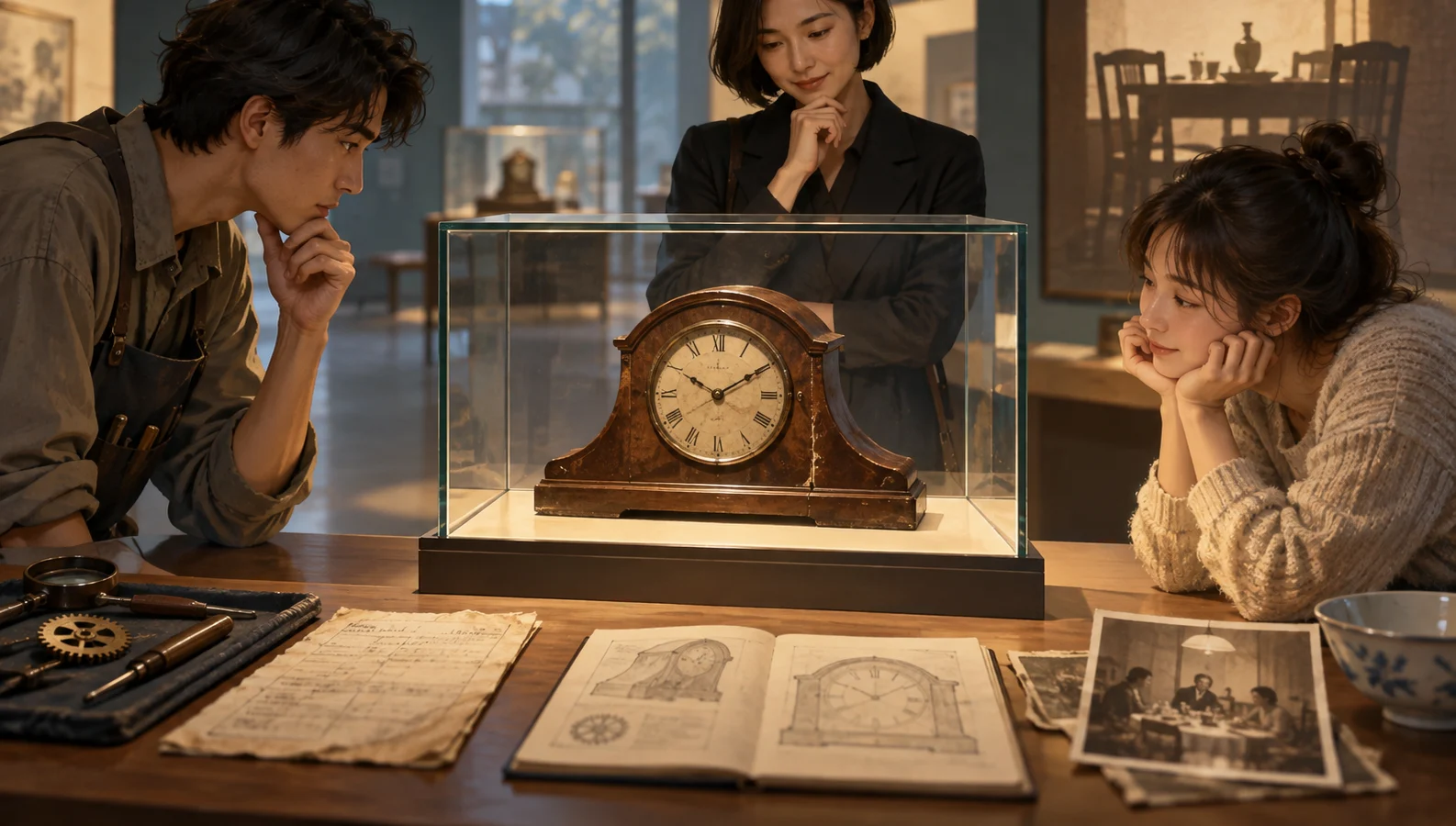
In the story, administrator Xiao He finds a reel without a film title. Visitors decide whether she first examines the film box or listens to the recording accompanying it. The gallery has one shared screen. At each opening, a host invites one volunteer to hold a choice card. Others watch and may discuss but do not submit the decision directly. This gives the decision-maker an identifiable position.
The task is not to write more branches but to help later arrivals distinguish whose result they are seeing and whether they still have a chance to participate.
Make a three-line entry card that changes with the phase
Place a separate information board by the entrance, so its information does not disappear with story subtitles. Its lines state the current scene, participation timing and reset point. Participation timing must identify who chooses, not just say “Please wait.” Use this template.
| Entry field | Template | This example during the result |
|---|---|---|
| Current scene | Who is doing what; what has already been decided | Xiao He is examining the film box; this round chose the box first |
| Participation timing | Who can submit; whether open now; when newcomers can join | The cardholder decides this round and submission is closed; newcomers may volunteer next round |
| Reset point | Visible signal for a new round; states that reset | Restart when the empty table and “New round” cue appear; both options reopen |
This is visitor-facing entry copy; node IDs and production notes need not appear. The host changes cards according to the script. No automatic arrival detection or synchronized updating is assumed.
The three lines must make sense alone and match the screen. “She is investigating” is too broad to distinguish the branches; “You chose the film box” assigns a choice to someone who did not make it. During the result, say “The cardholder chose to examine the film box first,” giving both the action and its source.
Rules stay fixed while the current state changes by phase. Separating them lets the host change cards without explaining the entire activity again.
Define choices and resets in a four-minute script
This example proposes four minutes per round solely to illustrate scheduling, not as a recommended duration. Both result segments are planned to last equally long, making the next-round entry easier to state. The handoff script should list the picture, entry card and host action together.
| Phase | Screen content | Entry card and host action |
|---|---|---|
| 0–30 seconds: opening | Empty table appears; Xiao He brings the film and recording box | Change to opening card; state no choice yet; invite a cardholder and repeat both options |
| 30–60 seconds: setup | Show the untitled film and ask which object to inspect first | Identify the cardholder as submitter; host checks they heard the question before options appear |
| 60–90 seconds: choice | Xiao He pauses at the table; both options shown in full | Change to open card; host receives and repeats the cardholder’s spoken decision; close submission after confirmation |
| 90–180 seconds: result | Play examination of the box or listening to the recording according to the choice | Change to matching result card; name the cardholder’s choice and state it cannot now be changed |
| 180–210 seconds: close | Xiao He writes her finding on a note and ends this investigation | Retain this round’s attribution; explain this is the ending, not a reset yet |
| 210–240 seconds: handoff | Objects leave the table; picture returns to the empty table | Host takes back the choice card; change cards and invite again when the next opening cue appears |
The box branch reveals a hand-drawn moon on its underside; the recording reveals the line “Wait until the lights go out before looking.” Both are fictional clues, written on this round’s note. A new round restores the starting point with film unexamined and recording unplayed; the previous note does not remain on the table.
If no one volunteers, the host announces, “This round is a curatorial demonstration; we will examine the film box first,” and uses a demonstration result card. Do not describe preset playback as “the audience decided together.” If the cardholder has not confirmed before the choice phase ends, use this explicitly labelled demonstration path too; silence is not a vote.
Follow one midway arrival through the attribution checks
Suppose visitor A Yao arrives at 120 seconds, while Xiao He is turning over the film box onscreen. The entry card tells her the cardholder has already chosen the box, the result is playing and participation is invited again only at the next opening. Without knowing every earlier line, she can tell it is not her turn to decide.
A Yao then sees the moon. The result message beside the screen retains the source of the choice, so she does not mistake the finding for fixed opening content. At the close, even though the scene has settled down, the card still says “This round’s ending,” rather than prematurely showing “Please choose.”
During handoff, A Yao can express interest, but the host gives her the card only after the empty table and new-round cue appear. As the next cardholder, she hears the question again and chooses the recording first. Only then does the result card describe the new decision. She takes over a complete new round, not the previous visitor’s unfinished investigation.
This is only a paper walkthrough. During script review, hide the opening, choice phase and ending in turn, and read the entry card from any remaining phase to check the three questions. If the opening must be replayed to learn who may submit, add the missing phase information. This does not establish that visitors already understand.
Use alternatives for different stays and define failure limits
For collective decisions, replace the card with one show-of-hands vote per round, but separately define eligibility, closing signal, tie handling and absence rules. Midway arrivals join that vote only if they hear the complete question explanation. Attribute the result to “those voting in this round,” not the entire gallery.
For very short stays, loop only clearly attributed curatorial demonstrations and schedule actual choices in separate sessions. This reduces drop-in choice opportunities but preserves consistent attribution on the shared screen. Individual viewing terminals need their own starting points; this script cannot be copied directly.
Include failure points in handoff notes. Missing a card change conflicts with the picture; a cardholder leaving undermines the physical card’s identifying role; unequal branch lengths make a fixed restart cue inaccurate. Respond by pausing new submissions, stating the current state, taking back or reassigning the card and rescheduling handoff to match actual segment lengths.
Final delivery should include each phase’s three-line card text, the loop script and the no-choice demonstration card. This plan addresses narrative entry and choice attribution in a fictional gallery only. It does not resolve equipment faults, venue capacity or every visitor’s reading needs. When these conditions change, recheck entrance position, information presentation and participation arrangements.