IP and Copyright Risk Checklist for AI Interactive Content Platforms: Names, Characters, Voices, and Asset Sources
Use a risk checklist that does not constitute legal advice to identify issues involving names, characters, voices, likenesses, music, and asset sources in interactive content.
Introduction
Disclaimer: This article is intended only to identify risks that require further verification and does not constitute legal advice. Rules differ across countries and platforms; consult a qualified lawyer in the target market when facing disputes, complaints, or decisions about commercial publication. This article does not determine whether any specific creator, work, or platform infringes rights.
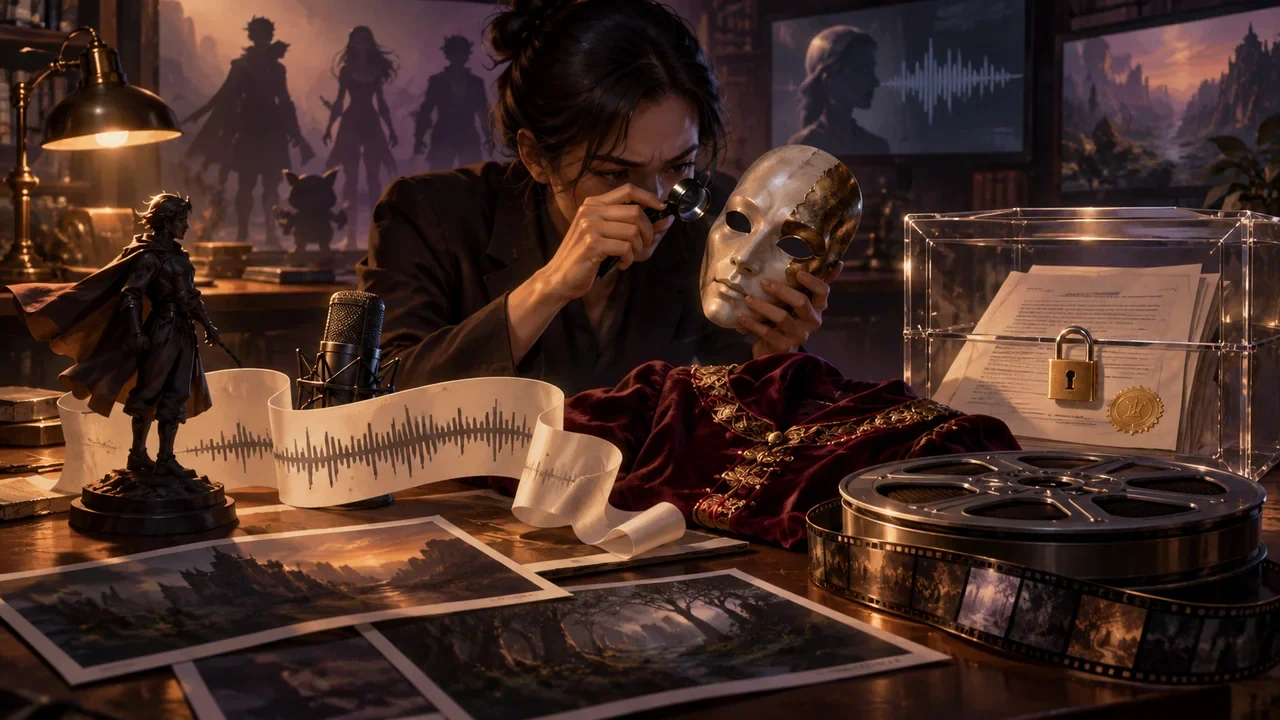
The most dangerous misconception for UGC platforms is treating “uploaded by users” as a reason the platform does not need to establish rules. Interactive content may simultaneously involve work titles and fictional worlds, character designs, actors’ likenesses, voices, music, training or reference materials, and generated outputs. The easier a platform makes one-click publication and monetization, the more it needs to incorporate rights verification into its workflow.
Four Types of High-Risk Signals
Explicitly Borrowing Well-Known Names and Fictional Worlds
Using recognizable franchises, schools, factions, or characters directly in a work’s title can lead users to mistakenly believe it is authorized. Even labeling it “fan work” does not automatically resolve trademark, copyright, or commercial-use issues.
Highly Similar Characters and Visuals
Changing a name while retaining clothing, faces, signature objects, and background settings may still cause confusion about the source. Platforms should not check only text titles.
Imitation of Voices and Likenesses
Using the recognizable voices and faces of public figures, actors, or ordinary people may implicate personality rights, rights of publicity, privacy, and platform rules. Being “AI-generated” does not eliminate authorization issues.
Untraceable Asset Sources
If creators cannot explain where images, music, fonts, models, and reference materials came from, platforms will struggle to respond to complaints and cannot demonstrate the scope of commercial authorization.
A Governance Workflow from Upload to Complaint
- Explain the scope of rights in plain language before upload and ask creators to confirm each item;
- Retain works, asset lists, sources, licenses, and confirmation timestamps;
- Screen names, images, voices, and descriptions for risks, using results only as signals for further review;
- Send high-risk content for human review, without automatically publishing or monetizing it;
- Provide a clear notification channel for rights holders and a counter-notification process;
- Preserve versions, timestamps, and grounds when taking action, and support appeals;
- Apply progressive restrictions to repeat violators.
Creator Self-Check
- Do I own or have permission to use all characters, voices, likenesses, and music?
- Does the authorization cover generative processing, public dissemination, and commercialization?
- Could ordinary users mistake the work for official content?
- Do the tool’s terms permit the current use and territory?
- Can I provide records of sources, contracts, or licenses?
- Can I quickly replace or remove the relevant assets after receiving a complaint?
What Platforms Should Avoid
Do not treat “for entertainment only” or “will remove if infringing” as universal disclaimers; do not actively recommend content that clearly depends on popular IP for the sake of growth; do not encourage cloning a specific actor’s voice without a basis in rights; and do not label creators as infringers solely on the basis of automated similarity scores.
DramaFork should bind authorization records to each character, voice, and media asset and allow them to be exported. A truly sustainable creator ecosystem makes rights boundaries visible, recordable, and reviewable from the start of creation, rather than waiting for disputes and then quickly deleting posts.
Risk Classification Must Consider More Than Whether a Name Appears
Even low-risk content may be unpublishable if asset licenses do not cover commercial use; characters that do not use original names may still be highly recognizable through a combination of appearance, voice, promotional composition, and background settings. Reviews should separately examine text, images, voices, music, model inputs, and marketing materials, then classify risk based on whether fees are charged, whether an impression of official affiliation is created, and whether rights holders have imposed explicit restrictions.
Automated matching is useful for identifying obvious names, trademarks, and similar assets, but cannot provide legal conclusions. Low-confidence results should not trigger automatic removal, and high-risk matches still require human review of context, authorization documents, and target-market rules. Every action must retain its reasons, the versions of the evidence, and a way to request review.
Rights Records Must Follow Asset Versions
For each asset, record its creator, original source, license, authorized territories, term, and whether modification, generative processing, and commercial dissemination are permitted. Create a new version after a character’s face is swapped, a voice is converted, or an asset is regenerated; do not reuse old authorization without checking its scope. Project exports should include the rights records so that proof of sources is not lost after leaving the platform.
If authorization is withdrawn or expires, the system should be able to locate affected works, shots, covers, and promotional pages and suspend new public dissemination. Deleting only the original file while retaining derivative covers, caches, and trailers does not complete the response.
Complaint Procedures Must Respect Both Parties’ Processes
Notification forms should collect the rights holder’s identity, the subject of the rights, specific URLs, the grounds for the claim, and contact information; after acknowledging receipt, the platform should preserve relevant evidence, assess whether temporary restrictions are needed, and then notify the creator to respond. Counter-notification, appeal, and repeat-violation policies should be clearly visible, while malicious complaints and bulk abuse of the complaint process should also be restricted.
This article provides only a product-governance framework. It does not determine whether specific works infringe rights and cannot replace legal advice. Before formal implementation, a lawyer in the target market must review local rules on copyright, trademarks, likenesses, voices, privacy, and platform liability, and map the final process to product capabilities that DramaFork can actually implement.